 Australia
  United Kingdom
  Singapore
  Malaysia
  Canada (Français)
 New Zealand


HR Audit Guide: Maximising Your HR Operations
Published
HR Audit Guide: Maximising Your HR Operations
Last Updated
Running a business in New Zealand means your people are one of your most significant investments. An HR audit is how you check that investment is actually working.
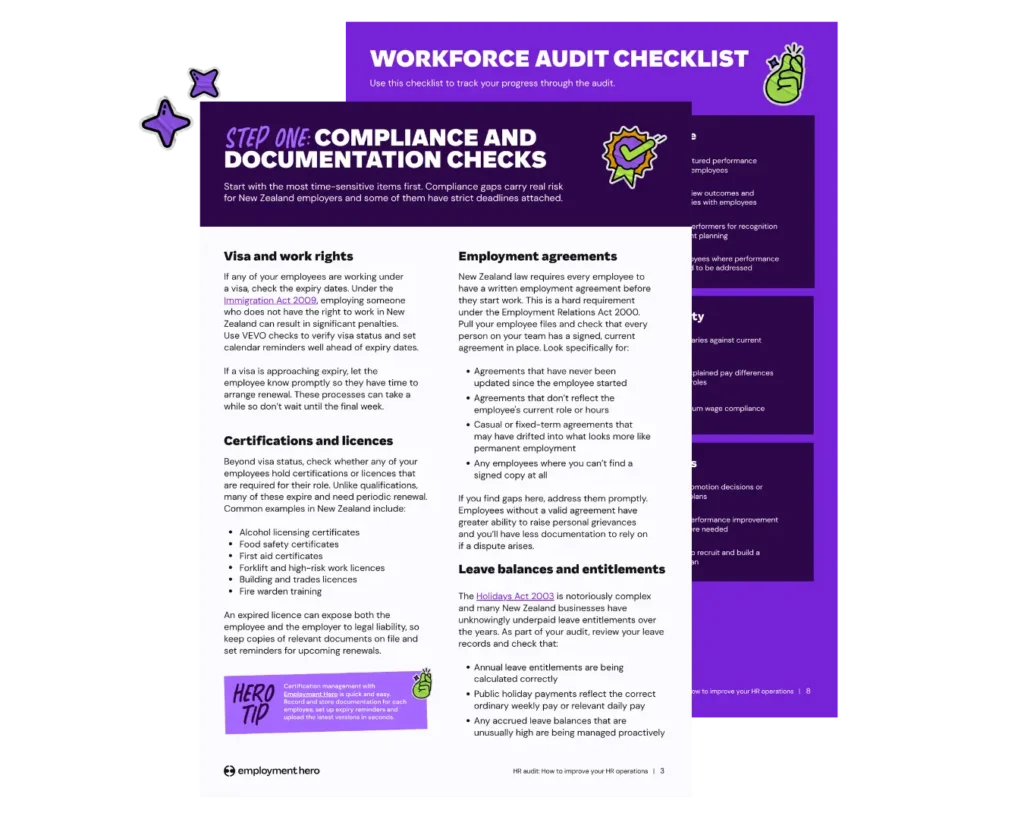
This guide walks you through a structured, practical audit process built for New Zealand employers. It shows how to:
- Check your compliance obligations under New Zealand employment law
- Map your workforce and identify resourcing gaps
- Run structured performance reviews and act on what you find
- Review pay against market rates and check for equity issues
- Make informed decisions about development, reassignment and recruitment
Download the guide by filling in the form on the right.
The information in this article is current as at 28 May 2026 and has been prepared by Employment Hero Pty Ltd (ABN 11 160 047 709) and its affiliates (Employment Hero). The views expressed in this article are general information only, are provided in good faith to assist employers and their employees, and should not be relied on as professional advice. Some information is based on data supplied by third parties. While such data is believed to be accurate, it has not been independently verified and no warranties are given that it is complete, accurate, up to date or fit for the purpose for which it is required. Employment Hero does not accept responsibility for any inaccuracy in such data and is not liable for any loss or damages arising directly or indirectly as a result of reliance on, use of or inability to use any information provided in this article. You should undertake your own research and seek professional advice before making any decisions or relying on the information in this article.
What is an HR audit?
An HR audit is a structured review of how your people, processes and compliance practices are holding up. It covers areas like employment agreements, performance management, pay, team structure and legal obligations.
For New Zealand businesses, it’s also a chance to check that you’re meeting your obligations under the Employment Relations Act 2000, the Holidays Act 2003 and other relevant legislation, before small gaps become bigger problems.
Why run one?
Businesses audit their finances regularly. Their people deserve the same attention.
A well-run HR audit helps you spot performance issues before they escalate, find high performers who are ready for more, tighten up compliance gaps that carry real legal risk and build a clearer picture of what your team actually needs to do their best work.
Who should run it?
For most small and medium businesses, an internal HR audit makes sense. Your team already knows the business, the people and where the pressure points are.
If your business is growing quickly, your HR function is new or you’re dealing with a complex situation, bringing in external support is a reasonable call. Either way, this guide gives you a framework to work from.
What the guide covers
The audit follows five clear steps:
Compliance and documentation — visa checks, certifications, employment agreements and Holidays Act obligations.
Organisational structure — workforce mapping, project allocation and an employee survey to surface what managers cannot always see.
Performance — how to run structured reviews, document outcomes and address concerns through a fair process.
Pay and equity — benchmarking salaries, checking for pay gaps and confirming minimum entitlement compliance.
Audit actions — a practical framework for promotions, development plans, formal warnings and recruitment planning.
A full checklist is included so you can track your progress at every stage.
How often should you run an HR audit?
Once a year is a reasonable starting point for most New Zealand businesses. Running one too frequently can create disruption before your actions from the previous audit have had time to take effect. Once a year gives you enough distance to see what has changed and enough frequency to stay on top of your obligations.
To download the guide, fill in the form on the right.
The information in this article is current as at 28 May 2026 and has been prepared by Employment Hero Pty Ltd (ABN 11 160 047 709) and its affiliates (Employment Hero). The views expressed in this article are general information only, are provided in good faith to assist employers and their employees, and should not be relied on as professional advice. Some information is based on data supplied by third parties. While such data is believed to be accurate, it has not been independently verified and no warranties are given that it is complete, accurate, up to date or fit for the purpose for which it is required. Employment Hero does not accept responsibility for any inaccuracy in such data and is not liable for any loss or damages arising directly or indirectly as a result of reliance on, use of or inability to use any information provided in this article. You should undertake your own research and seek professional advice before making any decisions or relying on the information in this article.
Register for the guide
Related Resources
-
 Read more: How Employment Hero’s AI Recruitment Agent helps New Zealand businesses hire faster
How Employment Hero’s AI Recruitment Agent helps New Zealand businesses hire faster
New Zealand businesses are drowning in applications and losing top candidates to faster competitors. Here’s how Employment Hero’s AI recruitment…
-
 Read more: The AI Adoption Blueprint
The AI Adoption Blueprint
What does it take to embed AI across an entire team? We’re sharing our training, our policies, and the lessons…
-
 Read more: Employment Essentials: AI Best Practices
Employment Essentials: AI Best Practices
Learn how to use AI in HR without creating privacy, compliance or employment risks in our latest webinar.

