

















How to prevent employee burnout: a practical guide for New Zealand workplaces
Published
How to prevent employee burnout: a practical guide for New Zealand workplaces
Last Updated
Running a business in New Zealand often feels like a balancing act. You want to grow, push boundaries and deliver great results, but you also need your team to stay healthy and motivated for the long haul. It’s a common challenge for employers across the country. We push hard to meet targets but sometimes that drive can tip over into something unsustainable.
That’s where burnout comes in. Burnout is a critical business issue that directly impacts productivity, staff retention and can have legal impacts. That’s why preventing burnout is one of the smartest investments you can make for your business’ health and bottom line.
In this guide, we’ll take you through common triggers of burnout, where your legal obligations lie and the proven strategies you can use to support your team.
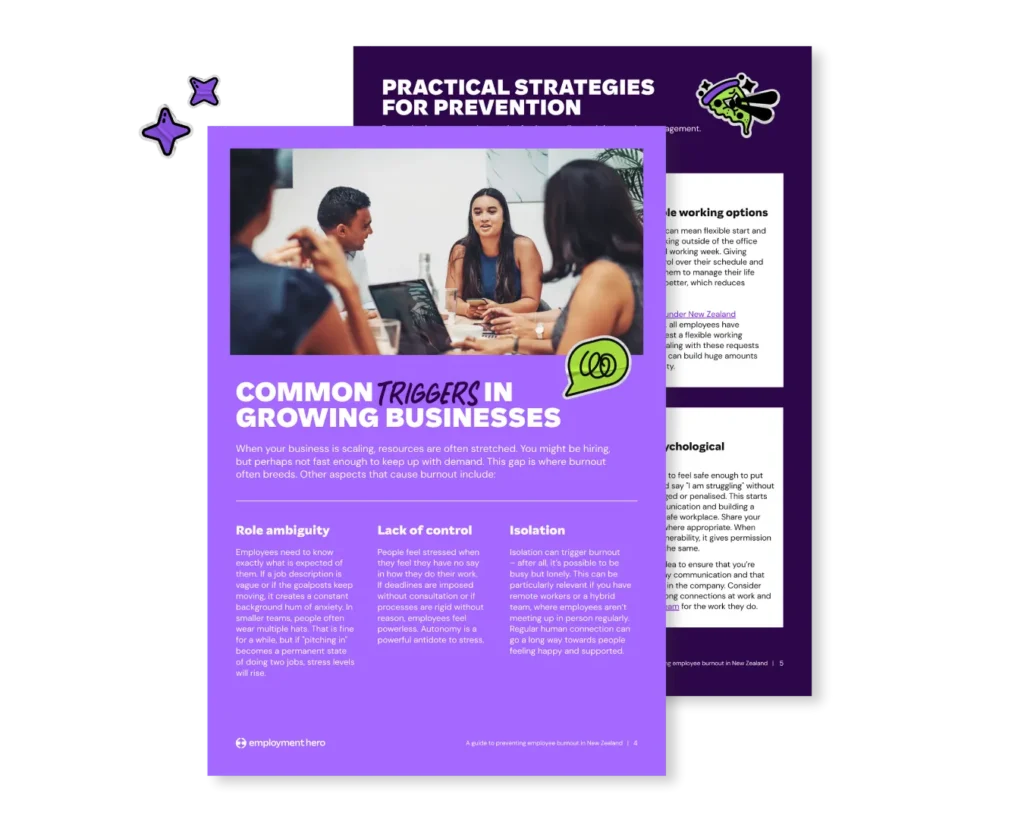
Why preventing burnout matters
Tackling burnout is not only important to look after your team; it’s also crucial to protect your business as a whole. When people are overwhelmed and potentially overworked, performance drops and good staff leave. Moreover, your legal obligations come into sharp focus.
The impact on productivity, retention and culture
Research shows that emotional or mental burnout is currently the main reason behind sick days in New Zealand. The costs add up quickly. You face a loss of productivity, higher recruitment expenses and damage to your team culture that can take years to repair.
Health and safety duties in New Zealand
As a New Zealand employer, you also have a legal duty to manage risks to your employees’ mental health. The Health and Safety at Work Act 2015 requires you to manage psychosocial hazards just like any physical risk. Ignoring the factors that lead to burnout could mean a failure to meet your legal responsibilities.
Understand the root causes before you act
Burnout often stems from systemic issues within a workplace. Here are five common triggers for employee burnout:
Excessive workloads
Consistent overtime, pressure to be available after hours and chronic understaffing create an unsustainable environment. When the workload always exceeds capacity, your team is on a direct path to burnout.
Role ambiguity
Employees need clarity. When expectations are unclear, priorities constantly shift or they have little autonomy over their work, it creates a deep sense of stress and powerlessness.
Leadership gaps
Managers have a significant impact on an employee’s wellbeing. A lack of support, poor communication or a culture that doesn’t prioritise psychological safety are strong predictors of team burnout.
Always-on culture
Technology can blur the lines between work and home. An expectation of constant availability and a flood of communication outside of work hours prevent employees from properly disconnecting and recovering.
Unfair treatment
Perceived unfairness can make a huge impact on employee happiness. When employees feel they are treated unjustly or a lack of trust exists, their engagement plummets and cynicism grows.
How to prevent employee burnout: key strategies
Effective prevention goes beyond weekly yoga or office fruit bowls. Instead, it’s important to dig into the causes of burnout in your business. This requires a focus on company and team structure, management and culture to create a truly sustainable work environment.
Design jobs with manageable workloads and clear roles
The foundation of burnout prevention is good job design. Ensure that roles are well-defined, targets are realistic and workloads are balanced. This gives your team clarity and the capacity to perform their roles effectively without being overwhelmed.
Build psychological safety
Create a culture where people feel safe to speak up without fear of negative consequences. Prioritise trust, fairness and open communication. When employees feel respected and heard, they are more engaged and resilient.
We recently created a guide on this exact topic – read our guide to psychological safety in the workplace here.
Train managers to recognise and address risks early
Managers account for up to 70% of the variance in employee burnout. Equip your leaders with the skills to spot early warning signs, have supportive conversations and proactively manage workload and stress within their teams.
Promote boundaries and healthy recovery time
Encourage your team to take their annual leave and disconnect fully from work. Implement clear policies around after-hours communication and support flexible work patterns that are sustainable for both the employee and the business.
Use data to monitor engagement and workloads
You can’t manage what you don’t measure. Use employee surveys, monitor absence data and track engagement metrics to get early insight into potential burnout risks. Employee engagement software can really help with this, and getting onto this data allows you to intervene before problems escalate.
Spot early warning signs before burnout escalates
For HR professionals and managers, knowing what to look for is half the battle. Recognising the early signs allows you to offer support before an employee reaches a crisis point.
Behavioural and performance shifts
Look for changes in normal behaviour. This could include increased absenteeism, uncharacteristic mistakes, missed deadlines or a general withdrawal from team activities and discussions.
Emotional and cognitive changes
Burnout often manifests as cynicism, irritability or a noticeable drop in engagement. You might see an employee who was once proactive become disengaged or struggle with decision-making and concentration.
Physical and health indicators
The physical toll of chronic stress is real. Pay attention to complaints of constant fatigue, frequent headaches or an increase in minor illnesses. These can be clear signs that an employee is running on empty.
Build a burnout prevention framework for your organisation
Moving from occasional tactics to a systematic approach is key to long-term success. A structured framework makes burnout prevention a core part of how your organisation operates.
Set clear prevention policies and channels
Embed your commitment to wellbeing in official policies. Define expectations around working hours, communication and flexible work. Establish clear, confidential channels for employees to report concerns about stress or workload.
Integrate prevention into HR and leadership cycles
Weave burnout prevention into all your key processes. This includes onboarding new hires, performance reviews, workload audits and regular employee engagement surveys. Make it a continuous part of the employee lifecycle.
Make leaders accountable for wellbeing
True change happens when leaders are held accountable. Tie team wellbeing and burnout prevention to leadership performance reviews and KPIs. This signals that employee health is a critical business priority.
Burnout prevention checklist
It can be difficult to know where to start. Try this burnout prevention checklist, that lists key strategies and methods to address burnout in your business. All of these are just starting points, but each has the potential to make a huge difference for your team.
- Review workloads and staffing levels regularly
- Ensure role clarity and decision-making autonomy
- Train managers on burnout prevention and early recognition
- Establish boundaries and recovery policies
- Monitor engagement and absenteeism trends
- Embed prevention into HR cycles and leadership KPIs
- Refresh strategies annually
Build your burnout prevention plan—download the guide
Ready to move from theory to action? Our practical guide gives you the tools and strategies you need to build a resilient, productive and healthy team.
The information in this article is current as at 30 December 2025, and has been prepared by Employment Hero Pty Ltd (ABN 11 160 047 709) and its related bodies corporate (Employment Hero). The views expressed in this article are general information only, are provided in good faith to assist employers and their employees, and should not be relied on as professional advice. Some information is based on data supplied by third parties. While such data is believed to be accurate, it has not been independently verified and no warranties are given that it is complete, accurate, up to date or fit for the purpose for which it is required. Employment Hero does not accept responsibility for any inaccuracy in such data and is not liable for any loss or damages arising directly or indirectly as a result of reliance on, use of or inability to use any information provided in this article. You should undertake your own research and seek professional advice before making any decisions or relying on the information in this article.
Register for the checklist
Related Resources
-
 Read more: Minimum wage: Guide for New Zealand employers and payroll teams
Minimum wage: Guide for New Zealand employers and payroll teams
Understand NZ’s minimum wage rates, training wage rules, and 2025 updates. Learn how Employment Hero NZ automates wage compliance.
-
 Read more: Navigating 2025: NZ Employment Law Forecast
Navigating 2025: NZ Employment Law Forecast
Stay ahead of NZ employment law changes in 2025 with insights on grievance laws, wages, and more.


