

















Workforce planning guide and template
Published
Workforce planning guide and template
Published
The New Zealand business landscape is shifting faster than ever. Between the rapid evolution of AI and a tightening talent pool, the “business as usual” approach to hiring is no longer enough to stay competitive. To thrive tomorrow, you need a strategy that turns today’s disruption into a distinct advantage.
Build a future-ready workforce for your business with our practical guide and template We’ll go through how to analyse your business and choose impactful strategies that will tackle your biggest challenges. Once done, you’ll have a clear roadmap for your team.
Download the guide and template by filling in the form on the right.
What is workforce planning?
Workforce planning is the process of analysing your current team and forecasting your future people needs. It ensures you have the right people with the right skills, in the right roles at the right time.
Workforce planning involves looking at both immediate and future needs:
- Short-term planning addresses immediate staffing requirements, like covering seasonal peaks or filling urgent vacancies.
- Long-term planning focuses on achieving strategic business goals over several years, such as developing future leaders or adapting to new technology.
Why workforce planning matters for New Zealand businesses
A solid workforce plan helps you tackle common business challenges in New Zealand. These include skills shortages, loss of talent to businesses overseas, demographic shifts affecting labour supply and the ongoing need to improve productivity.
The benefits are clear. Workforce planning allows you to:
- Align your workforce directly with your strategic goals
- Reduce staff turnover and the high costs of recruitment
- Support your diversity and inclusion objectives
- Meet your compliance and reporting obligations more easily
Workforce planning vs succession planning
While related, workforce planning and succession planning are not the same. They’re complementary processes that both contribute to a strong people strategy.
| Workforce Planning | Succession Planning |
|---|---|
| Focuses on the entire organisation or specific departments. | Focuses on key leadership and critical roles. |
| Addresses overall talent needs, skills gaps and headcount. | Identifies and develops high-potential individuals for future roles. |
| A broad strategic process to meet long-term business goals. | A targeted process to ensure leadership continuity. |
Workforce planning framework
A simple framework can guide your efforts, providing structure while allowing flexibility for your business needs. We recommend a five-step approach to keep the process manageable and effective. Each step builds a foundation for the next and together they form a continuous cycle.
Step 1: Understand your current workforce
Begin by auditing the team you have now. Go beyond counting staff to look at job roles, skill sets, length of service, age profile and any qualifications. For example, you may discover you have a concentration of experience in one department but a lack of digital skills elsewhere. Consider conducting a skills matrix or employee survey to gather this information. The goal is to identify strengths, gaps and areas where employees could develop further.
Step 2: Analyse future needs
Next, forecast the skills and roles your business will require to achieve its objectives. Factor in plans for growth, changes in products or services, shifts in technology and any known projects. For instance, moving into e-commerce could mean needing web developers or digital marketers. Regulatory requirements and industry changes from MBIE or other sector bodies may prompt additional workforce needs. If you expect seasonal fluctuations, consider how those peaks and troughs will impact your resourcing.
Step 3: Identify the gaps
Once you know where you stand and where you’re headed, compare your current workforce with the forecast. Do you have a shortage of experienced managers? Are there emerging skills, like data analysis or compliance expertise, that you’ll need but currently lack? This step can highlight both shortages and surpluses.
Step 4: Develop and implement strategies
Create an action plan to bridge any gaps. This often includes a mix of recruiting for new talent, upskilling or cross-training existing staff and planning for succession in key roles. For example, if you face a shortage of qualified tradespeople, you might launch an apprenticeship programme or partner with training providers. Where you have workforce surpluses, consider retraining or redeployment. Outline responsibilities, set measurable objectives and set timelines for each action.
Step 5: Monitor and adjust
Regularly review your plan and adapt it as needed. Set up a schedule to monitor your progress, such as quarterly check-ins with your leadership team or HR. Track key workforce metrics, like employee turnover, vacancy rates, training completions or achievement of diversity targets. If a new market opportunity emerges or there’s a change in employment law, update your plan accordingly. This ongoing review process keeps your workforce planning aligned with changing business priorities.
The workforce planning process: step-by-step
Here’s how to put that framework into practice.
Step 1 – Assess your current workforce
Gather data on your current team. Look at headcount skills, demographics, turnover rates and other key workforce metrics. This information gives you a clear baseline.
Step 2 – Forecast future needs
Look ahead at your business strategy and growth plans. What changes are on the horizon? Use external data from sources like MBIE, labour market reports and Stats NZ projections to understand wider trends.
Step 3 – Identify gaps and risks
Analyse your findings to pinpoint potential issues. You might find a critical skills shortage, a weak leadership pipeline or high turnover risk in a key department.
Step 4 – Develop your workforce plan
Create strategies to address the gaps you’ve identified. Your plan might include targeted recruitment, internal upskilling programs, adopting automation or using contingent workers.
Step 5 – Implement and monitor
Put your plan into action. Assign responsibilities, set timelines and define key metrics to track progress. Regular reviews will keep your plan on track and relevant.
Workforce planning examples
Here are a few scenarios showing workforce planning in action in New Zealand industries.
- A healthcare provider anticipates growing demand from an ageing population. Its workforce plan focuses on recruiting and training more aged-care nurses and allied health professionals.
- A tech company facing a shortage of specialised developers creates an internal training academy to upskill junior staff, addressing its skills gap from within.
- A retail business uses workforce planning to scale its team effectively for the busy Christmas season, ensuring stores are well-staffed without over-hiring.
Common workforce planning challenges (and how to overcome them)
Even the best plans can face hurdles. Here are some common challenges and how to solve them.
- Challenge: The plan isn’t aligned with business strategy.
- Solution: Integrate your workforce planning cycle with your overall business planning and budgeting cycles from the start.
- Challenge: You lack good data and visibility over your workforce.
- Solution: Use a Human Resource Information System (HRIS) to centralise your people data and generate insightful reports.
- Challenge: You don’t have buy-in from senior leadership.
- Solution: Link your workforce plan directly to business outcomes like revenue growth, cost savings and productivity gains.
- Challenge: The plan is too rigid for a dynamic market.
- Solution: Build flexibility into your plan. Use scenario planning to prepare for different outcomes and review the plan regularly.
How often should you review your workforce plan?
Workforce planning is a continuous process, not a one-off task. We recommend reviewing your plan quarterly or at least annually. It’s also wise to revisit it whenever a major trigger event occurs, such as a merger, an acquisition or a significant shift in your market. Tying these reviews to your regular business planning or budgeting cycles can help make it a consistent habit.
Download our workforce planning template
Ready to start planning? Download our free template to guide you. It includes practical worksheets and tables to help you structure your analysis and build your action plan.
The information in this article is current as at 30 December 2025, and has been prepared by Employment Hero Pty Ltd (ABN 11 160 047 709) and its related bodies corporate (Employment Hero). The views expressed in this article are general information only, are provided in good faith to assist employers and their employees, and should not be relied on as professional advice. Some information is based on data supplied by third parties. While such data is believed to be accurate, it has not been independently verified and no warranties are given that it is complete, accurate, up to date or fit for the purpose for which it is required. Employment Hero does not accept responsibility for any inaccuracy in such data and is not liable for any loss or damages arising directly or indirectly as a result of reliance on, use of or inability to use any information provided in this article. You should undertake your own research and seek professional advice before making any decisions or relying on the information in this article.
Register for the guide
Related Resources
-
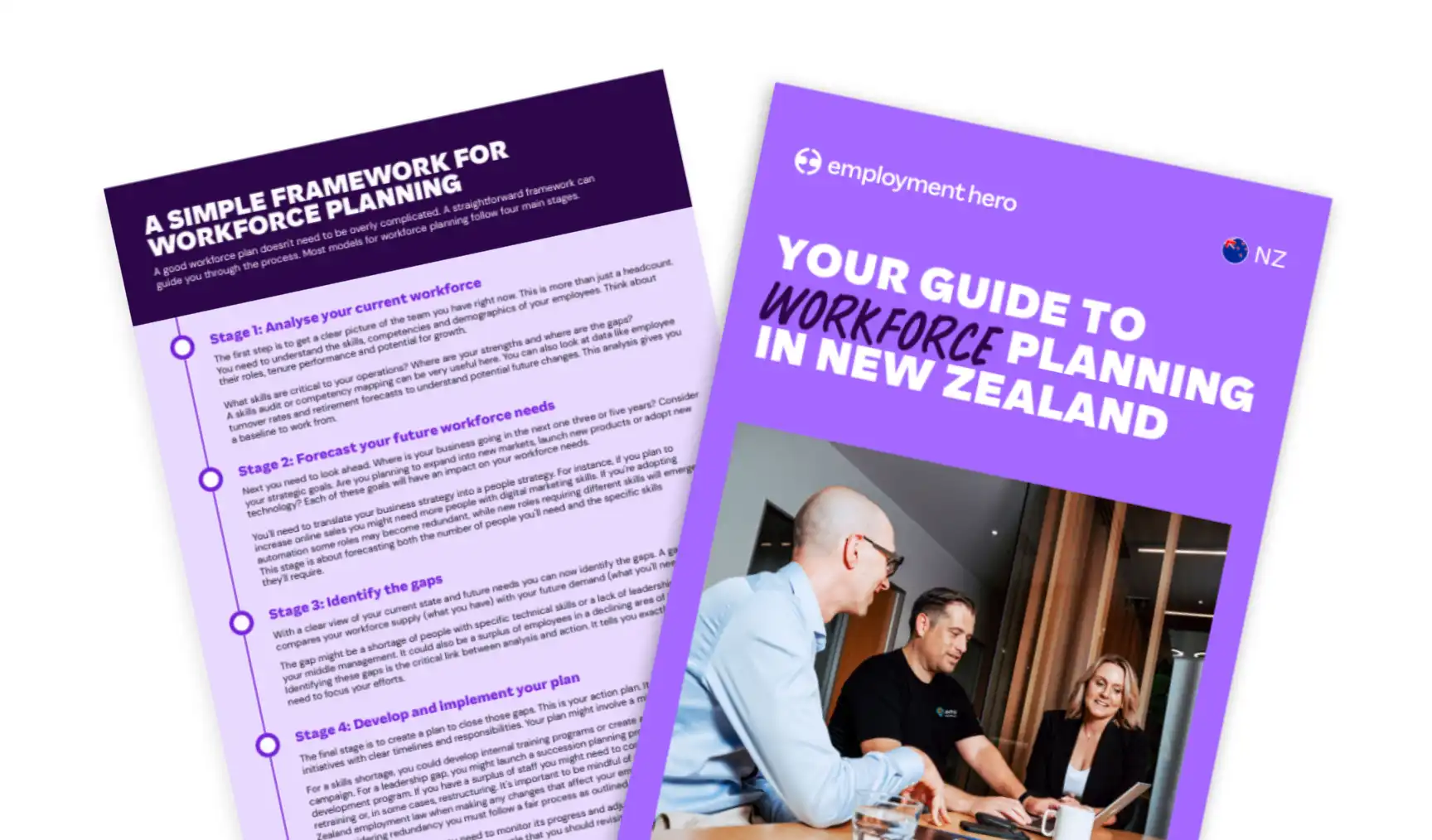 Read more: Workforce planning guide and template
Workforce planning guide and template
Learn how to build a future-ready workforce with our NZ workforce planning guide. Discover frameworks, examples & download a free…
-
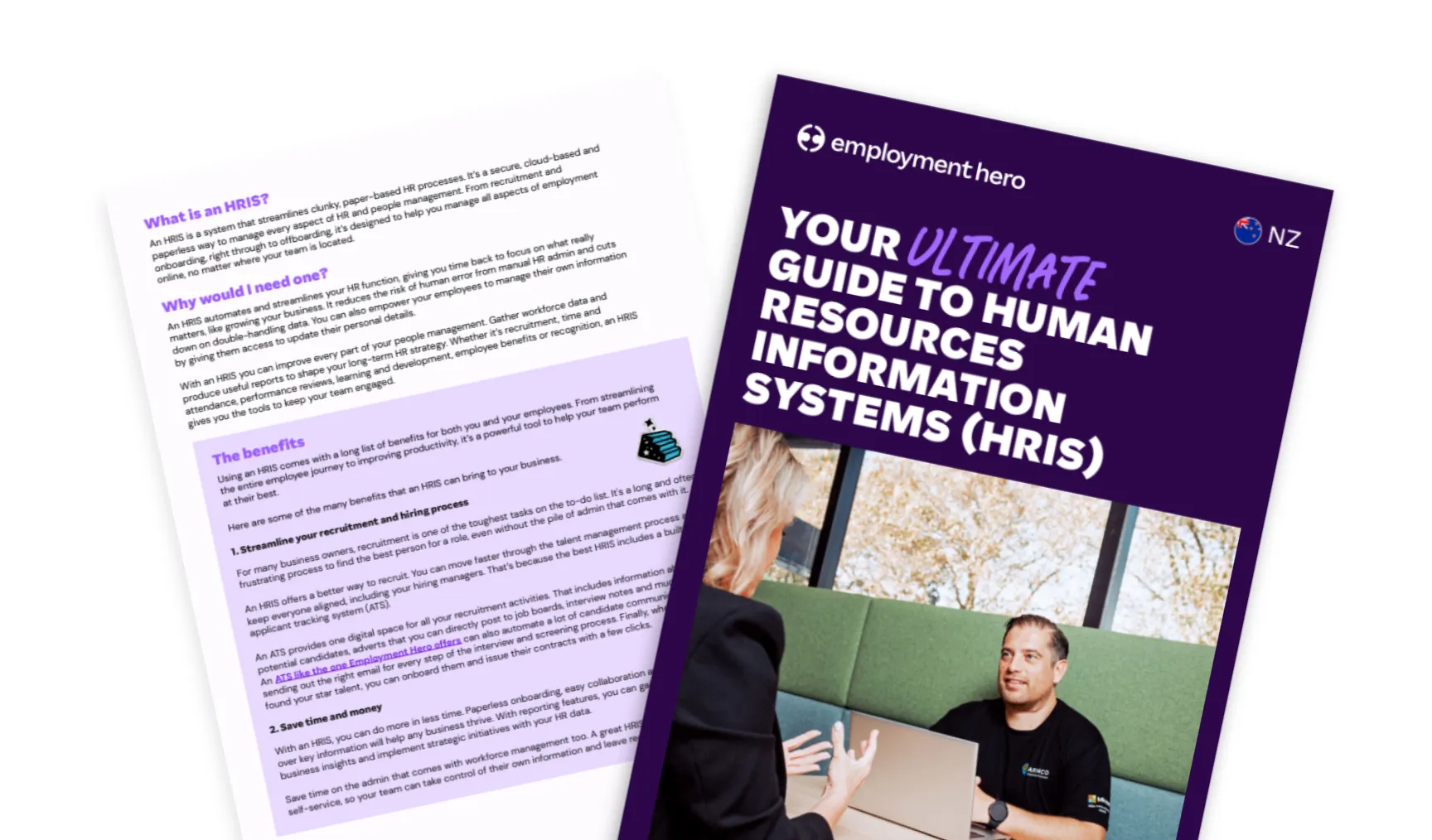 Read more: Your ultimate guide to Human Resources Information Systems (HRIS)
Your ultimate guide to Human Resources Information Systems (HRIS)
Learn what an HRIS is, how it works, and why it matters for NZ businesses. Discover key functions, benefits, and…
-
![Overtime policy template [free download]](https://employmenthero.com/nz/wp-content/uploads/sites/5/2026/01/Overtime-Policy-Template-Thumbnail.webp) Read more: Overtime policy template [free download]
Read more: Overtime policy template [free download]Overtime policy template [free download]
Download our NZ overtime policy template to manage overtime hours and pay with ease.
