
 Australia
 New Zealand
 United Kingdom
 Canada
 Singapore
 Malaysia


A complete guide to the change management process
Published
A complete guide to the change management process
Published
2 min read
Change is a constant reality for every business in New Zealand. Whether you are a retail chain in Auckland rolling out a new point-of-sale system, a manufacturing firm in Christchurch restructuring your shifts or a tech startup in Wellington scaling rapidly, the need to adapt is unavoidable. However, simply deciding to change is not enough. The success of any new initiative depends entirely on how well you manage the transition for your people.
In the current economic climate, businesses that can pivot quickly and efficiently have a distinct advantage. Yet, the statistics are often discouraging. Global studies frequently cite high failure rates for organisational change initiatives — often because the focus remains solely on the technical aspects, rather than the human ones. For Kiwi businesses, the challenge is compounded by specific legal obligations around consultation and the “good faith” employment relationship.
Our guide explores the fundamentals of change management within the New Zealand context. We’ll unpack the most effective models, the legal requirements around change and the practical steps you can take to ensure your next big shift is a success.
Download the guide by filling out the form on the right.
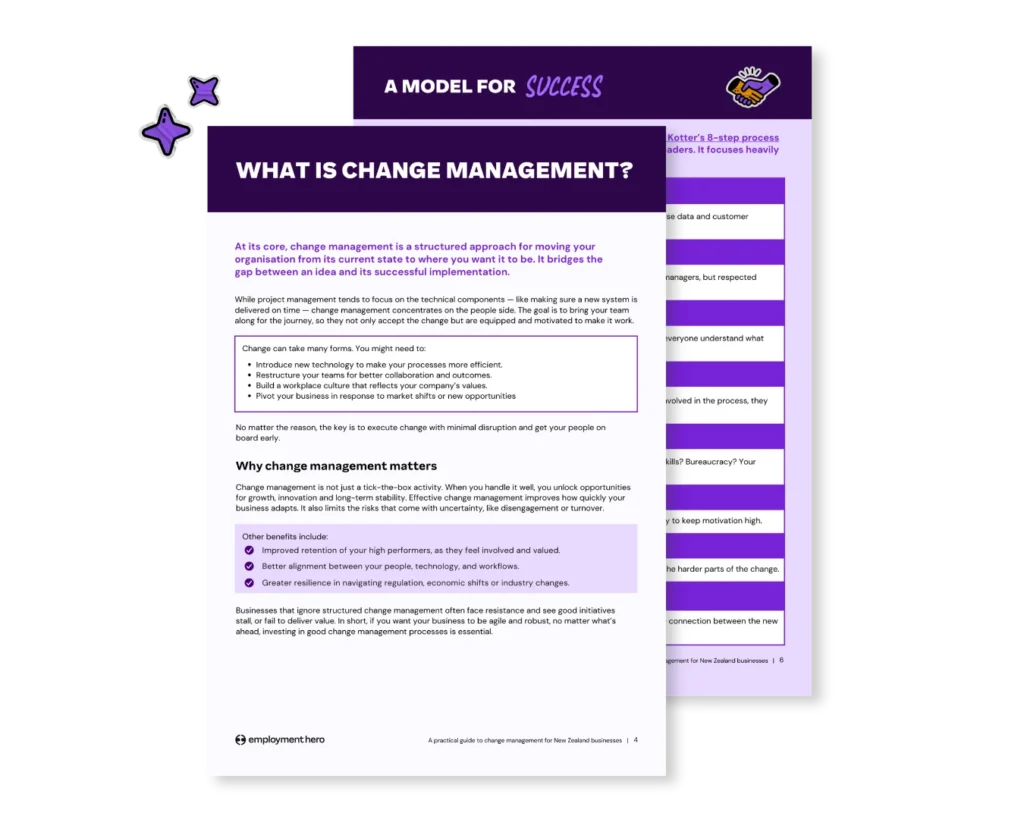
What is change management?
At its core, change management is the structured approach to moving an organisation, its teams and its individuals from a current state to a desired future state. It’s the bridge between a good idea and its successful execution.
It is important to distinguish change management from general leadership or project management. Project management focuses on the “technical” side of change, such as installing software, redesigning the office layout or writing a new policy. Change management focuses on the “people” side. It is about ensuring that your employees embrace, adopt and use the new solution effectively.
For example, if a logistics company installs a sophisticated new tracking system (the project), but the drivers and dispatchers refuse to use it or find it too confusing (the people), the initiative fails. Change management is the set of tools and processes used to ensure those drivers and dispatchers feel supported, trained and motivated to use the new system.
Why change management is important
The importance of change management cannot be overstated. When change is poorly managed, the costs are high. You risk project delays, budget overruns and a decline in productivity. More critically, you risk losing your best people. Employees who feel blindsided or unsupported during a transition are likely to disengage or leave.
Conversely, effective change management delivers significant benefits:
- Higher success rates: Projects are more likely to meet their objectives and be completed on time and within budget.
- Increased adoption: Employees embrace new processes faster and more effectively.
- Reduced resistance: Proactive communication and engagement minimise pushback and anxiety.
- Improved morale: When people feel heard and supported, their trust in leadership grows.
- Organisational agility: A team that navigates one change successfully is better prepared for the next one.
Ultimately, change management is about risk mitigation and value realisation. It ensures that the investment you make in a new initiative actually pays off.
Key principles of effective change management
While every organisation is different, successful change initiatives share common DNA. Adhering to these foundational principles will set you on the right path.
Leadership alignment is critical
Change must start at the top. If your leadership team is not aligned on the vision and the reasons for the change, your employees will sense the hesitation. Leaders must speak with one voice and model the new behaviours they expect to see. They need to be visible champions of the change, not just signatories on an email.
Communication must be two-way
One email or town hall meeting is never enough. Information needs to be shared frequently through multiple channels. Crucially, communication should not just be a broadcast. You need to create mechanisms for employees to ask questions and express concerns, so that you can gather important feedback.
Engagement builds ownership
People support what they help to create. Whenever possible, involve those who will be affected by the change in the design and implementation process. This could mean asking for input on how a new process should work or testing new software with a pilot group. When employees feel they have a stake in the outcome, their resistance drops significantly.
Feedback loops allow for adjustment
No plan survives contact with reality perfectly. You need established ways to gather feedback on how the change is landing. This allows you to identify sticking points early. Whether it’s a glitch in the new system or a misunderstanding of a new policy, adjust your approach before small issues become major roadblocks.
Types of change management models and frameworks
There is no single “right” way to manage change. Over the years, experts have developed various frameworks to help leaders navigate transitions. Understanding these can help you choose the best approach for your specific situation.
Kotter’s 8-step change model
Developed by Harvard professor John Kotter, this is perhaps the most famous model for leading large-scale organisational change. It is highly structured and focuses on creating momentum.
- Create urgency: Help others see the need for change and the importance of acting immediately.
- Build a guiding coalition: Assemble a group with enough power to lead the change effort.
- Form a strategic vision: Clarify how the future will be different from the past.
- Enlist a volunteer army: Get as many people as possible united around the vision.
- Enable action by removing barriers: Remove obstacles to change and encourage risk-taking.
- Generate short-term wins: Plan for visible performance improvements and recognise people who made them possible.
- Sustain acceleration: Press harder after the first successes. Be relentless with instituting change after change until the vision is a reality.
- Institute change: Anchor new approaches in the culture for sustained success.
Lewin’s change model
Kurt Lewin’s model is often favoured for its simplicity. It breaks change down into three stages, using the analogy of a block of ice.
- Unfreeze: This involves preparing the organisation to accept that change is necessary. It is about breaking down the existing status quo.
- Change: This is the transition phase where people move towards a new way of being. It is often a time of uncertainty and fear.
- Refreeze: The final stage is about establishing stability once the changes have been made. The new norms are solidified and become the standard way of operating.
This model is particularly useful for straightforward changes where the end state is clear and fixed.
ADKAR model
Created by Prosci, the ADKAR model focuses less on the organisation and more on the individual. It posits that for organisational change to succeed, individuals must progress through five outcomes:
- Awareness of the need for change.
- Desire to support and participate in the change.
- Knowledge of how to change.
- Ability to implement required skills and behaviours.
- Reinforcement to sustain the change.
This model is excellent for diagnosing why a change is stalling. For example, if your team knows how to use the new software (Knowledge) but doesn’t see why they should (Awareness), you know you need to focus on communication rather than training.
McKinsey 7-s framework
This framework takes a holistic view of the organisation. It suggests that seven elements must be aligned for a business to be successful: strategy, structure, systems, shared values, skills, style and staff.
When implementing change, you use this model to understand the ripple effects. If you change your strategy (e.g., moving to a digital-first model), you must assess how that impacts your structure (do we need new teams?), your systems (do we have the right tech?), your skills (does staff need training?) and so on. It ensures you don’t miss the wider implications of a focused change.
Nudge theory
Based on behavioural economics, Nudge Theory suggests that you can influence people’s behaviour through positive reinforcement and indirect suggestions (“nudges”) rather than strict instructions.
Instead of mandating a new process, you make the new process the easiest option. For example, if you want staff to save paper, you change the printer default to double-sided. If you want people to choose healthier food, you put fruit at eye level in the cafeteria. It is a subtle but powerful way to drive adoption of new habits.
When to use a change management process
A formal change management strategy isn’t necessary for every minor tweak. However, when the stakes are high and the impact on people is significant, a structured approach is essential.
Mergers and acquisitions
Merging two companies is one of the most complex challenges a business can face. You’re not just combining balance sheets; you are colliding two different cultures. Employees on both sides will be anxious about their job security and reporting lines.
A robust change management process is crucial to align values, integrate operational systems and reassure staff. Without it, you risk an “us vs them” mentality that can affect the workplace for years.
Digital transformation
New Zealand businesses are increasingly digitising their operations. Whether it’s moving to the cloud, implementing an ERP system or automating a production line, technology changes how people work. The technical rollout is often the easy part. The hard part is getting staff to adopt the new tools. Change management bridges the gap between deployment and adoption.
Organisational restructures and growth
As businesses scale or pivot, structures must evolve. This might mean creating new departments, flattening hierarchies or unfortunately, downsizing. Any change to reporting lines or job descriptions strikes at the heart of an employee’s security and identity. Managing this with empathy and clarity is vital to maintain morale and retain key talent during the transition.
Regulatory or policy changes
The legislative landscape in New Zealand is always shifting. Changes to the Holidays Act, health and safety regulations or industry-specific compliance rules often require businesses to update their policies and procedures. Change management ensures that every employee understands their new obligations and that the business remains compliant without friction.
Who is responsible for managing change initiatives?
While everyone plays a part, specific roles have distinct responsibilities in a change initiative.
Senior leadership
Executives provide the vision and the “why”. They authorise the resources and budget required. Most importantly, they must model the change. If the CEO isn’t using the new dashboard, no one else will.
Change managers
In larger organisations, dedicated change managers (or external consultants) design the strategy. They conduct impact assessments, create communication plans and support project teams in integrating the people side of change.
HR managers
HR plays a pivotal role, particularly regarding the legal and cultural aspects. They manage the consultation process to ensure it meets good faith obligations. They also support training needs and help manage any restructuring or role changes.
Line managers
These are the linchpins of change. They are the ones who have to explain the change to their teams, answer daily questions and manage resistance. They need to be equipped with the right information and skills to support their direct reports.
Employees
Ultimately, employees are responsible for engaging with the change. Their role is to participate in training, provide honest feedback and make an effort to adopt new ways of working.
Common challenges in implementing organisational change
Even the best-planned initiatives encounter hurdles. Being aware of these common pitfalls allows you to prepare for them.
Lack of strategic planning
Too often, businesses rush into execution without fully scoping the impact. They underestimate the time required or fail to allocate enough budget for training and support. A change that is rushed is often perceived as chaotic by staff, leading to a loss of confidence in leadership.
Resistance to change
Resistance is human nature. It is not necessarily a sign of insubordination; it’s often a sign of fear. Employees might worry they won’t be able to learn the new system, or that the change will make their jobs harder. Sometimes resistance comes from “change fatigue”, when staff feel they have been through too many upheavals in a short time.
Communication gaps
In the absence of clear information, people create their own narratives. If communication is sporadic or vague, rumours spread. A common issue is inconsistent messaging, where different managers say different things. This creates confusion and erodes trust. Another gap is failing to communicate the individual benefits to staff. If they don’t see how the change can help them, they’ll have little incentive to change.
Steps to a successful change management process
Following a structured roadmap significantly increases your chances of success. Here is a practical process for effective change management.
Define the vision and create urgency
Before you start, you must be crystal clear on what you are trying to achieve. What does the future look like? Why is the status quo no longer an option? You need to build a compelling case for change that resonates with your team.
Use data where possible. For example, “Our current manual processing is costing us 15 hours a week and causing customer delays. Moving to this new system will free us up to focus on service.”
Build leadership alignment
Gather your leadership team and ensure everyone is singing from the same song sheet. Any dissent at this level will be amplified down the line. Next, identify “change champions” throughout the organisation. These are influential employees (not necessarily managers) who are respected by their peers. Get them on board early. Their endorsement will carry more weight with sceptical staff than an executive memo.
Develop a strategic change plan
This is your roadmap. It should detail:
- Scope: What is changing and what is staying the same?
- Stakeholders: Who is impacted and how?
- Timeline: What are the key milestones?
- Resources: What budget, people and tools do we need?
- Risk assessment: What could go wrong and how will we mitigate it?
Communicate the change clearly
Develop a communication plan that covers the entire lifecycle of the project. Use a mix of channels: emails for formal updates, town halls for vision setting, team meetings for detailed discussion and intranet posts for resources. Be honest about what you don’t know yet. Transparency builds trust. Address the “people” questions first: Will I have a job? Will my pay change? Will I need to learn new skills?
Empower teams
Give your people the tools they need to succeed. This means providing comprehensive training that caters to different learning styles. It also means removing friction. If the new process requires a new piece of software, ensure everyone has a login and a working computer.
Implement in phases
Don’t try to boil the ocean. Break the implementation down into manageable phases. Look for small, easy changes that deliver immediate, visible benefits. Celebrating these quick wins builds momentum and proves to the sceptics that the change is working.
Measure impact and adjust as needed
How do you know if you have succeeded? Set clear Key Performance Indicators (KPIs) before you start. These could be adoption rates, error reduction stats, employee sentiment scores or productivity metrics. Monitor these closely. If the data shows you are off track, or if feedback indicates a problem, be brave enough to pause and adjust your plan.
Embed the change into the culture
The change isn’t over until it becomes the way things are always done. Update your induction materials to include the new processes. Rewrite job descriptions if roles have changed. Recognise and reward employees who model the new behaviours. You need to anchor the change in your organisational culture so it doesn’t slide back to the old ways once the project team disbands.
Change management tools and technology
Managing the complexity of change is easier with the right tools. Modern HR platforms can do much of the heavy lifting for you.
Tools like Employment Hero can centralise your communication, ensuring every employee receives the same message at the same time. You can use the platform to distribute new policies and track who has read and signed them. The survey features allow you to take the pulse of your organisation in real-time, gathering feedback on how the change is landing.
Furthermore, digitising your HR processes is often a change project in itself — one that frees up your HR team from admin so they can focus on the strategic support of your people during transitions.
Download the change management guide
Navigating change is one of the toughest challenges a business leader faces, but you don’t have to do it alone. We have compiled all the essential strategies and tips you need into one comprehensive resource.
Whether you are planning a small process tweak or a major transformation, our guide will help you lead with confidence. Download the guide by filling in the form on the right.
The information in this article is current as at 30 December 2025, and has been prepared by Employment Hero Pty Ltd (ABN 11 160 047 709) and its related bodies corporate (Employment Hero). The views expressed in this article are general information only, are provided in good faith to assist employers and their employees, and should not be relied on as professional advice. Some information is based on data supplied by third parties. While such data is believed to be accurate, it has not been independently verified and no warranties are given that it is complete, accurate, up to date or fit for the purpose for which it is required. Employment Hero does not accept responsibility for any inaccuracy in such data and is not liable for any loss or damages arising directly or indirectly as a result of reliance on, use of or inability to use any information provided in this article. You should undertake your own research and seek professional advice before making any decisions or relying on the information in this article.
Register for the guide.
Related Resources
-
 Read more: The High Performance Series: The Power of Recovery
The High Performance Series: The Power of Recovery
Learn how elite teams manage recovery and prevent burnout. Join Employment Hero and The Blues for practical HR mental health…
-
 Read more: 6 ways that Employment Hero helps manage health and safety in the workplace
6 ways that Employment Hero helps manage health and safety in the workplace
Learn how our suite of workforce management tools can help you maintain a safe workplace.
-
 Read more: AI For Hospo: How to Hire, Support & Keep Great People
AI For Hospo: How to Hire, Support & Keep Great People
Staff turnover and labour costs are squeezing hospo operators across NZ. See how AI can help you hire, support and…

