 Australia
  United Kingdom
  Singapore
  Malaysia
  Canada (Français)
 New Zealand





Workplace grievance handling policy template (New Zealand)
Published
Workplace grievance handling policy template (New Zealand)
Last Updated
Grievance handling can be a delicate task, as the issues involved are often personal and emotional. If it involves workplace misconduct, bullying or sexual harassment, it can get very complicated.
To ensure everyone understands what processes to follow, it’s important to implement a grievance handling policy in your business. That’s why we’ve created a template that you can easily adapt and send out to your team.
Download our policy template by filling in the form on the right.
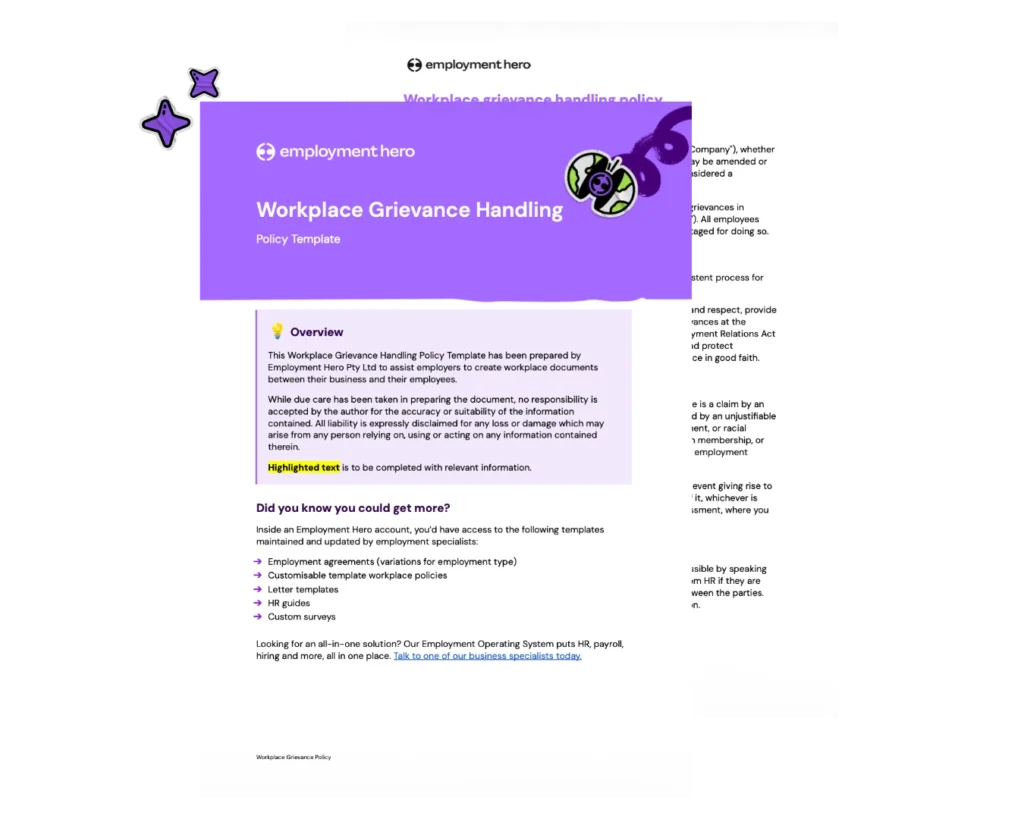
Using this grievance handling policy template
This free grievance handling policy will outline how your business achieves consistent treatment in any feeling of dissatisfaction or injustice that an employee experiences.
The objectives of this policy are to, as far as reasonably practicable:
- Ensure all employees can voice their complaints in a constructive way.
- Establish a fair grievance procedure to make sure employees are heard and avoid conflicts.
- Enable employees to file grievance complaints easily.
- Create a clear outline on what grievance complaints can be filed.
What is a grievance handling policy?
A grievance handling policy outlines how an organisation deals with complaints or grievances raised by its employees. The policy sets out the steps that employees can take to report their grievances, as well as the process for investigating and resolving those grievances.
In New Zealand, this isn’t just good practice. It’s closely tied to obligations under the Employment Relations Act 2000 (ERA 2000), which governs how personal grievances must be raised and handled.
Types of grievances
Understanding what kind of grievance you’re dealing with is the first step. In New Zealand, the most common categories are:
Unjustified dismissal
If you’ve been fired and believe the dismissal was unfair or lacked proper process, you may have grounds for a personal grievance. Under the ERA 2000, employers must have a substantively justified reason to dismiss an employee and must follow a fair process before doing so. This is one of the most frequently raised grievances in New Zealand.
Constructive dismissal
This occurs when an employer’s conduct — whether through pressure, demotion, reduced hours, or a hostile work environment — effectively forces an employee to resign. Even though the employee technically resigned, the law may treat it as a dismissal if the employer’s behaviour left them with no reasonable alternative.
Discrimination
Employees in New Zealand are protected from discrimination under both the ERA 2000 and the Human Rights Act 1993. Discrimination on the basis of sex, race, age, disability, religion, sexual orientation, and several other grounds is unlawful. This applies to hiring, pay, promotion, training, and conditions of employment.
Harassment
Harassment (including sexual harassment) is explicitly prohibited under the ERA 2000. Employers have a duty to maintain a safe workplace and can be held liable if they fail to address harassment when it’s brought to their attention.
Pay disputes
These include being paid below the minimum wage (currently set under the Minimum Wage Act 1983), not receiving holiday pay entitlements under the Holidays Act 2003 or being paid incorrectly relative to your employment agreement. Pay disputes can be raised internally or through the Labour Inspectorate.
Why is it important to have a formal grievance procedure policy?
A well-defined grievance handling policy is essential because it ensures that employees feel heard, valued and respected, and that their concerns are taken seriously. It can also help to prevent conflicts from escalating into more serious issues that could affect overall employee morale and productivity. Here are the main reasons why it matters:
Ensures fairness and consistency
An official grievance procedure policy provides a consistent and fair process for handling employee complaints. This helps to ensure that all employees are treated equally, have transparency over the entire process and that complaints are addressed in a timely and appropriate manner.
Protects the rights of employees
Having a grievance procedure policy provides a clear process for employees to raise concerns about workplace issues. It helps protect the rights of employees by ensuring they have an avenue to be heard and that those concerns are addressed accordingly.
Confidentiality and anti-retaliation protections
Employees in New Zealand have the right to raise a grievance without fear of retaliation. Under the ERA 2000, it is unlawful for an employer to disadvantage an employee because they raised a legitimate complaint.
Confidentiality obligations apply to everyone involved in the process. The person handling the grievance must not disclose details of the complaint beyond those who need to know in order to investigate and resolve it. Breaching confidentiality can itself become grounds for a further complaint. Employees should also be informed of who will have access to information about their grievance before the process begins.
Maintains a positive work environment
A workplace grievance occurs when an employee is discontent or feels victimised at work. It could arise from the management style of a direct supervisor, a toxic team dynamic, or miscommunication and misunderstandings. If it isn’t handled properly, it could negatively affect overall morale and productivity.
A formal grievance procedure policy helps by providing a structured process for resolving conflicts and preventing them from escalating, leading to better employee morale and job satisfaction.
Supports legal compliance
In New Zealand, the Employment Relations Act 2000 establishes the legal framework for personal grievances. Key obligations include:
- Employees have the right to raise a personal grievance within 90 days of the action (or of becoming aware of it).
- Employers must respond to grievances in good faith, a core principle running through all of New Zealand employment law.
The ERA 2000 requires employers to have a fair and reasonable process, not just a substantively justified reason, before taking any adverse action.
Failure to follow a fair process, even when the substantive decision was correct, can result in remedies being awarded against the employer.
The specific requirements will vary depending on the size of your organisation and the nature of the complaint. We strongly recommend consulting an employment lawyer or HR adviser to ensure your policy meets current New Zealand legal obligations.
Avoids legal and financial risk
A clear, consistent process for addressing employee complaints resolves issues before they become more serious. When complaints are handled promptly and in good faith, they’re far less likely to escalate to the ERA. If they reach the ERA, remedies can include reinstatement, financial compensation and costs orders against the employer.
Try informally first
New Zealand employment law actively encourages parties to resolve issues informally before escalating to a formal process. The ERA 2000 places a strong emphasis on good faith, which includes being open, communicating promptly and genuinely attempting to resolve problems before they become entrenched.
If something is bothering an employee at work, the first step is usually a direct conversation with their manager or, if the issue involves their manager, with HR or a more senior leader. They don’t need to frame it as a formal complaint; simply raising the issue and asking for a resolution is often enough.
If the informal conversation doesn’t lead to a satisfactory outcome — or if the issue is serious enough (such as harassment or discrimination) that an informal approach isn’t appropriate — employees should move to a formal grievance.
Step-by-step grievance procedure
While the exact process will vary by organisation, a sound grievance procedure in New Zealand typically follows these steps:
Step 1 — Raise it informally
Where appropriate, employees should attempt to resolve the matter through a direct conversation with the relevant manager or HR contact. Many issues can be resolved at this stage without the need for a formal process.
Step 2 — Lodge a written grievance
If the informal approach doesn’t work, or isn’t appropriate given the nature of the complaint, employees should submit their grievance in writing. This creates a formal record and triggers the employer’s obligation to respond. The written grievance should be submitted to HR or, where HR isn’t available, to a senior manager.
Step 3 — Acknowledgement
The employer should acknowledge receipt of the grievance promptly and outline the process they’ll follow to investigate and resolve it.
Step 4 — Investigation
The employer conducts a thorough, impartial investigation. This may involve interviews with the employee, relevant colleagues, and other parties, as well as a review of any documents or records. The investigation should be conducted by someone who is independent enough to be fair, which may mean bringing in an external investigator in some cases.
Step 5 — Evaluation
Once the investigation is complete, the employer evaluates the grievance against the relevant policies, employment agreement and applicable laws.
Step 6 — Resolution and decision
The employer communicates the outcome in writing, including the decision reached, the reasoning behind it, any actions to be taken and the employee’s right to appeal or escalate the matter.
Step 7 — Appeal or escalation
If the employee is not satisfied with the outcome, they can appeal internally (if the policy provides for this) or escalate the matter to the ERA.
How to write a grievance letter
A clearly written grievance letter helps ensure a complaint is taken seriously and investigated properly. Here’s what to include:
Grievance letter checklist
- Employee details — name, role, team, and contact information
- Date of the letter and the date(s) of the incident(s)
- What happened — a factual, chronological account of events
- Who was involved — names and roles of relevant parties
- Supporting evidence — any documents, messages or records
- How it affected them — the impact on their work, health or wellbeing
- The outcome they’re seeking
What happens after an employee lodges a grievance?
Once a grievance is formally received, the employer has a number of obligations.
Acknowledge the complaint. The employer should confirm receipt promptly and let the employee know who will be handling the matter and what the process looks like.
Assess the claim. The employer will review the complaint to understand its nature and determine the appropriate response. Not every complaint will require a full investigation, as some may be resolved through a conversation or mediation.
Investigate where necessary. For more serious complaints, the employer must conduct a thorough investigation. This should be done impartially and without undue delay. All parties involved have the right to be heard.
Maintain confidentiality. Information about the grievance must be kept confidential throughout the process and shared only with those who need to know. The employee raising the grievance should not face any disadvantage as a result of doing so.
Communicate the outcome. The employer must inform the employee of the decision in writing, including the reasoning and any next steps.
Employees are entitled to have a support person present at any meetings held as part of the grievance process.
Who handles the grievance?
The right person to manage a grievance depends on the organisation and the nature of the complaint. Common options include:
- HR manager or HR team — the most common first point of contact, particularly in larger organisations.
- A dedicated grievance committee — some organisations convene a panel to ensure impartiality.
- A senior manager — appropriate where HR isn’t available, such as in smaller businesses, and where the manager isn’t involved in the complaint.
- An external investigator — used when the complaint involves senior leadership, when there’s a conflict of interest internally or when the organisation needs to demonstrate independence (for example, in cases involving sexual harassment or serious misconduct).
Whoever handles the grievance must be sufficiently independent to conduct a fair process. If the person the grievance is about is also the person responsible for handling it, a different arrangement must be made.
Tips for employers handling grievances in the workplace
Grievance handling can be incredibly complicated with multiple parties involved, or when it involves intangibles like individual behaviour and conduct. Here are some tips to help:
Act promptly
Time is of the essence when a grievance is filed. Employers should act promptly to show that employee concerns are taken seriously. Delaying action could make the situation worse and lead to increased frustration or dissatisfaction. It could also contribute to a finding that the employer failed to act in good faith.
Appoint a well-trained and effective grievance handler
The grievance handler is the main point of contact for the aggrieved employee and the key mediator overseeing the resolution process. You’ll want them to have a problem-solving mindset, be open to exploring multiple resolutions and maintain strict confidentiality throughout.
They should also be meticulous about note-taking to ensure accurate records of facts and decisions. Active listening and empathy are essential, since the handler needs to genuinely understand the feelings of dissatisfaction or distress the employee is experiencing.
Address the root of the issue
Is there a deeper, underlying issue that led to the grievance? It’s vital that the employer investigates thoroughly and addresses the root problem, rather than arriving at an easy solution just to placate the aggrieved employee. If there are structural or cultural changes that need to be made internally, this is the time to make them. Addressing the underlying problem can prevent similar grievances from arising in the future.
Document the entire process
Honesty and transparency are key. Documenting the entire grievance handling process demonstrates that the process was fair and impartial, and provides a clear record if the matter is later escalated.
Resolution outcomes
Resolution can take a number of forms depending on the nature of the grievance and the willingness of the parties to reach an agreement:
Mediation — a neutral third party helps both sides reach a mutually acceptable solution. Employment New Zealand offers mediation services that are free for employers and employees.
Mutual agreement — the parties agree on a course of action without formal mediation, such as a change in working arrangements, an apology, or a policy update.
Disciplinary action — where the investigation finds that another party acted inappropriately, the employer may take disciplinary action, up to and including dismissal.
ERA remedies — if the matter is escalated to the Employment Relations Authority, potential remedies include:
- Reinstatement to the employee’s former role
- Compensation for lost wages
- Compensation for hurt and humiliation
- Reimbursement of costs
The ERA will consider whether the employer followed a fair process, acted in good faith, and had substantive justification for their actions.
The 90-day rule
Under the Employment Relations Act 2000, employees must raise a personal grievance within 90 days of the action giving rise to the grievance, or within 90 days of becoming aware of it. Missing this deadline will generally prevent the ERA from considering the complaint. The only exception is for personal grievances related to sexual harassment, which have a 12 month reporting period.
Handling workplace grievances with Employment Hero
Grievance handling is a challenging task for any employer. That’s exactly why workplace policies are so important, and why Employment Hero can help you manage all of this easily. HR policies written by HR experts? You got it.
Our cloud-based platform has a full library of policies ready to go. All you have to do is choose which policies apply to your business and have your employees digitally acknowledge each document. It’s fuss-free and completely paperless.
The information in this article is current as at 25 May 2026, and has been prepared by Employment Hero Pty Ltd (ABN 11 160 047 709) and its related bodies corporate (Employment Hero). The views expressed in this article are general information only, are provided in good faith to assist employers and their employees, and should not be relied on as professional advice. Some information is based on data supplied by third parties. While such data is believed to be accurate, it has not been independently verified and no warranties are given that it is complete, accurate, up to date or fit for the purpose for which it is required. Employment Hero does not accept responsibility for any inaccuracy in such data and is not liable for any loss or damages arising directly or indirectly as a result of reliance on, use of or inability to use any information provided in this article. You should undertake your own research and seek professional advice before making any decisions or relying on the information in this article.
Register for the template
Related Resources
-
 Read more: MFA policy: what it is, why you need one and how to write it
MFA policy: what it is, why you need one and how to write it
Learn how to create an MFA policy that protects your business from unauthorised access. Includes a template, implementation steps and…
-
 Read more: Your strategic guide to winning leadership buy-in for HR and payroll system change
Your strategic guide to winning leadership buy-in for HR and payroll system change
Struggling to get sign-off on a new HR or payroll system? This guide walks you through everything you need to…
-
 Read more: Employment Leave Act: your questions answered
Employment Leave Act: your questions answered
Answers to the most-asked questions from our Employment Leave Act webinar, covering casual hours, leave pay, cash-ups and what to…
