
















Building an employee upskilling program: Training program template
Published
Building an employee upskilling program: Training program template
Published
Is your business struggling to find people with the right skills? Are you worried about your best talent leaving for better opportunities? You’re not alone. New Zealand businesses are navigating a complex job market, where talent can be hard to find and the pressure to keep up with change is immense. The solution might be closer than you think.
Instead of constantly searching for new hires, leading employers are investing in the people they already have. They’re building the skills they need from within, creating a more resilient, capable and engaged workforce. This is upskilling, and it’s more than just a buzzword. It’s a strategic investment in the future of your business.
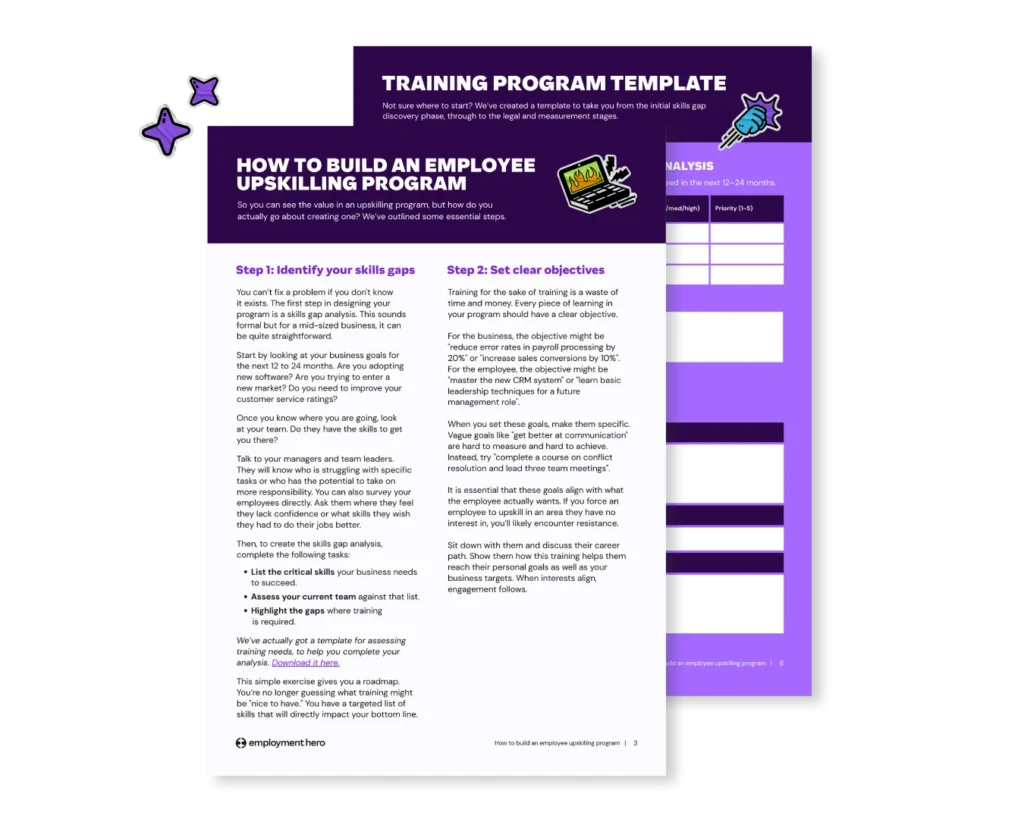
Our guide provides a step-by-step framework for building an employee upskilling program that drives real growth. We’ll walk you through everything, from identifying skills gaps to measuring your return on investment, all within the unique context of the New Zealand business environment.
Download the guide by filling in the form on the right.
New Zealand’s labour market is in a constant state of flux. We face ongoing productivity challenges, a persistent “brain drain” and the rapid pace of digital transformation. For a small or medium-sized business, these pressures are felt acutely. Finding skilled workers is tough and keeping them is even tougher.
Upskilling provides a direct response to these challenges. By investing in your team’s development, you create a powerful incentive for them to stay. You show them there is a path for growth within your company. This not only boosts retention but also transforms your business into an employer of choice, making it easier to attract top talent when you do need to hire externally.
The cost of not upskilling your workforce
It’s easy to focus on the cost of training. But what is the cost of doing nothing?
A workforce with stagnant skills is a liability. It leads to lower productivity, more errors and reduced innovation. Your competitors who are investing in their people will pull ahead, leaving you behind. Ambitious employees will eventually leave in search of development, and you’ll be left with a disengaged team and a constant cycle of recruitment.
Remember, the cost of replacing an employee (including recruitment fees, lost productivity and training a new hire) is far greater than the cost of upskilling a loyal one.
What is an employee upskilling program?
An employee upskilling program is a structured, strategic initiative designed to teach your current employees new skills and competencies. The goal is to enhance their capabilities within their current roles or prepare them for more senior positions within the company. It’s about building on existing talent to close skill gaps and support business growth.
This is different from ad-hoc training sessions. A program is a coordinated effort that aligns employee development directly with your company’s long-term objectives.
Upskilling vs reskilling vs professional development
These terms are often used interchangeably, but they mean different things.
| Term | Definition | Example |
| Upskilling | Enhancing an employee’s existing skills to improve their performance in their current role or prepare them for a promotion. | A marketing coordinator learns advanced data analytics to better measure campaign performance. |
| Reskilling | Training an employee for an entirely new role within the company, often because their previous role has become redundant. | An administrative assistant whose job is being automated is retrained to become a junior payroll officer. |
| Professional development | A broader term for ongoing learning to improve skills and knowledge, which may or may not be tied to a specific job or business goal. | An employee attends an industry conference to stay current with general trends. |
Your business likely needs a mix of all three, but a formal upskilling program provides the most direct path to closing specific, identified skill gaps.
Benefits for employees and employers
A well-designed upskilling program creates a win-win situation. It can offer the following benefits: –
For employers:
- Improved retention: Employees who see a future with your company are less likely to leave.
- Increased productivity: A more skilled workforce is a more efficient workforce.
- Stronger talent pipeline: You can promote from within, which is faster and more cost-effective than external hiring.
- Enhanced adaptability: Your team will be better equipped to handle new technologies and market changes.
For employees:
- Career growth: They gain new skills that can lead to promotions and higher pay.
- Increased job satisfaction: Learning and development opportunities are a key driver of employee engagement.
- Greater job security: Employees with in-demand skills are more valuable and less vulnerable to market shifts.
Steps to build a successful employee upskilling program
Creating a program doesn’t have to be a huge administrative task. By following a clear process, you can build an effective system that delivers measurable results.
Assess current and future skill gaps
You can’t plan a journey without knowing your destination. The first step is to conduct a skills gap analysis.
Start by looking at your business strategy for the next one to three years. Are you launching new products? Adopting new software? Expanding into a new market? List the skills your business will need to achieve these goals.
Next, assess your current team. Where are the gaps between the skills you have and the skills you need? You can gather this information by:
- Talking to managers and team leaders.
- Reviewing performance appraisals.
- Surveying employees about their confidence levels and training needs.
Align upskilling goals with business strategy
Once you know your skill gaps, you can set clear objectives for your program. Training should never be for the sake of just ticking boxes. Every learning opportunity must be tied to a specific business outcome.
For example, a business goal of “improving customer satisfaction” could translate into an upskilling objective of “training the customer service team in advanced conflict resolution techniques”.
Make these goals specific, measurable, achievable, relevant and time-bound (SMART). This clarity helps you measure the success of your program and ensures you are investing in training that directly contributes to the bottom line.
Design learning pathways and delivery methods
People learn in different ways, so a successful program will offer a variety of methods.
- On-the-job training: This involves learning by doing, such as taking on a stretch project or shadowing a more experienced colleague. It’s highly practical and cost-effective.
- Mentoring and coaching: Pairing junior employees with senior leaders for guidance and support. This builds relationships and transfers valuable institutional knowledge.
- E-learning: Online platforms offer flexible, self-paced learning that can be broken down into small, manageable chunks. This minimises disruption to the workday.
- Formal courses: For specialised skills, you might send employees to external workshops or for qualifications recognised by the New Zealand Qualifications Authority (NZQA).
The best approach is often a blended one, combining different methods to create a comprehensive and engaging learning pathway for each employee.
Engage employees through consultation and co-design
In New Zealand, the principle of good faith is a cornerstone of employment relations. This includes consulting with your employees on changes that affect their work. An upskilling program is no exception.
Forced training is rarely effective. Instead, involve your employees in the process. Sit down with them to discuss their career aspirations. Show them how the proposed training aligns with their personal goals, as well as the company’s needs. When employees feel they are part of the process, their motivation and commitment skyrocket.
Measure success with clear KPIs and feedback loops
How do you know if your program is working? You need to track its impact. Refer back to the objectives you set earlier and measure your progress against them.
Key performance indicators (KPIs) to track could include:
- Employee retention rates.
- Internal promotion rates.
- Productivity metrics (e.g. sales figures, error rates).
- Employee engagement survey scores.
It’s also crucial to gather qualitative feedback. Ask employees if they found the training useful and engaging. Use this information to continually refine and improve your program.
What should a training program outline include?
If you’re creating your own training program, you need an outline. A training program outline serves as a roadmap to ensure structured and effective learning. It should include the program title, objectives, target audience and duration to set clear expectations.
Additionally, it outlines the delivery method (e.g. in-person, virtual or hybrid) and provides a detailed agenda, breaking down topics, activities and time allocations to keep the training organized and engaging.
The outline should also highlight key content, learning materials and interactive elements like group discussions or hands-on exercises to enhance participant engagement. Assessment methods, such as quizzes or practical demonstrations, help measure progress, while post-training support, like follow-up resources or Q&A sessions, ensures continued learning and application.
Tools and platforms to support upskilling
Designing a training program can be a lot of work. Luckily, modern technology makes creating or managing an upskilling program easier than ever.
Digital learning management systems (LMS)
An LMS is a software platform that helps you deliver, track and manage your training content. You can host e-learning modules, assign courses to employees and monitor their progress. A good LMS centralises all your learning activities, providing a single source of truth for employee development and making administration much simpler.
Partnering with education and training providers
You don’t have to create all your training content from scratch. New Zealand has a robust ecosystem of education providers, from universities and polytechnics to private training establishments and industry training organisations (ITOs). Partnering with these institutions can give your team access to high-quality, expert-led training.
Leveraging micro-credentials and NZQA-recognised certifications
Micro-credentials are short, focused courses that certify achievement in a specific skill. They’re a flexible and efficient way to upskill employees without committing to a full degree program. Look for certifications that are recognised by the NZQA, as this provides a quality assurance benchmark that is respected across the country.
Best practices from leading organisations
Many successful companies have embraced upskilling as a core part of their strategy. While their budgets might be larger than a typical SME’s, the principles they follow are universal.
What makes their programs successful
Leading companies don’t just offer training; they build a culture of learning. They empower employees to take ownership of their development, provide dedicated time for learning and have leaders who champion the importance of continuous improvement. They also closely tie their upskilling initiatives to internal mobility, creating clear pathways for employees to advance within the organisation.
Lessons that NZ SMEs can apply
You don’t need a massive budget to create a culture of learning. Start small.
- Encourage knowledge sharing: Set up “lunch and learn” sessions where team members teach each other new skills.
- Lead by example: When leaders share what they are learning, it sends a powerful message.
- Celebrate learning: Publicly acknowledge employees who complete a course or master a new skill.
Common challenges and how to overcome them
Building an upskilling program is not without its hurdles. Being prepared for them is half the battle.
Balancing cost and ROI
Challenge: Training costs money and time, and the return on investment isn’t always immediate.
Solution: Start with low-cost, high-impact methods, like mentoring and on-the-job training. For more expensive training, you can use a bonding clause, where an employee agrees to repay a portion of the costs if they leave within a certain period. Be sure any such agreement is fair and that deductions from wages comply with the law.
Managing resistance to change
Challenge: Some employees may be resistant to learning new skills, fearing they will fail or that it’s just more work.
Solution: Communication is key. Clearly explain the “why” behind the training and highlight the benefits for the employee. Involve them in the design process to give them a sense of ownership. Create a psychologically safe environment where it’s okay to make mistakes while learning.
Sustaining learning culture over time
Challenge: Initial enthusiasm for a new program can fade over time.
Solution: Embed learning into your regular business rhythms. Make development conversations a standard part of performance reviews. Use an LMS to provide continuous access to learning resources. Most importantly, leaders must consistently champion and model a commitment to learning.
How Employment Hero can help build your upskilling program
Managing an upskilling program manually can be time-consuming. Employment Hero’s all-in-one HR platform simplifies the entire process.
Our integrated Learning Management System (LMS) allows you to create, assign and track training courses with ease. You can build your own content or access a library of pre-made courses covering key compliance and professional development topics.
With our performance management tools, you can seamlessly link development goals to performance reviews, ensuring that upskilling is an integral part of your team’s career progression. Analytics and reporting give you the data you need to measure the impact of your program and demonstrate its value to the business.
Final thoughts
Investing in an employee upskilling program is one of the most powerful strategic decisions a New Zealand business can make today. It’s the most effective way to close skill gaps, improve retention and build a resilient workforce that is ready for the future.
By following the steps in our guide, you can design a program that delivers real, measurable growth for your business and your people.
Download the guide by filling in the form on the right.
The information in this article is current as at 30 December 2025, and has been prepared by Employment Hero Pty Ltd (ABN 11 160 047 709) and its related bodies corporate (Employment Hero). The views expressed in this article are general information only, are provided in good faith to assist employers and their employees, and should not be relied on as professional advice. Some information is based on data supplied by third parties. While such data is believed to be accurate, it has not been independently verified and no warranties are given that it is complete, accurate, up to date or fit for the purpose for which it is required. Employment Hero does not accept responsibility for any inaccuracy in such data and is not liable for any loss or damages arising directly or indirectly as a result of reliance on, use of or inability to use any information provided in this article. You should undertake your own research and seek professional advice before making any decisions or relying on the information in this article.
Register for the guide
Related Resources
-
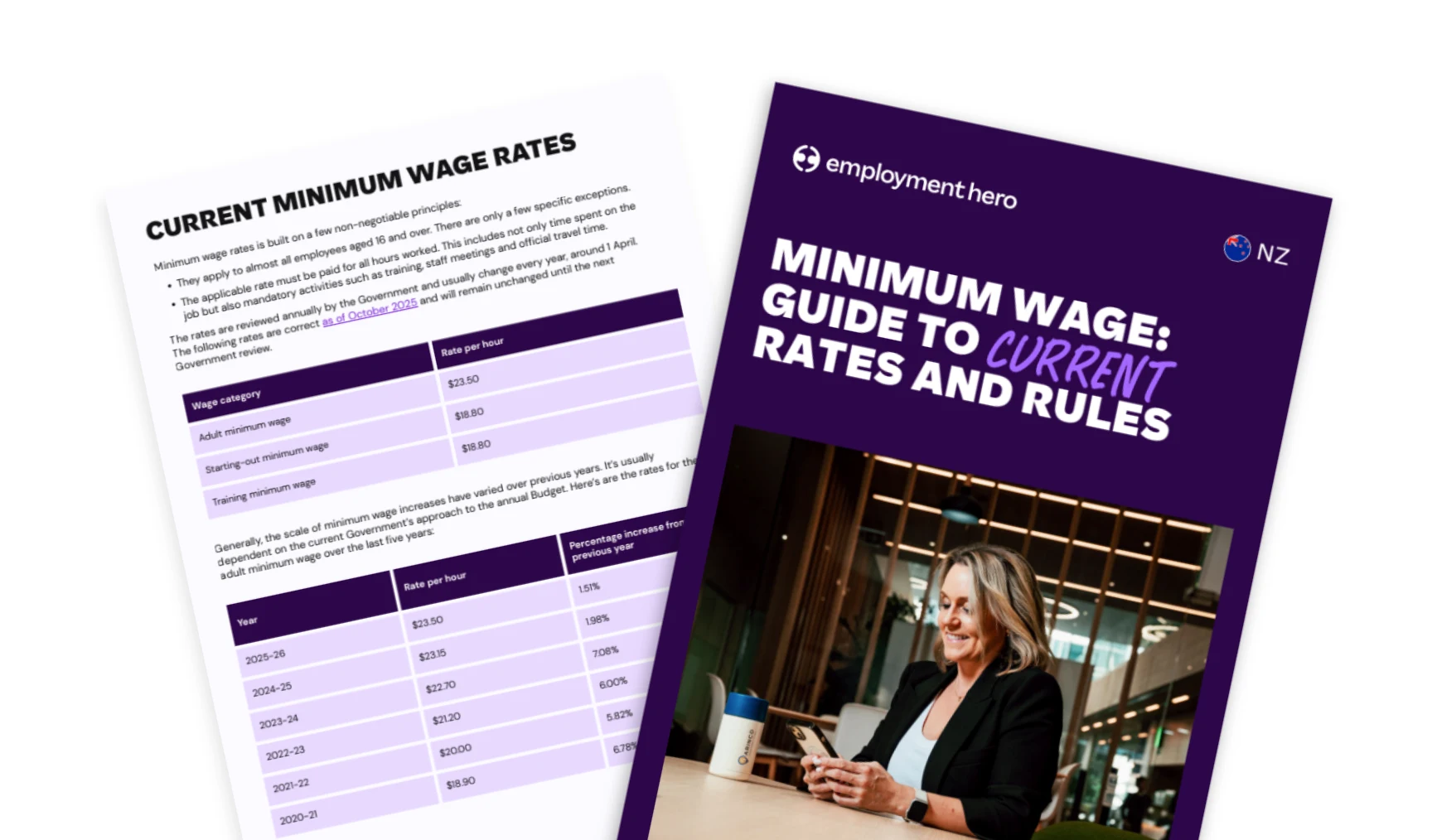 Read more: Minimum wage: Guide for New Zealand employers and payroll teams
Minimum wage: Guide for New Zealand employers and payroll teams
Understand NZ’s minimum wage rates, training wage rules, and 2025 updates. Learn how Employment Hero NZ automates wage compliance.
-
 Read more: Navigating 2025: NZ Employment Law Forecast
Navigating 2025: NZ Employment Law Forecast
Stay ahead of NZ employment law changes in 2025 with insights on grievance laws, wages, and more.


