

















Essential guide to contract management
Published
Essential guide to contract management
Published
Managing contracts is one of the most fundamental responsibilities for any New Zealand business. Whether you are hiring your first employee or managing a team of 50, contracts sits at the heart of those relationships. Employment agreements and policies protect your business and set the tone for your company culture.
Yet many employers still rely on outdated methods to manage these critical documents. Filing cabinets stuffed with paper, desktop folders cluttered with unorganised PDFs or email chains where the final signed version is impossible to find. These manual processes are more than just annoying administrative hurdles. They introduce significant risk to your operations.
Our guide to contract management looks at why moving away from manual processes is essential for modern businesses and how technology can transform this burden into a strategic advantage. You’lll learn about the contract lifecycle, the risks of getting it wrong and how to choose the right tools to streamline your HR operations.
Download the guide to contract management by filling in the form on the right.
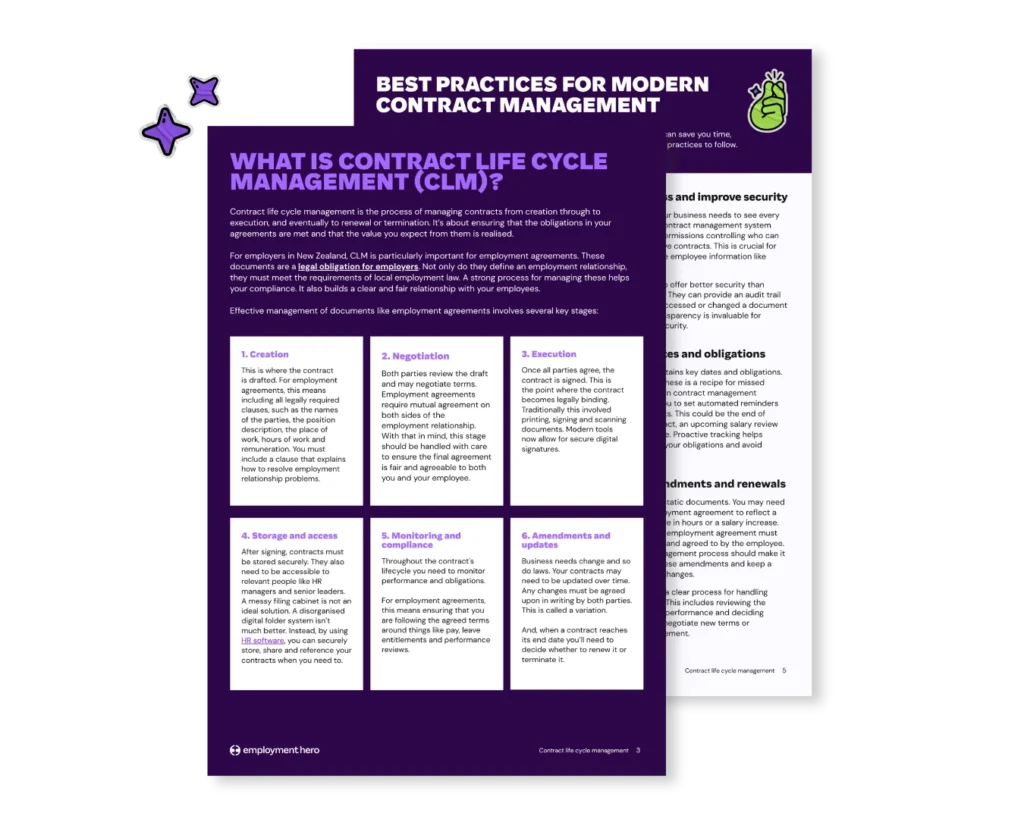
Best practices for contract management
Effective contract management doesn’t happen by accident. It requires a deliberate approach to how you create, store and monitor your agreements. For New Zealand employers, this is particularly important given the specific legal requirements around documentation and record-keeping.
The first best practice is centralisation. All your employment agreements should live in a single secure location. This single source of truth ensures that when you need to check a clause regarding notice periods or public holiday entitlements, you’re looking at the correct and current document.
Standardisation is equally critical. Using consistent templates for your employment agreements reduces the risk of human error. It ensures that every new hire receives a contract that includes all the necessary clauses required by New Zealand law. This might include details on the trial period, hours of work or the agreed pay rate. When you rely on copying and pasting from old documents, you risk carrying over outdated terms or mistakes.
Finally, you must be proactive, rather than reactive. Best practice involves setting up systems that remind you of key dates. This could be a visa expiry date for a migrant worker or the end date of a fixed-term agreement. Relying on your memory or a sticky note is not a robust business strategy.
Understanding contract lifecycle management (CLM)
Contract lifecycle management, or CLM, is the proactive management of a contract from the initiation stage through to the award, compliance and renewal. For many businesses, the focus is often solely on getting the contract signed. However, the lifecycle extends far beyond a signature on a page.
It encompasses the entire journey of the agreement. This includes the initial request for a contract, the drafting of terms, the negotiation between employer and employee, the approval process and the final execution. But it doesn’t stop there. The lifecycle continues into the storage of the document, the monitoring of obligations and eventually the renewal or termination of the agreement.
Understanding CLM is critical for business efficiency. When you view contracts as a lifecycle rather than a static event, you can identify opportunities to improve speed and compliance at every stage. It transforms contracts from a static piece of paper into a dynamic business tool that supports your organisational goals.
Optimising your CLM
Optimising your contract lifecycle management starts with mapping your current process. Identify where the bottlenecks are when managing and finalising contracts. Is it the drafting stage where managers are waiting for HR approval? Is it the signing stage where documents sit in inboxes for days?
Once you’ve identified the pain points, you can look for technology solutions to address them. Digital signature tools are a quick win. They allow new employees to sign contracts from their phone, drastically reducing turnaround times.
Another step is to integrate your contract management with your other HR systems. When a candidate accepts an offer, their details should flow automatically into their employment agreement. This eliminates data entry errors and speeds up the onboarding process.
What are the risks of manual contract management?
Sticking to manual processes might feel comfortable, but it exposes your business to a variety of risks. The most obvious is the risk of non-compliance. Employment law in New Zealand changes regularly. If you’re manually updating templates saved on a local drive, it is easy to miss an update. You might inadvertently send out an employment agreement that doesn’t reference the latest legislation on sick leave or fair pay agreements.
Lost or damaged documents are another significant risk. Physical paperwork is vulnerable to fire, flood or simply being misplaced during an office move. Even digital files can be lost if a computer crashes or an employee leaves and their files are deleted. If you face a personal grievance or a labour inspector audit, being unable to produce a signed employment agreement is a serious issue.
There is also the risk of inefficiency. Manual data entry is prone to human error. Typos in salary figures, incorrect start dates or misspelling a name can make your business look unprofessional and cause payroll issues down the line. The time your HR team spends correcting these errors and chasing paper trails is time they can’t spend on strategic initiatives that grow your business.
Security is the final major risk. Employment agreements contain sensitive personal data. Leaving them in an unlocked filing cabinet or an unsecured shared folder creates a privacy risk. You have an obligation to protect your employees’ data and manual systems often fall short of the necessary security standards.
How modern contract management software delivers value
Adopting a contract management system like Employment Hero’s HR software transforms how you handle employment agreements. It replaces chaos with order and risk with reliability.
The primary benefit is consistency. Employment Hero gives you access to a template library, filled with editable documents suited to the New Zealand employment landscape. This eliminates the need for manual drafting and ensures consistency across all your hiring.
Transparency is another key value driver. With a digital system, you have complete visibility over the status of every contract. You can see who has viewed a document, who needs to sign it and where bottlenecks are occurring. This allows you to follow up effectively and keep the hiring process moving.
Stakeholder collaboration is also significantly improved. HR managers, hiring managers and business owners can all access the same platform to review and approve contracts. There is no need for emailing versions back and forth. Everyone works from a single source of truth.
Perhaps most importantly, modern software reduces the administrative burden. By automating the repetitive tasks associated with contract management, you free up your team to focus on people and culture. You can spend less time pushing paper and more time building a great place to work.
Contract lifecycle management software: What to look for
When evaluating software options, it is important to look for features that support scalability and compliance. You want a solution that will grow with your business, not one you will outgrow in a year.
Integration capabilities are essential. Your contract management software should talk to your payroll and HR systems. This seamless flow of data prevents silos and reduces administrative double-handling.
Look for a robust library of templates. For New Zealand businesses, it’s vital that the software provides templates that have been written with local employment law in mind. These should be regularly updated by the provider to reflect legislative changes.
Security features are non-negotiable. Ensure the platform offers role-based access control, so you can define exactly who can see and edit sensitive documents. Two-factor authentication and audit logs are also must-have features for data protection.
Ease of use is critical for adoption. If the software is clunky or difficult to learn, your team will revert to their old manual ways. Look for an intuitive interface and good customer support to ensure a smooth implementation.
Take control of your contract management
Moving away from manual processes is a crucial step for any growing business. A robust contract management system saves you time, reduces administrative headaches and minimises legal risks. It provides a solid foundation for building strong professional relationships with your employees.
By centralising your contracts, automating key tasks and using templates you can transform a complex process into a simple and efficient one. A platform like Employment Hero brings all these elements together in one user-friendly system. It empowers you to manage the entire employee lifecycle, from contract creation to termination, all in one place. It offers one secure space for critical information and ensures easy access management amongst teams.
To find out how Employment Hero can support your business, book a call with one of our team.
The information in this article is current as at 13 February 2026, and has been prepared by Employment Hero Pty Ltd (ABN 11 160 047 709) and its related bodies corporate (Employment Hero). The views expressed in this article are general information only, are provided in good faith to assist employers and their employees, and should not be relied on as professional advice. Some information is based on data supplied by third parties. While such data is believed to be accurate, it has not been independently verified and no warranties are given that it is complete, accurate, up to date or fit for the purpose for which it is required. Employment Hero does not accept responsibility for any inaccuracy in such data and is not liable for any loss or damages arising directly or indirectly as a result of reliance on, use of or inability to use any information provided in this article. You should undertake your own research and seek professional advice before making any decisions or relying on the information in this article.
Register for the guide
Related Resources
-
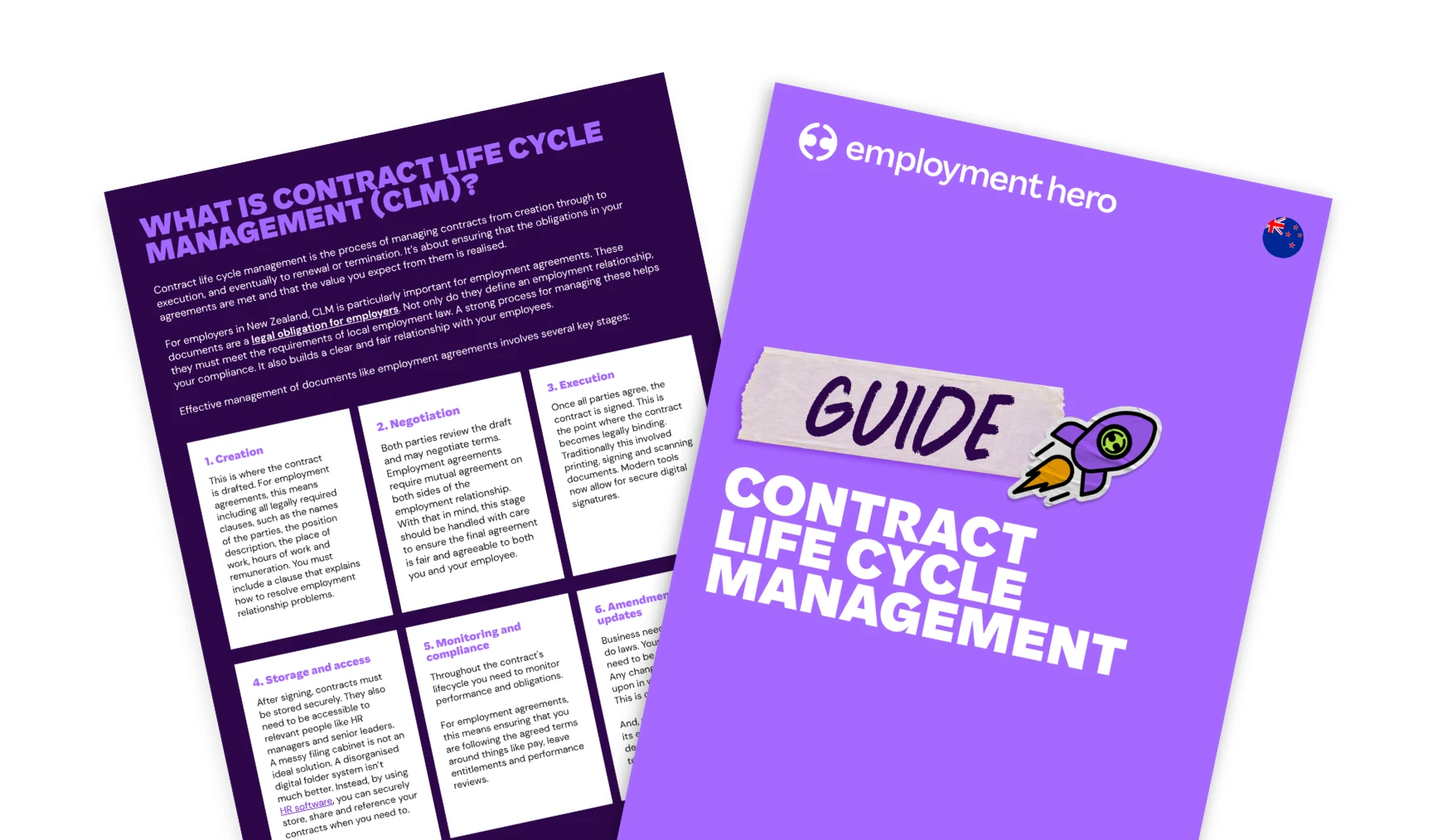 Read more: Essential guide to contract management
Essential guide to contract management
Understand contract management from creation to renewal, and why the right software is essential for reducing risk and getting your…
-
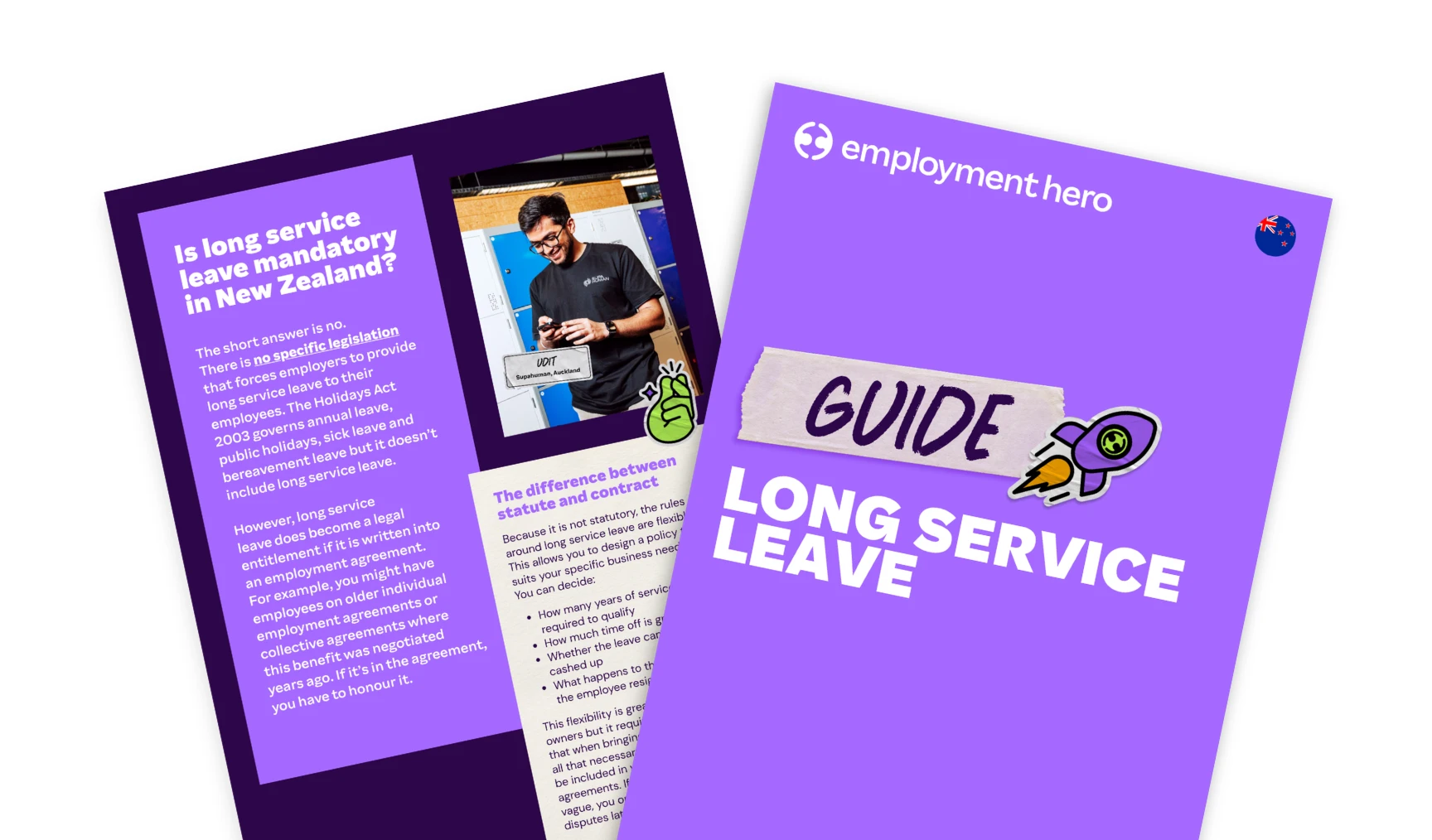 Read more: Guide to long service leave in New Zealand
Guide to long service leave in New Zealand
Learn about long service leave entitlements, pay rates and regulations.
-
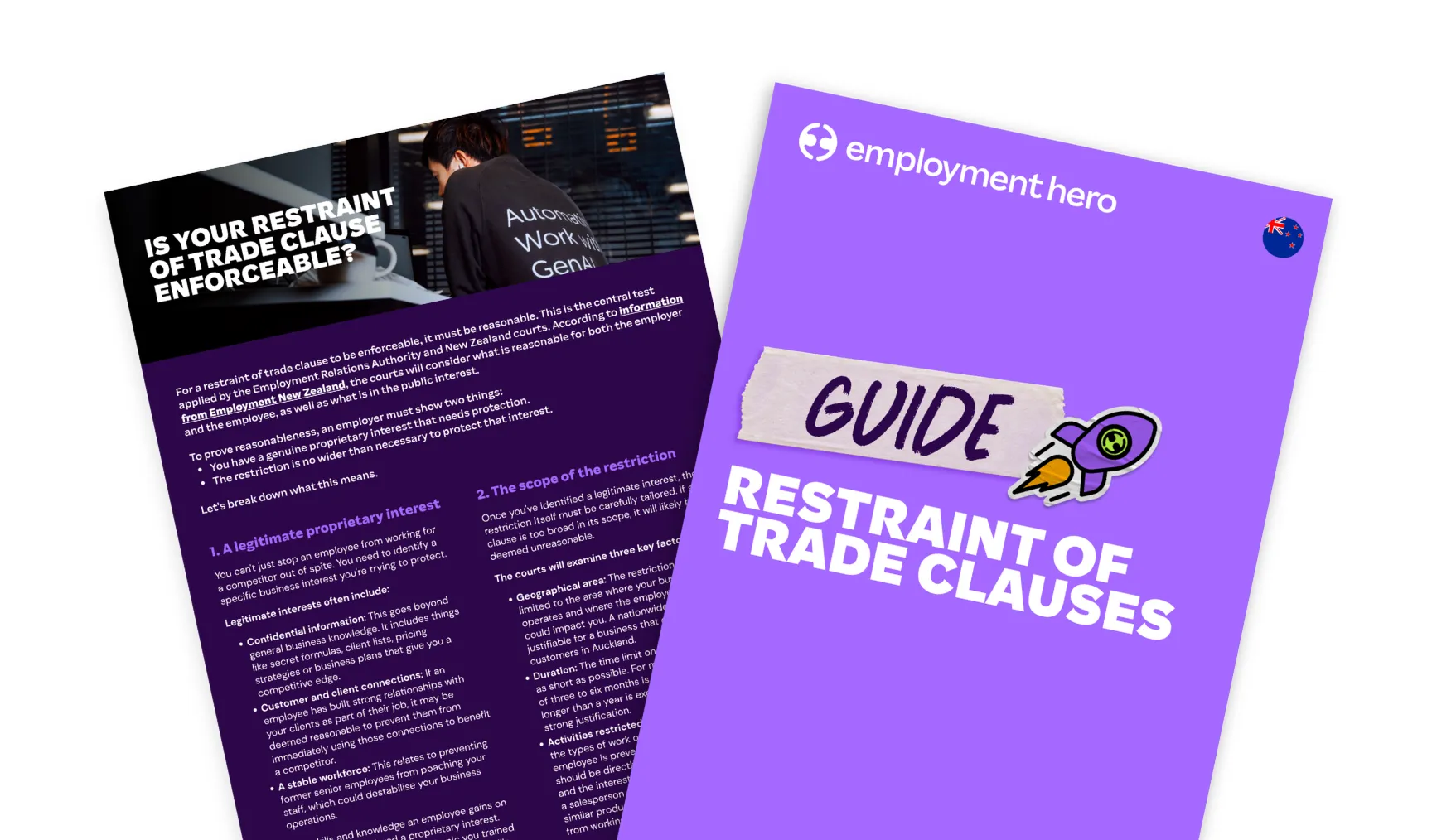 Read more: Guide to restraint of trade clauses in New Zealand
Guide to restraint of trade clauses in New Zealand
A straightforward guide to restraint of trade clauses, enforceability and protecting your trade secrets.

