 Australia
 United Kingdom
 Singapore
 Malaysia
 Canada (Français)

 New Zealand





Welcome to the second Employment Hero Annual Jobs Report. Employment Hero works with more than 350,000 small and medium businesses and more than 2.5 million employees around the world. Few organisations see where work, pay and jobs are heading with that much depth. This report is where we share what we see.
It hasn’t been an easy year for anyone running a business. AI keeps moving fast, and I believe it will create kinds of work we can’t name yet. I think small business owners feel the uncertainty whether they follow the markets or not.
Work is changing shape and I firmly believe people remain at the centre of that change. This report uncovers what’s happening inside small and medium businesses and for the people who work in them, and suggests what’s driving it.
I’m an optimist. I believe the trials of now will pass, but I’m also a realist. So we need to look at today’s numbers and face them head on, so we can make better decisions for our businesses and for the people we work alongside every day.
I hope this year’s report serves as a set of questions, and that we answer them together. What can we see? What are our options? And what will we do in 2027 and beyond? I’m hopeful about the answers. I believe small businesses will set the pace on AI, because they move quickly and they know their people. We’re focused on putting small businesses in the most competitive position we can, so they have every opportunity to create as many jobs as possible for the global small business workforce.

What this report shows is that New Zealand employees are choosing to stay in their roles because changing jobs in the current market feels risky or difficult. Sixty-eight per cent of those surveyed have stayed in a job they wanted to leave for that reason.
That’s because their values have shifted towards security. My own work points the same way. Across roughly 600 personal values debriefs at Cultures at Work over the past 12 months, financial security has moved from appearing in about a quarter of people’s top five values to about three quarters.
When financial security becomes a core personal value, a steady pay packet stops being a transaction and becomes something people protect. That is what job hugging is: people holding on to what they have, because a bird in the hand is worth two in the bush. This report suggests job hugging is a rational response to the economy, politics and uncertainty people are living through, and it will shift as those conditions shift.
When confidence returns, people will move. I watched the same pattern after the 1987 sharemarket crash. For about two years people held on to their jobs or worried about losing them, and when conditions improved they moved on. Employers should expect the same again. The ones who stay will be those who have found more reasons to stay than to go.

Employment Hero analysed 13 months of platform data covering employment and wages to create this report. This was paired with findings from a survey of 804 employed New Zealanders1, commissioned by Employment Hero and conducted by Pureprofile in October 2026. Where relevant we benchmark this data against Australian survey data and local government figures to offer a wide view of what we’re seeing.
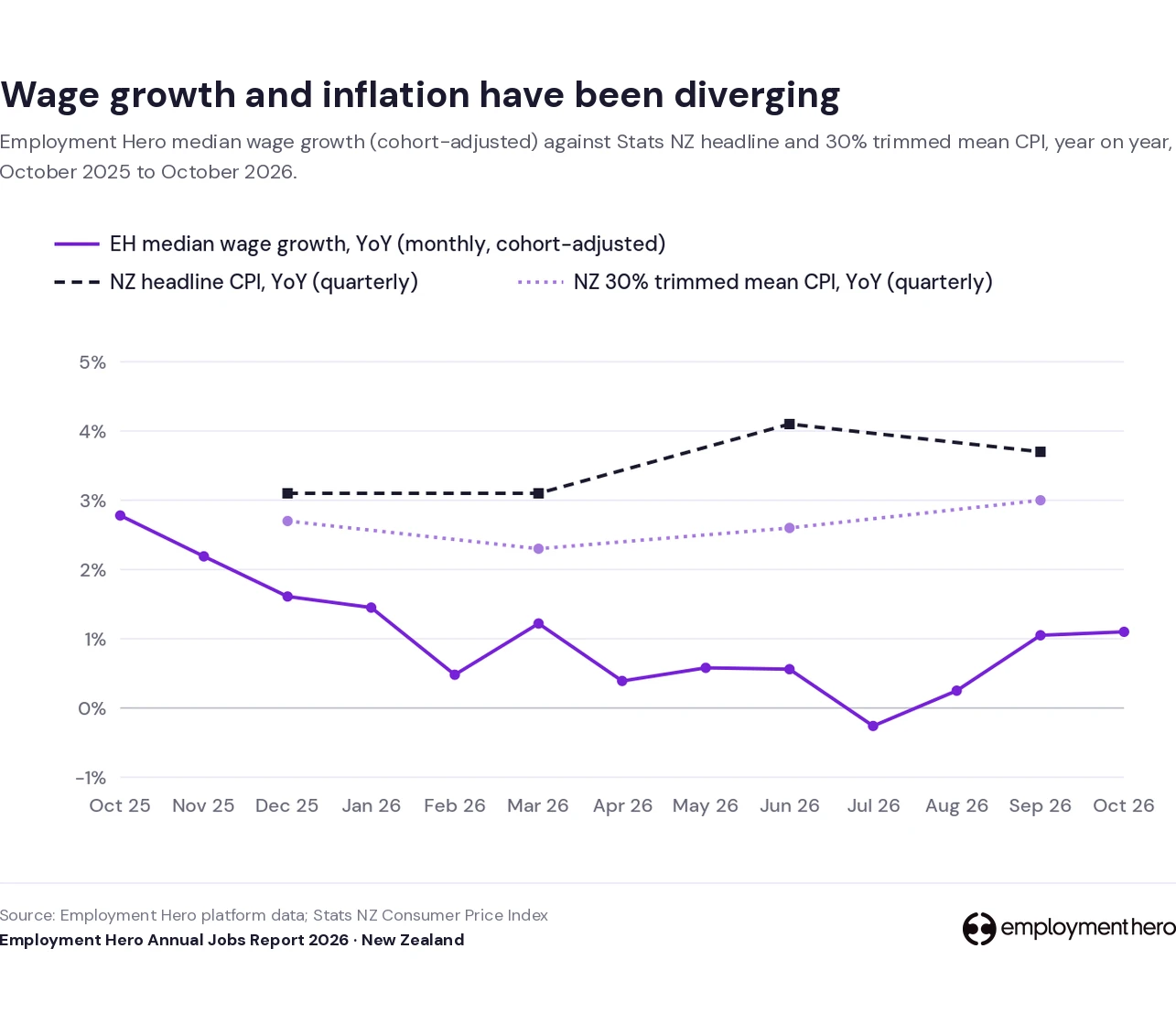
Pay in New Zealand has stalled while hiring has held up. Employment Hero data shows median year-on-year wage growth on the platform was just 1.1 per cent in October 20262, down from 2.8 per cent a year earlier. Employers are still bringing people on, but pay has not moved with them.
Statistics New Zealand (Stats NZ) reported unemployment rose to 5.7 per cent in the September 2026 quarter and underutilisation rose to 13.8 per cent in the same quarter.3 With that much spare capacity, employees have less room to push for pay rises.
I suspect two things are at play. The first is job hugging, a term used to denote when people stay put in their current roles because they see moving as too risky. When fewer people move, employers have less reason to pay up to keep the people they have or to attract new ones. The second is the size of recent pay rises. Kiwibank noted in its May 2026 labour market release4 that most pay rises in New Zealand sat in the 1–2 per cent range.
A lack of movement is indicative of confidence – or lack thereof – in the broader market. 38 per cent of people think that things are getting worse for employees compared to 24 per cent who think it’s getting better.1 Only half feel confident they could get a new job in three months if they had to. When employees feel the market is closing in, staying put starts to look like the safest option. Pay is a key lever for employers, but their ability to use it in this landscape is limited, and until employees feel more confident about their options, I expect pay to stay subdued.
Work in New Zealand: what the data shows
Pay has stalled, not fallen
Employment Hero data shows median wage growth on the platform slowed from 2.8 per cent year on year in October 2025 to 1.1 per cent in October 20262, dipping slightly negative in July (-0.3%). The raw median hourly rate rose from $35.54 to $36.055 between January and May, then rose more slowly, reaching $36.40 in October. Hiring held up through the same months, with quarterly headcount growth of around 2 per cent from February to June, picking up to an average of 3.5 per cent between July and October.6
Casual roles account for much of that hiring pickup, whilst casual pay is lower than full-time pay. Some of the overall wage slowdown is likely to come from who is being hired, rather than from pay cuts for the same people. Full-time annual pay growth still fell, from 3.9 per cent to 1.8 per cent between October 2025 and October 2026.
The fall is not spread evenly. Healthcare and community services moved from a median of 4.5 per cent wage growth across 2025 to negative year-on-year growth from January 2026, reaching -6.1 per cent in August. Growth has picked up since August, but it was still negative at -4.1 per cent in October.2 Auckland held steady, while several regions outside it, including Wellington, have moved to flat or negative.
Earnings are also falling behind inflation. Employment Hero data shows the gap between wage growth and inflation widened to -3.5 points in June, when Stats NZ reported CPI at 4.1 per cent for the June quarter.3 Official measures tell a steadier story. The Stats NZ Labour Cost Index held at about 2 per cent over the same period, and public sector wage growth fell to 1.7 per cent in the March 2026 quarter. The Employment Hero platform measures small and medium businesses, and that is part of why it reads weaker.
Labour market slack is the backdrop. Unemployment rose to 5.7 per cent in the September 2026 quarter, according to Stats NZ, and underutilisation rose from 12.9 per cent to 13.8 per cent.3
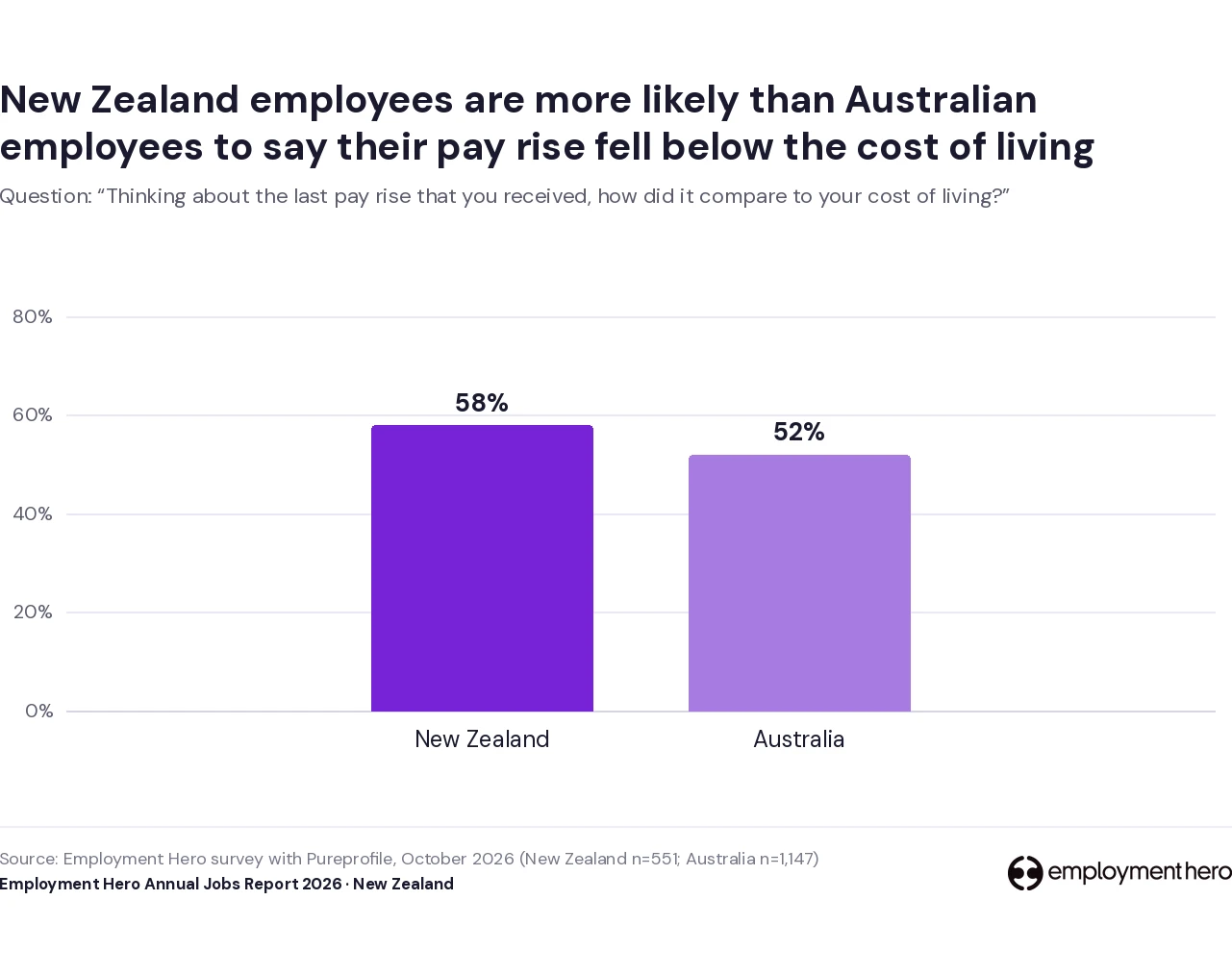
Data from our Pureprofile survey points the same way. Of employees surveyed, 71 per cent say their pay rose in the last 12 months. Among those whose pay increased, 58 per cent believe it fell behind the cost of living.1
Half (50%) of all employees surveyed earn less than the income they say that they need to feel comfortable. Among those who fall short, the typical shortfall is $37,5007 a year. Separately, the median full-time employee surveyed earns $86,700, while the median income they say they need is about $100,400, a difference of $13,7007.
Loyalty is not perceived to be paying off either. 34 per cent believe employees who stay loyal to an employer end up worse off financially, against 22 per cent who believe they are better off.1 Pay is falling behind, but job security is holding people in place. How long that holds depends on whether the market stays where it is.
Wage growth and inflation have been diverging
Source and data notes
Note: Median wage growth is the cohort-adjusted Employment Hero figure for small and medium businesses on the platform, year on year, by month, between October 2025 and October 2026 (note 2). Inflation is Stats NZ quarterly headline and 30% trimmed mean CPI, year on year. September 2026 is the latest quarter (note 3).
Rising costs have made flat pay feel smaller
Employment Hero data shows the gap between wage growth and inflation was close to zero in October 2025. It reached -1.5 points in December, -3.5 points in June 2026 and -2.6 by September 2026. Pay stopped rising while prices kept climbing.
Fuel added to that pressure. Stats NZ said consumer price index (CPI) inflation for the June quarter would have been 2.9 per cent without the change in petrol and diesel prices, rather than 4.1 per cent.3 Kiwibank says the fuel shock that began in late February 2026 affected business confidence, investment and hiring intentions.
Prices have since eased. Stats NZ reported annual CPI inflation slowed to 3.7 per cent in September, as petrol fell during the quarter.3 Pump prices were still 19.1 per cent higher than a year earlier, so relief has been partial.
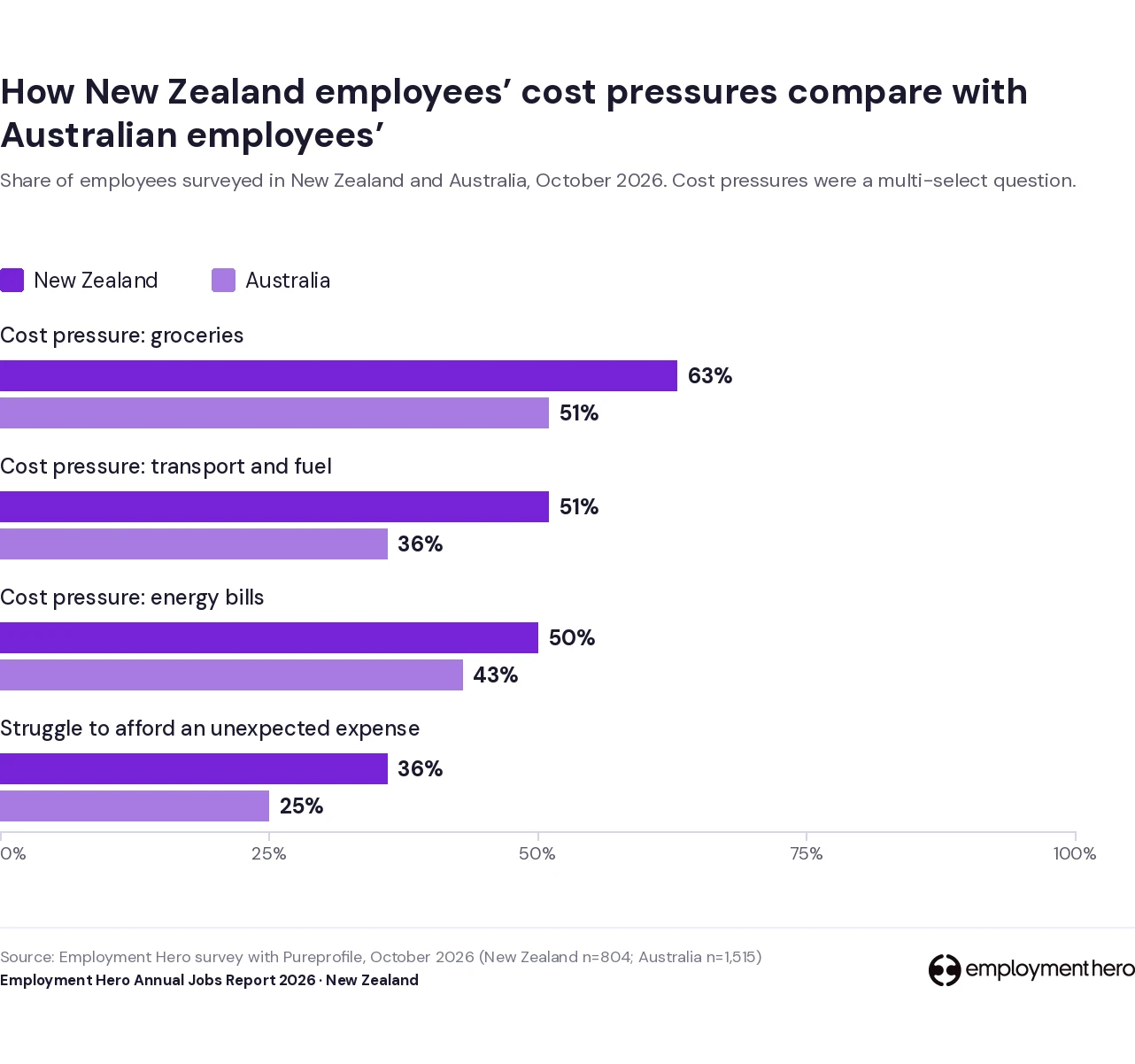
In the Pureprofile survey, 63 per cent of employees surveyed report pressure on groceries, against 51 per cent of Australian employees surveyed.8 Transport and fuel comes next at 51 per cent (against 36 per cent), then energy bills at 50 per cent (against 43 per cent). New Zealand employees are also more likely to struggle with an unexpected expense, at 36 per cent (against 25 per cent).1
The same survey found 12 per cent of employees started a side job or freelance work in the last year.1
How New Zealand employees’ cost pressures compare with Australian employees’
Source and data notes
Note: Survey with Pureprofile, October 2026 (New Zealand n=804; Australia n=1,515), run at the same time with the same screening criteria and quotas in both markets. Cost pressures were a multi-select question, so figures do not sum to 100%. The unexpected expense measure is the share who say an unexpected expense is a struggle to afford (notes 1 and 8).
New Zealand employees are more likely than Australian employees to say their pay rise fell below the cost of living
Source and data notes
Note: Survey with Pureprofile, October 2026. Base: employees who received a pay rise in the last 12 months (New Zealand n=551; Australia n=1,147). Question: “Thinking about the last pay rise that you received, how did it compare to your cost of living?” (notes 1 and 8).
Job security is winning over ambition
Job security is winning out, and the view has persisted for over a year. Data from the Pureprofile survey found 63 per cent of employees say they prioritise job security over ambition because of the cost of living, largely the same as 64 per cent in our August 2025 YouGov survey.9
Employees are less gloomy about conditions than they were in 2025. Among those surveyed, 24 per cent think things are getting better for employees, up from 17 per cent, a statistically significant rise.9 That is still a low share, and most employees do not yet see things improving. Confidence in adapting to new technology rose from 71 per cent to 76 per cent, a statistically significant change.
Fewer employees are willing to move. Among employees surveyed, 34 per cent say they would relocate for the right job, down from 42 per cent in 2025, a statistically significant fall.9 The survey suggests sentiment has improved from a low base without more movement, which fits a frozen market.
How settled people feel in their current job is broadly unchanged. The share feeling very settled, scoring 8 to 10 on a 0 to 10 scale, slipped from 47 per cent to 43 per cent.9 That change is not statistically significant, but it is indicative of persistent job hugging and its emotional effect.
Risk is a common reason given for staying. Of employees surveyed, 68 per cent say they have stayed in a job they wanted to leave because moving felt too risky or difficult. 25 per cent say they are fulfilled in their current job, and a further 46 per cent say it is not perfect but good enough. Furthermore, 26 per cent say they are staying purely because the job market is too tough to navigate, and 30 per cent cite benefits, perks or working arrangements.1
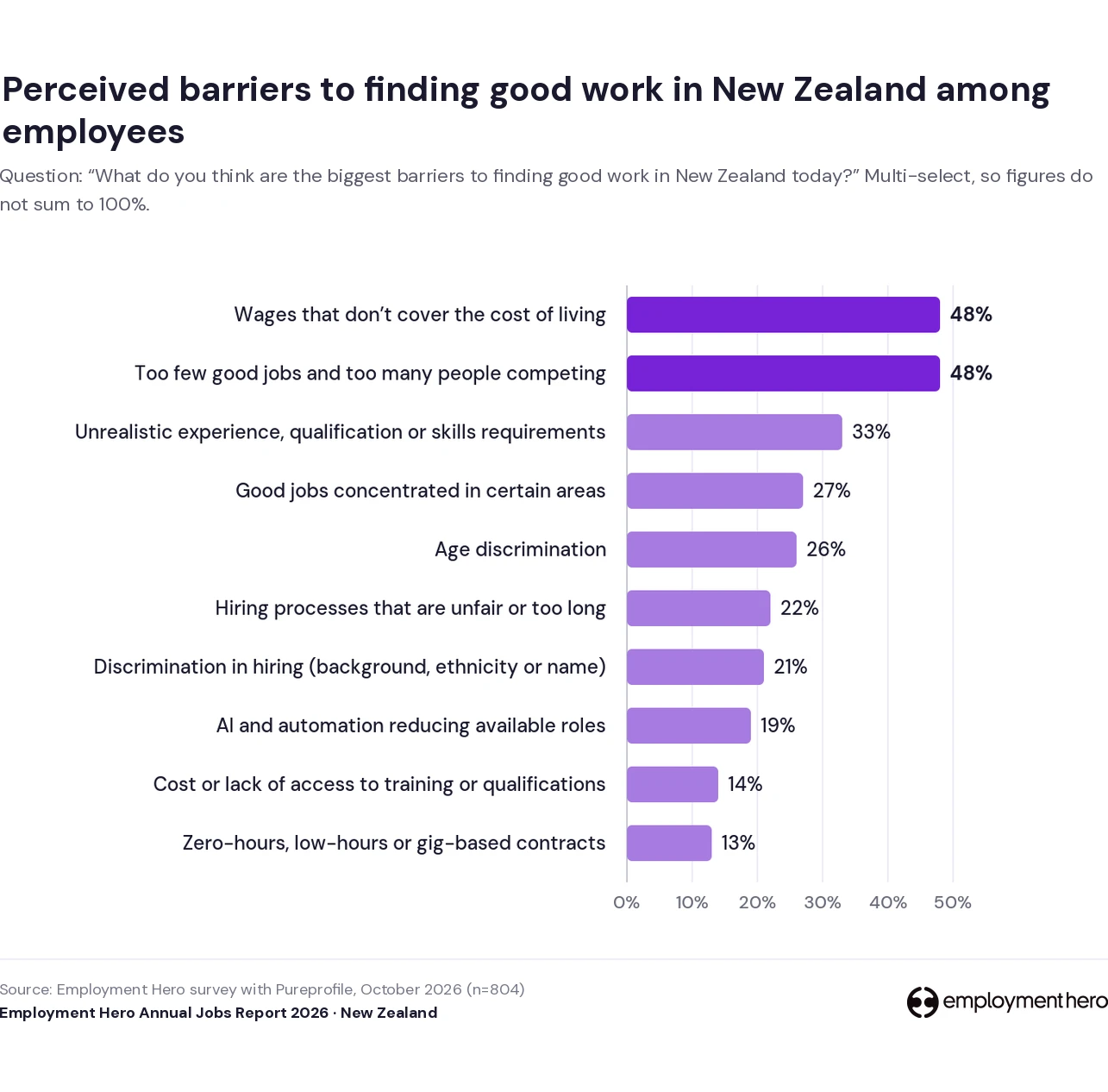
Employees surveyed named two barriers to good work well above the rest: wages that do not cover the cost of living (49 per cent) and too few jobs with too much competition (48 per cent).1 Both point to a market that seems to be halting moves, so many people feel they need to hold on to the jobs they have.
Feeling towards conditions for employees is shifting more positively but people are less willing to move. If confidence keeps rising, the open question is whether mobility follows.
Perceived barriers to finding good work in New Zealand among employees
Source and data notes
Note: Survey with Pureprofile, October 2026, n=804 (note 1). Multi-select question, so percentages do not sum to 100%. 4% said there are no barriers. Question: “What do you think are the biggest barriers to finding good work in New Zealand today?”
Some employees are considering a move abroad
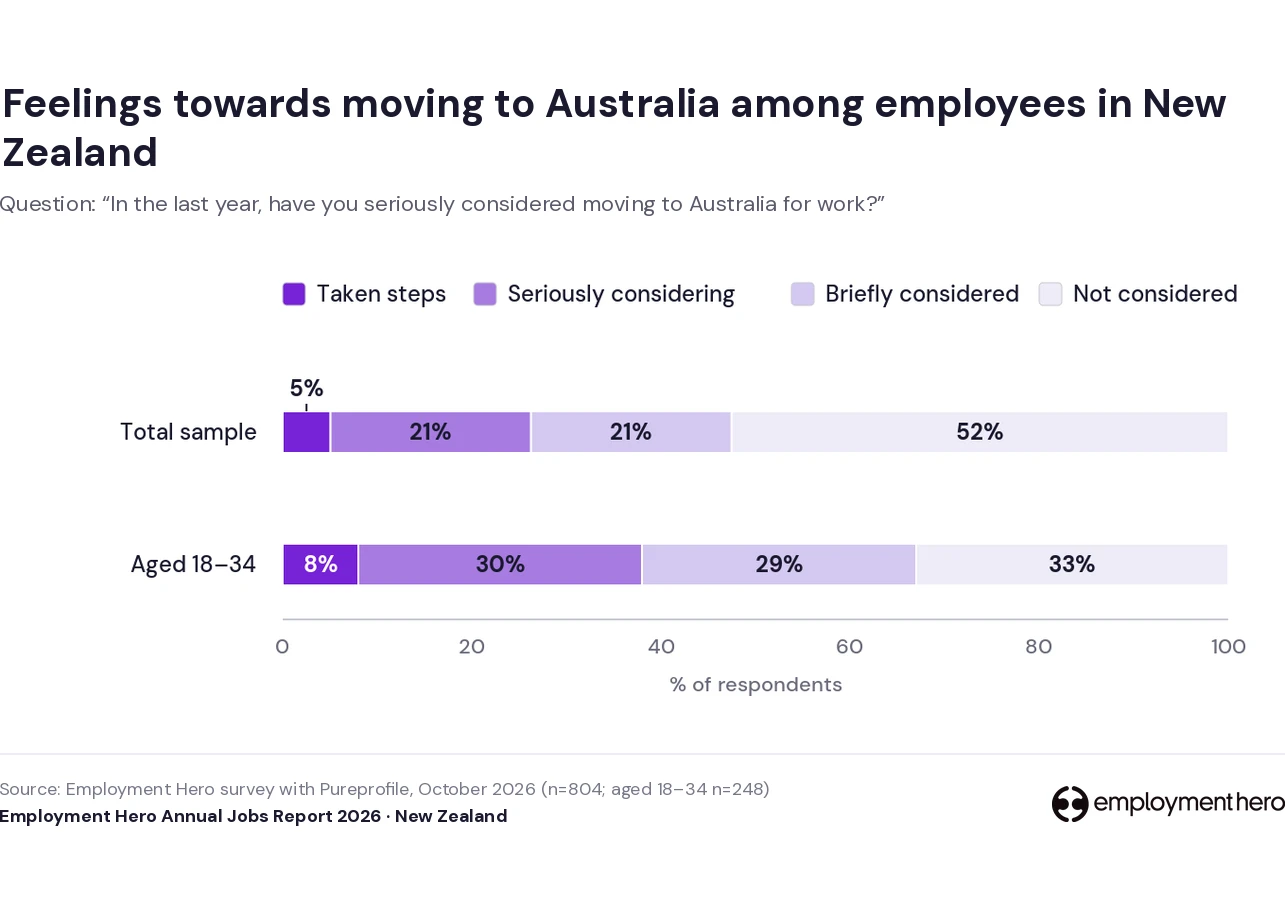
Data from the Pureprofile survey found 48 per cent of employed adults say they considered moving to Australia in the last year, even if only briefly.1
Of employees surveyed, 26 per cent say they are seriously considering the move or have already acted on it, and 5 per cent say they have taken steps to go. Among those who considered the move, higher pay (35 per cent) and the cost of living in New Zealand (28 per cent) are the top reasons.1
The pull is strongest among younger employees. 67 per cent have considered moving to Australia. Of younger employees surveyed, 38 per cent are seriously considering it or have acted, and 8 per cent say they have taken steps to go.1
Australia has cost pressures of its own. Australian employees surveyed are significantly more likely to report cost pressure from rent or mortgage payments; 50 per cent against 36 per cent in New Zealand.8
Feelings towards moving to Australia among employees in New Zealand
Source and data notes
Note: Survey with Pureprofile, October 2026, n=804 total and n=248 aged 18–34 (note 1). Survey question: “In the last year, have you seriously considered moving to Australia for work?” Figures may not sum to 100% due to rounding; segments are scaled to the row total.
Employees doubt job ads and are split over AI in hiring
Many job seekers are wondering whether the job postings they are looking at are real. Data from the Pureprofile survey found 41 per cent of those who have looked at job ads in the last two years suspect they have seen a ghost job, a listing for a role that is not really open.101
Doubt covers job boards more widely. Only half of employees trust salary information or match relevance completely or mostly, at 51 per cent each. Genuine roles and live vacancies are doubted by a significant number of job seekers; only 57 per cent have faith in job boards for showcasing real jobs (completely/mostly trust).1
That makes a hard market harder to navigate. When an ad cannot be taken at face value, moving feels like a gamble, and staying put can look like the safer option.
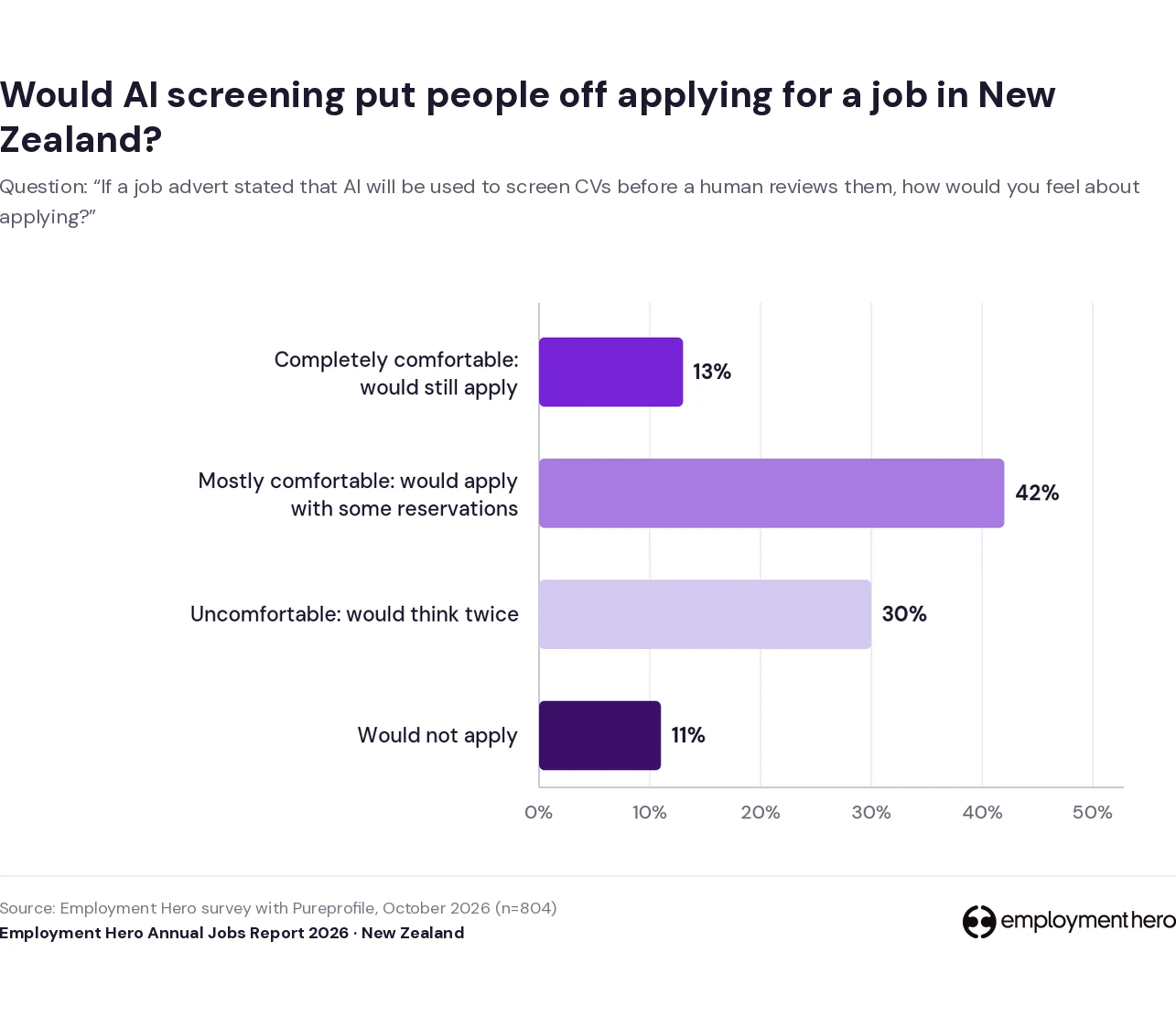
AI can ease parts of the search, but it also adds to the doubt. Of employees surveyed, 55 per cent would still apply for a job if AI screened CVs before a person reviewed them. For 30 per cent, it would make them think twice, and 11 per cent would not apply at all. The data suggests that AI screening is not putting off the vast majority of job seekers. Only 1 in 10 wouldn’t apply and that will likely change fast as AI becomes more understood, commonplace and normalised in this process.1
Acceptance is highest for AI matching CVs to roles, at 38 per cent, followed by AI-scored skills tests at 28 per cent and automated CV screening at 24 per cent. Candidates and employers are now using AI at both ends of the process. Of employees surveyed, 53 per cent say it is acceptable for candidates to use AI to write applications when employers use AI to assess them. Another 23 per cent say it is not.1
Scepticism about AI in hiring may partly reflect how new it is. For many employees, AI in hiring is still unfamiliar, and unfamiliar processes can feel less trustworthy. Employers can respond by being open about where AI is used and how decisions are made.
Would AI screening put people off applying for a job in New Zealand?
Source and data notes
Note: Survey with Pureprofile, October 2026, n=804 (note 1). 4% answered “don’t know” and are not shown. Survey question: “If a job advert stated that AI will be used to screen CVs before a human reviews them, how would you feel about applying?”
Explore New Zealand’s Workforce Data
Dig into the key data points behind this year’s Annual Jobs Report: job hugging, the cost of staying and platform data.
Look Forward
New Zealand Forecast
Over the next year, pay growth is likely to stay low. Employers can still recruit. With spare capacity in the labour market and little pressure on wages to rise, though, they are unlikely to use pay increases to hold people.2
The OECD put New Zealand’s real wages 6.4% below 2021 levels and said only New Zealand and Australia are near the trough of the cost-of-living squeeze. To us, this indicates that observed pay growth deceleration in the Employment Hero platform could persist.11
Job security is outranking ambition for many employees and leave rules are holding some people in place, which will continue until the Employment Leave Act comes into force in August 2028.12 Political and environmental factors that bolster this job hugging sentiment aren’t going anywhere, suggesting younger employees, who are the most open to moving to Australia, are likely to look elsewhere for opportunities.1
Progression and leave terms are the levers employers control today and will continue to do so over the next 12 months. Making the next step visible, and recognising the work people are doing now, can give staff a reason to stay that does not depend on pay. Leave terms deserve the same scrutiny, because they can keep people in place without anyone asking whether they want to stay.
Risks to this view are a faster hiring pick-up and renewed price pressure. As more roles open up, employers face more competition for staff and median pay growth could return above 2%. ASB economists forecast inflation of 4.7% in the December quarter13, which we believe could push employees to seek pay rises even without a hiring boom.
Want monthly employment data?
Visit the Employment Index for monthly insights on employment and wage growth across New Zealand’s SME workforce, updated every month.
Methodology, notes and definitions
First party data. Employment and wage figures come from Employment Hero platform data, covering 2,300+ organisations and 105,000+ employees. Employment growth is the average change in employees per organisation, measured across organisations present in both periods. Month-on-month and quarter-on-quarter figures are shown where stated.
Wage growth is the year-on-year change in the median hourly rate, compared like-for-like across the same organisations (cohort-adjusted). Raw changes in the median rate are not used for growth, as they can shift with sample mix. We report medians rather than means for wages.
Figures are only reported where at least 30 organisations are included. Data runs from October 2025 to October 2026. These results describe organisations on the Employment Hero platform, not the whole New Zealand labour market.
Third party data. Unemployment and underutilisation are from Stats NZ’s Household Labour Force Survey. Inflation is the annual Consumers Price Index rate, published quarterly by Stats NZ.
Survey data. The custom survey was commissioned by Employment Hero and conducted by Pureprofile, fielded 16 to 26 October 2026. The sample is 804 employed adults.14 Respondents were in paid employment, full-time or part-time, and the sample excludes business owners and self-employed people by design, because most questions concern experiences within an employing organisation. Quotas on age, gender and region were applied during recruitment to match the New Zealand employed population. Results are unweighted.
Income is personal, not household, and is collected in bands. Medians are interpolated within the band where they fall, assuming responses are spread evenly across it. Comfortable income is the income respondents say they need to feel financially comfortable (“not rich, not stressed, just comfortable”). The comfortable income gap excludes respondents who already feel comfortable. In person-level shortfall measures, those respondents are counted as not short.
Comparisons to Australia use a survey fielded at the same time, also with Pureprofile, using exactly the same screening criteria and quotas.
Year-on-year comparisons use a YouGov NZ survey fielded in August 2025 (n=520). Solo operators were removed (n=30), and the 2025 sample was weighted to the 2026 NZ profile on age, gender, employment and region. Questions were matched on wording and answer options.
Significance uses effective sample size and is tested with two-sided two-proportion z-tests, with significance at p<0.05, applying to percentages and not medians or means.
- Survey. Employment Hero commissioned Pureprofile to survey 804 employed New Zealanders aged 18 and over, in paid employment, full-time or part-time. Fieldwork ran from 16 to 26 October 2026. The sample is unweighted and excludes business owners and self-employed people by design.↩
- Platform wage growth. Cohort-adjusted. The year-on-year change in the median hourly rate for employees on the Employment Hero platform, compared like-for-like across the same organisations. Each employee’s pay is compared only with their own pay in the comparison period, and only employees in the same businesses in both periods are included. The growth figure is the median of those individual changes.↩
- Official statistics. Unemployment and underutilisation are from Stats NZ’s Household Labour Force Survey. Inflation is the annual Consumers Price Index rate, published quarterly by Stats NZ.↩
- Kiwibank. Kiwibank labour market release, May 2026.↩
- Raw median hourly rate. The median pay of all employees in the sample in the month shown. It is not cohort-adjusted, so it will not match the growth figures.↩
- Platform employment growth. The average change in employees per organisation, measured across organisations present in both periods. Month-on-month and quarter-on-quarter figures are shown where stated.↩
- Median gap and comfortable income. The median gap across all employees surveyed between their current pay and the income they say they need to feel comfortable. The comfortable income gap excludes respondents who already feel comfortable. The full-time gap is the median gap among full-time employees surveyed.↩
- Comparisons to Australia. A survey fielded at the same time, also with Pureprofile, using exactly the same screening criteria and quotas.↩
- Year-on-year comparisons. A YouGov NZ survey fielded in August 2025 with 520 employed adults, using the same screening. Solo operators were removed (n=30). The 2025 sample is weighted to the 2026 profile on age, gender, employment and region. Questions were matched on wording and answer options. Differences are tested with two-sided two-proportion z-tests at p<0.05.↩
- Ghost jobs. The base is employees surveyed who have looked at job ads in the last two years. A ghost job is a listing for a role that is not really open.↩
- OECD. Real wage comparison for New Zealand against 2021 levels, and the comparison with Australia, as cited in the forecast.↩
- Employment Leave Act 2026. Replaces the Holidays Act 2003. It received Royal Assent on 6 August 2026 and comes into force on 6 August 2028 (Ministry of Business, Innovation and Employment).↩
- ASB economists. Inflation forecast of 4.7% for the December quarter.↩
- Employees. In this report, “employees” means the people surveyed: adults in paid employment, working full-time or part-time for an employer. Business owners, self-employed people, solo operators and freelancers were screened out of the survey, so the views reported are those of employed people.↩
