 Australia
  United Kingdom
  Singapore
  Malaysia
  Canada (Français)
 New Zealand


A global report by employment hero
The AI Paradox
How employers and employees really feel about AI at work.
Foreword

CEO and Co-Founder,
Employment Hero
Every twenty years or so, the way we work gets rewritten. In the early 2000s, it was the cloud. Before that, the PC. Each time, the businesses that moved first reset the rules. This time, it’s AI, and it feels different.
For the past two years, the dominant narrative around AI has been defined by fear. Job displacement, hollowed-out junior roles and a shrinking human workforce. It’s a tempting story and it misses what our data is showing us.
Our mission at Employment Hero is to make employment easier and more valuable. We want the most jobs possible. So we set out to find out what AI is actually doing to businesses. What we found flips the fear narrative on its head.
What did we find? AI appears to be acting as a job creator.
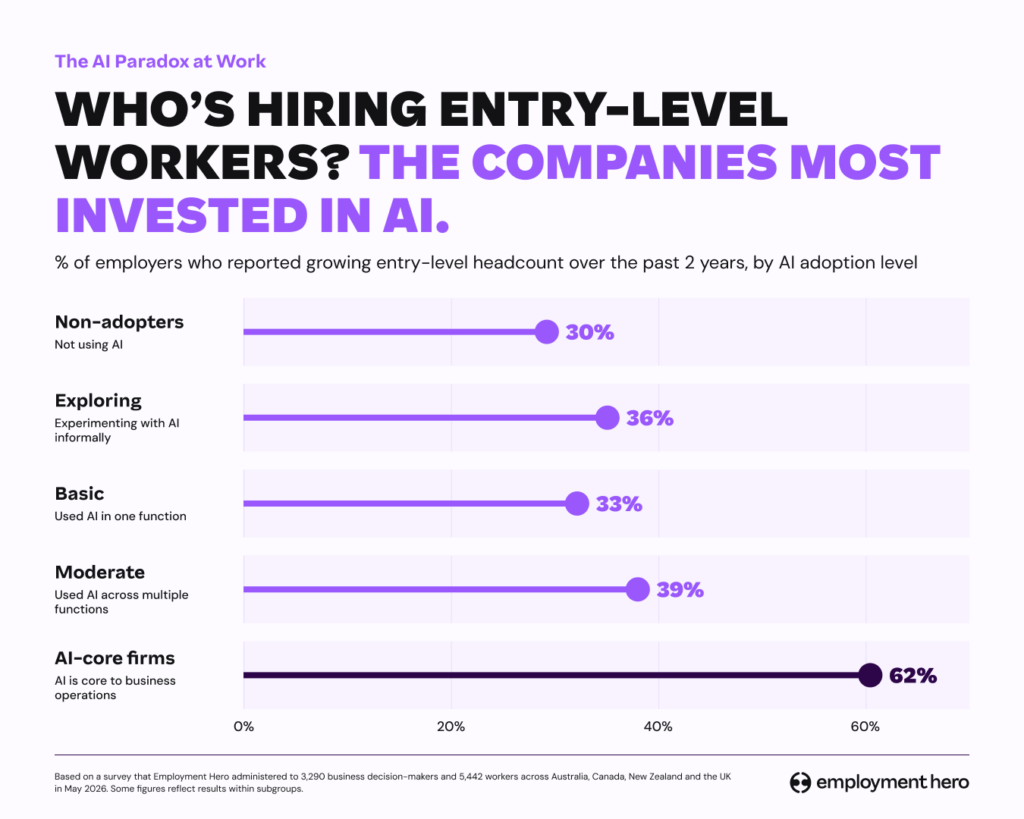
Businesses most invested in AI are hiring more, not less. 62% of AI-core firms grew their entry-level headcount over the past two years. More than double the rate of non-adopters at 30%.
That isn’t a contradiction. When new technology gives a business more leverage and greater output, the response isn’t to shrink the team. It’s to do all the things you’ve wanted to in order to expand your business, develop meaningful relationships with your customers and invest 1:1 time with your team, the backbone of your business.
We’re not the only ones seeing it. Across the industry, there are many examples of AI-mature companies reporting growth, not subtraction. New roles and bigger teams offering new opportunities to maximise human potential.
For this report, we surveyed 8,800 business leaders and employees across four markets to pressure-test the picture. And believe me, there’s real tension underneath. Adoption runs ahead of maturity. Time saved runs into more work. The experience of AI looks different from the boardroom than the front desk. Leaders think their teams are on board.
A sizable share of employees appear conflicted. That tension is one of the bigger findings in this report. This isn’t just a technological shift, it’s a cultural one and how we handle it will shape the workforce that comes out the other side.
But our research suggests the direction of travel is clear. The businesses that get this right won’t be the ones deploying AI fastest, they’ll be the ones using the leverage to build more, and the ones who help their people see AI as an ally rather than a threat.
This is The AI Paradox. It’s a story of growth, not loss. Of businesses doing more, teams getting bigger, and people getting the chance to do work that matters.
The best of it is still ahead.
1
The Junior Job Myth
AI-focused businesses are creating jobs
Our data challenges one of the loudest narratives in the media right now; that AI is wiping out the entry-level job.
42% of companies grew their entry-level headcount over the past two years. Among businesses with AI at the core of their operations, that figure rises to 62%. More than double the rate of non-adopters at 30%.
Yes, there’s a real wave of AI-attribution when businesses cut roles, but it’s narrower than the headlines suggest. Only 16% of companies cut entry-level roles over the past two years, and among that group, AI and automation was the most-cited reason.
Whether AI is driving the growth, or whether the most AI-mature companies are simply the ones doing best overall, is a question the data can’t fully settle. But at the very least, advanced AI firms are not cutting entry-level jobs. If anything, they’re hiring more.
2
The New Credential
AI skills compete with University degrees
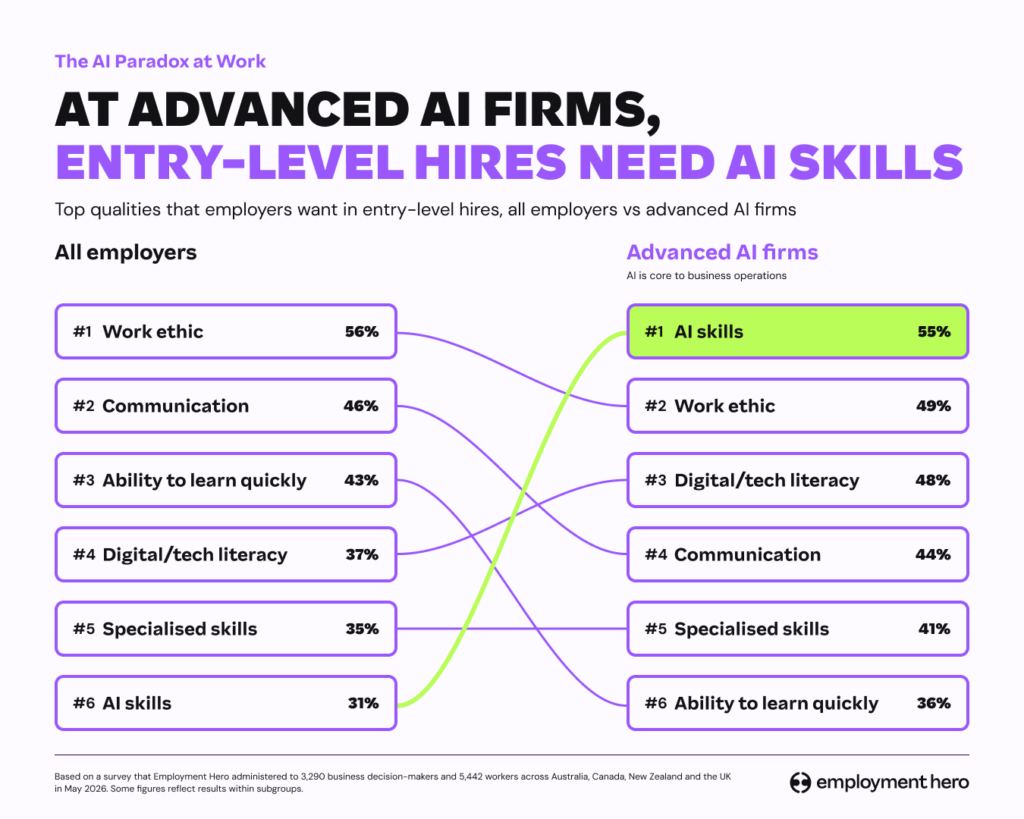
Hiring criteria are shifting fast. Soft skills still sit at the top. Work ethic leads at 56%. Communication isn’t far behind at 46% and quick learning at 43% but AI skills are climbing up the list.
AI skills now rank sixth across all employers, sitting at 31%, ahead of prior work experience and ahead of holding a degree. Among advanced AI firms, AI skills rank first.
58% of businesses have already updated their hiring criteria to better weight AI skills. Another 24% plan to do the same. That said, the workforce hasn’t caught up. Six in ten employees rate their own AI competence as low or average.
Job descriptions confirm it. Our 1st party data shows that mentions of AI skills are up 235% year on year, with “Claude” now the fastest-growing skill term of 2026.
3
The Upskilling Gap
Employees are taking the lead and upskilling themselves
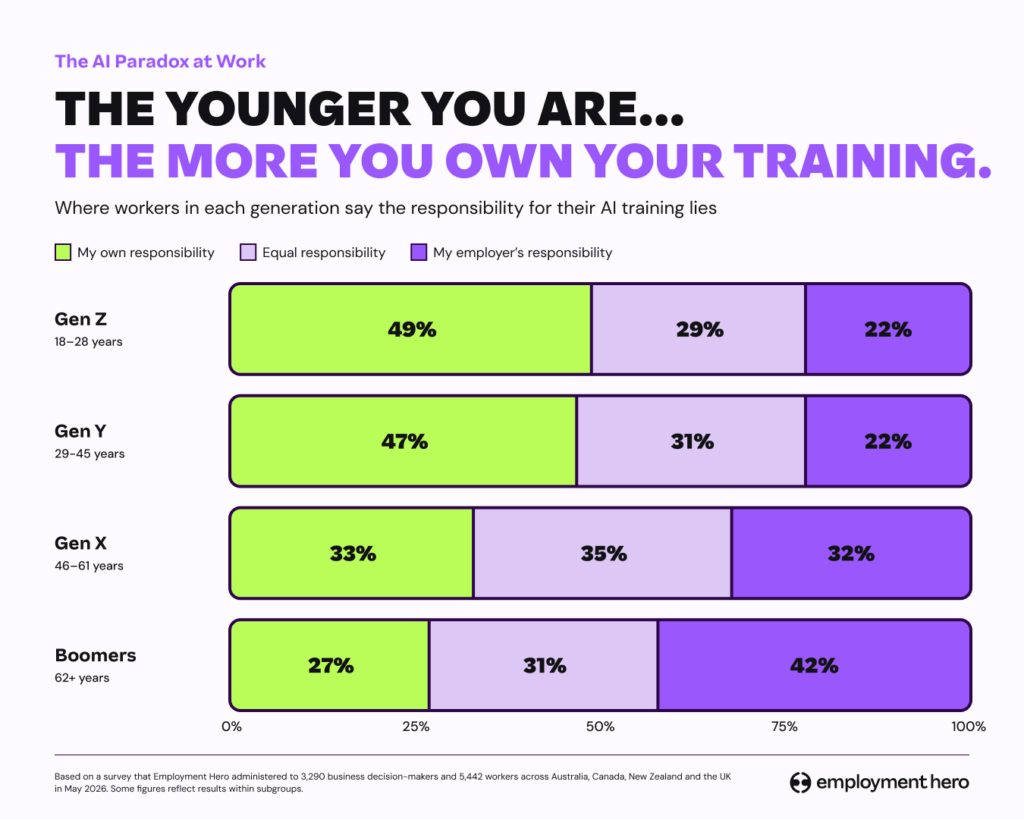
Half of the workforce say their employer is doing little or nothing to help them develop AI skills. 41% think AI upskilling is their own responsibility, compared to 27% who put it on the employer. 32% are undecided and believe it’s a mix of both.
The most unexpected part of this picture is where that self-responsibility is concentrated. 18-24-year-olds are the ones entering a job market that rank AI skills above a degree, are 1.8 times more likely than 55+ to put the training burden on themselves.
38% of businesses run formal training programs on AI. Among businesses with AI at the core of their operations, nearly two in three do.
Where is the workforce actually learning AI? More than half use social media platforms like YouTube, TikTok, Reddit and Discord. Employees are showing a real interest to upskill in AI providing businesses with an opportunity to provide support and guidance to help drive business growth.
4
The Cheating Feeling
Employees feel guilty about using AI
Interestingly, there’s a disconnect between employers who believe their team views AI positively, and the sheer number of employees who feel like they are ‘cheating’ by using it.
60% of employers think their employees view AI positively. Meanwhile, 42% of AI-using employees say doing so feels like cheating. 65% of employers say AI is accelerating their business and allowing them to work faster. 63% of employees say AI has created more work checking outputs.
60%
of employers think employees view AI positively.
42%
of AI-using employees say using AI feels like cheating.
While the technology is the same, the day to day experiences are different.
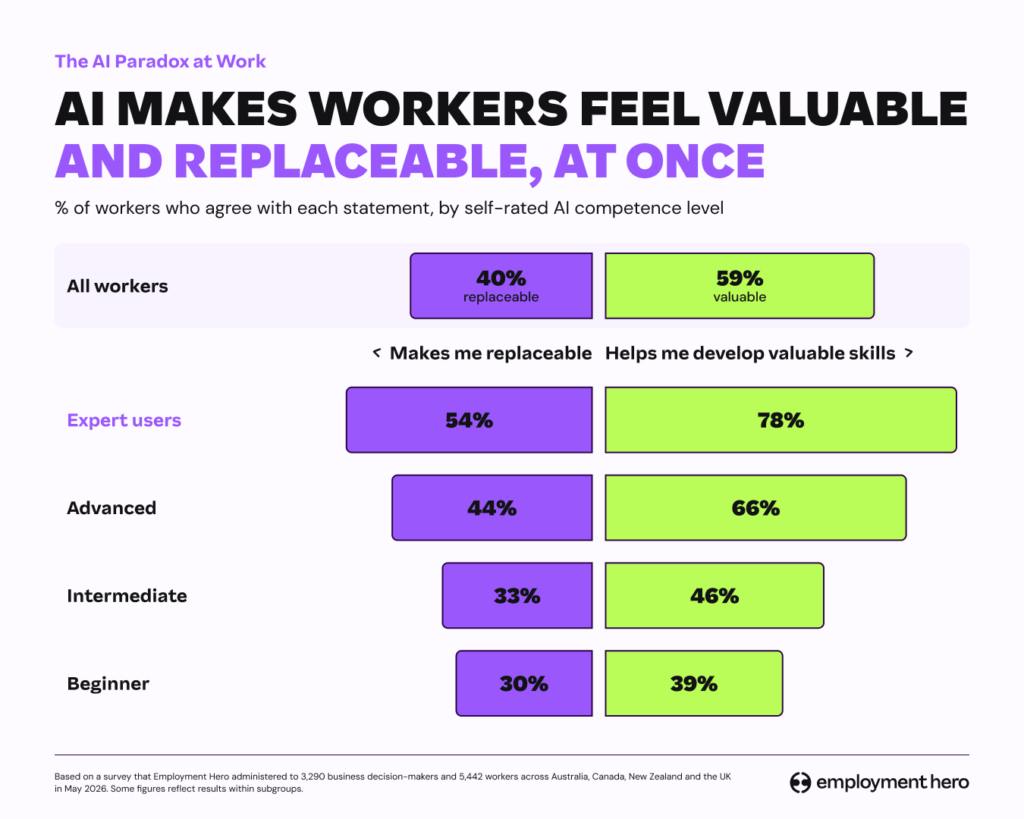
The conflict is sharpest among the workforce’s AI experts. They are more likely than the average worker to say AI is building valuable skills (78% vs 59%) and producing higher quality work (87% vs 73%). They are also more likely to feel replaceable (54% vs 40%) and more vulnerable to layoffs. The closer employees get to AI, the more they see it as both a promise and a threat.
5
The Dividend Divide
AI is as powerful as the person using it
The productivity dividend isn’t experienced evenly. 87% of expert AI users say AI has enabled more time for high-impact work. Among beginners, that drops to 35%.
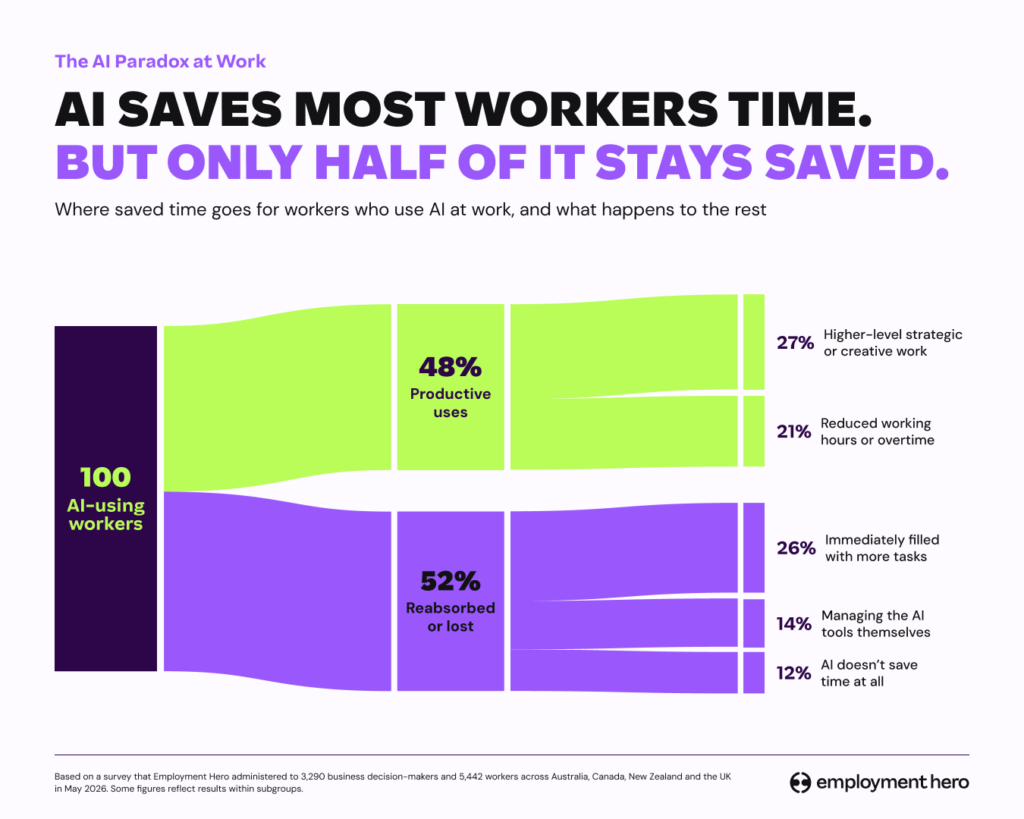
Nearly three in four employees say AI has boosted their productivity. But only one in four say the boost has been significant. For those who are saving time, where is it going? Roughly a quarter (27%) are redirecting it into higher-level strategic or creative work. Almost as many (26%) say it simply flows into more tasks. 14% spend it managing the AI itself. Only 21% say it has allowed them to work fewer hours.
And for 12% of employees, AI doesn’t save time at all.
The gap is just as visible on the business side. Advanced AI firms are more than twice as likely as non-adopters to report productivity gains.
The opportunity
The playing field is levelling
The opportunity here is bigger than the headlines have made room for.
AI is starting to act as an equaliser. 39% of small businesses report cost savings from AI, almost identical to the 41% at large enterprises. Productivity gains scale with how well people use the tools, not with how big the company is.
For small and medium businesses, this is a chance to compete on terms that used to belong to bigger players.
The businesses that get there first won’t be the ones with the most AI. They’ll be the ones whose people get the most out of it.
Regional Spotlights
Browse the voices, statistics, and comparisons from each of the four markets in this study.
Methodology
Source: Employment Hero, The AI Paradox at Work (2026). Survey of 3,290 business leaders and 5,454 employees across Australia, Canada, New Zealand, and the UK. Conducted with Focaldata between 23rd April – 7th May.
