
















Employment Uncovered: Inside the Story of New Zealand Work in 2025
Inside the story of New Zealand work in 2025. From the rise in ‘sickies’, and annual leave left untouched, see how work patterns are shifting.
Contents
After a demanding year, Kiwi workers are heading into 2026 tired, restless and ready for change.
It’s a contrast that feels distinctly New Zealand in 2025: a workforce under pressure, stretched thin by inconsistent rest, patchy hiring experiences and clarity in expectations yet more determined than ever to shape work on their own terms.
For many, the year was defined by missed leave, rising emotional strain, an increasingly difficult recruitment landscape and a renewed appetite for flexibility. But beneath that fatigue sits something more hopeful: a clearer understanding of what workers need to thrive, and a stronger willingness to pursue it.
Insights from Employment Hero’s Employment Uncovered survey offer a detailed picture of these shifting patterns. Drawing on aggregated and anonymised insights from more than 70,000 employee records across small businesses and a national survey of 500 Kiwi workers, the findings reveal a year where exhaustion rose, mobility surged and trust in the hiring process wavered, but workers continued to show resilience, ambition and a renewed focus on fairness.
Annual Leave left at the Office
On paper, 2025 offered opportunities for rest, but for many New Zealanders, that rest didn’t fully materialise.
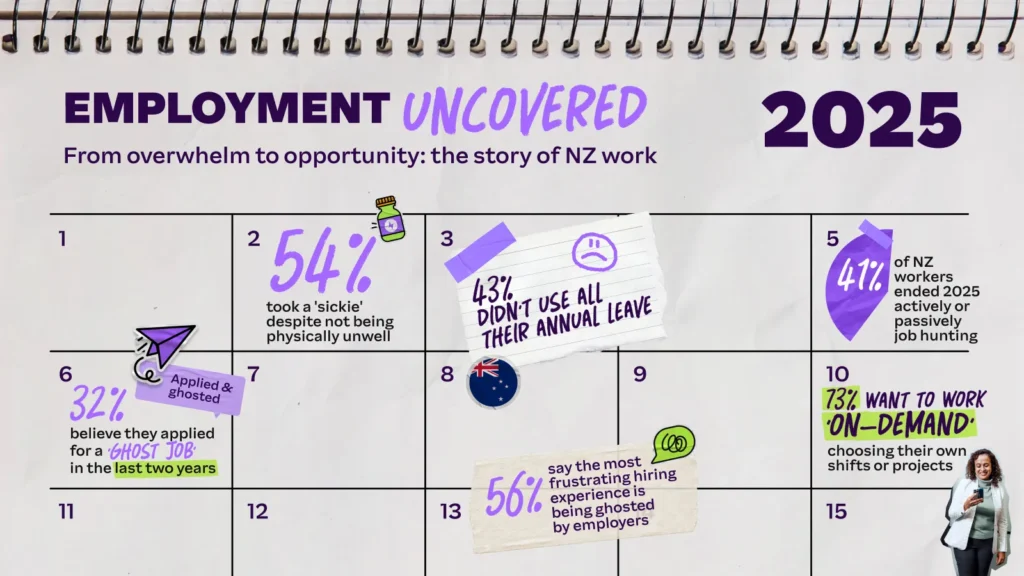
Forty-three percent of workers missed out on some of their annual leave, and younger workers struggled most. Nearly half (49%) of 18–34-year-olds said they didn’t take their full entitlement. Those who changed jobs this year were hit even harder, with 54% missing out on leave during transitions.
Sickies as a Last Resort for Real Downtime
One of the clearest signs of accumulated strain comes from how New Zealanders used their sick leave in 2025.
More than half of all workers (54%) said they took at least one “sickie” despite not being physically unwell and 40% did this more than once. Full-time employees were particularly likely to use sick days for rest (65%), while only 21% of self-employed workers did the same.
When asked why, workers pointed overwhelmingly to burnout and emotional fatigue:
- 49%: felt mentally or emotionally burnt out
- 41%: felt overwhelmed and needed a break
- 33%: caregiving or family responsibilities
- 18%: life admin
- 10%: social commitments or extending weekends/holidays
Younger workers were again more likely to use sick days for emotional recovery, suggesting that for many, traditional leave simply hasn’t been enough to reset.
Sick days have increasingly become the fallback option for genuine downtime, a signal that the country’s recovery systems aren’t keeping pace with rising pressure.
A Year Marked by Job Hunting and Job Switching
Kiwis didn’t just think about change in 2025, they acted on it.
By year’s end:
- 57% had searched for a new job
- 37% had applied for one
- 26% had started a new job or new role
But transitions weren’t always smooth. One in four (25%) who started a new job said their onboarding experience was bad. Poor onboarding experiences were particularly challenging for workers trying to find stability in the middle of a career shift.
The story behind these numbers is one of a workforce increasingly motivated to find working conditions that align with their priorities around flexibility but frustrated by inconsistent recruitment experiences.
A Hiring Landscape Wearing People Down
Perhaps the strongest theme to emerge from New Zealand’s data is rising frustration with the hiring process.
Twenty-eight percent of workers said securing their current role was difficult and this jumps to 36% for those who joined a new company in 2025. Younger workers feel this challenge most intensely; those aged 18–34 were 68% more likely to struggle than older workers.
Common pain points appeared repeatedly:
- No salary listed (44%)
- Vague or jargon-heavy job ads (39%)
- Unrealistic skill expectations (33%)
- Algorithm-suggested jobs requiring skills they don’t have (30%)
- Ghost jobs (19%)
The emotional toll is significant. Six in ten (62%) workers say they’ve been discouraged from looking for new roles because the hiring process feels too draining, and this rises to 70% among younger workers.
And one issue remains at the top of the list:
56% say the worst part of job hunting is simply never hearing back.
Paperwork (26%), long delays (48%), and impersonal automated rejections (40%) also contributed to a system that feels slow, disconnected and increasingly misaligned with worker expectations.
Ghost jobs (roles that disappear without explanation) are rising too. One in three (32%) suspect they’ve applied for one, and among those who’ve been in a hiring process in the past two years, that figure rises to 45%.
A Workforce Redefining Flexibility, Technology and Control
Despite the challenges of 2025, New Zealanders are thinking ahead and embracing new models of work.
A move toward on-demand flexibility
A striking 73% of workers would prefer to work on-demand, picking up shifts or projects through digital platforms if the work remained consistent. Among younger workers, this rises to 80%.
Flexibility still matters more than money, but not for everyone
Thirty-nine percent would accept lower pay in exchange for greater flexibility.
But interestingly, a larger group (53%) said they would prefer slightly higher pay even if it meant reduced flexibility, a sign that financial pressures are shaping workers’ priorities more sharply than in the past.
AI is gaining traction, but unevenly
AI has become part of daily work for many:
- 21% use AI daily
- 36% use it weekly
- 52% of those who started new roles this year use AI weekly
Workers under 45 are twice as likely to use AI as those over 45, but employers aren’t consistently supporting this shift. Just 47% of workers say their organisation encourages AI use, while 38% say their employer is indifferent. Another 6% say their employer discourages it entirely.
Skills for the future
Workers see two key skill groups emerging:
- Digital & data (29%), and
- Human-centric, care-focused capabilities (also 29%), including empathy and wellbeing
Business and financial skills follow at 19%. This blend shows that Kiwis see the future of work as both technologically progressive and deeply people-centred.
Preparing for 2026
Employment Uncovered paints a picture of a workforce that is stretched yet striving, one that felt the weight of 2025 but remained committed to progress.
New Zealanders didn’t always rest well this year, and many struggled to disconnect. They faced increasingly demanding hiring processes, patchy onboarding and rising emotional strain. But they also explored new roles, embraced digital tools, and made clear what they value most: flexibility, wellbeing, and greater control over how they work.
As businesses move into 2026, the priorities come into sharp focus:
Support real downtime. Simplify hiring. Strengthen onboarding. Embrace technology. And design work environments that give Kiwis the balance and autonomy they’re seeking.
Employers who respond to these needs will stand out in the year ahead. Those who don’t may find themselves falling behind as workers continue their search for environments that match their expectations.
Related Resources
-
 Read more: Essential guide to contract management
Essential guide to contract management
Understand contract management from creation to renewal, and why the right software is essential for reducing risk and getting your…
-
 Read more: Guide to long service leave in New Zealand
Guide to long service leave in New Zealand
Learn about long service leave entitlements, pay rates and regulations.
-
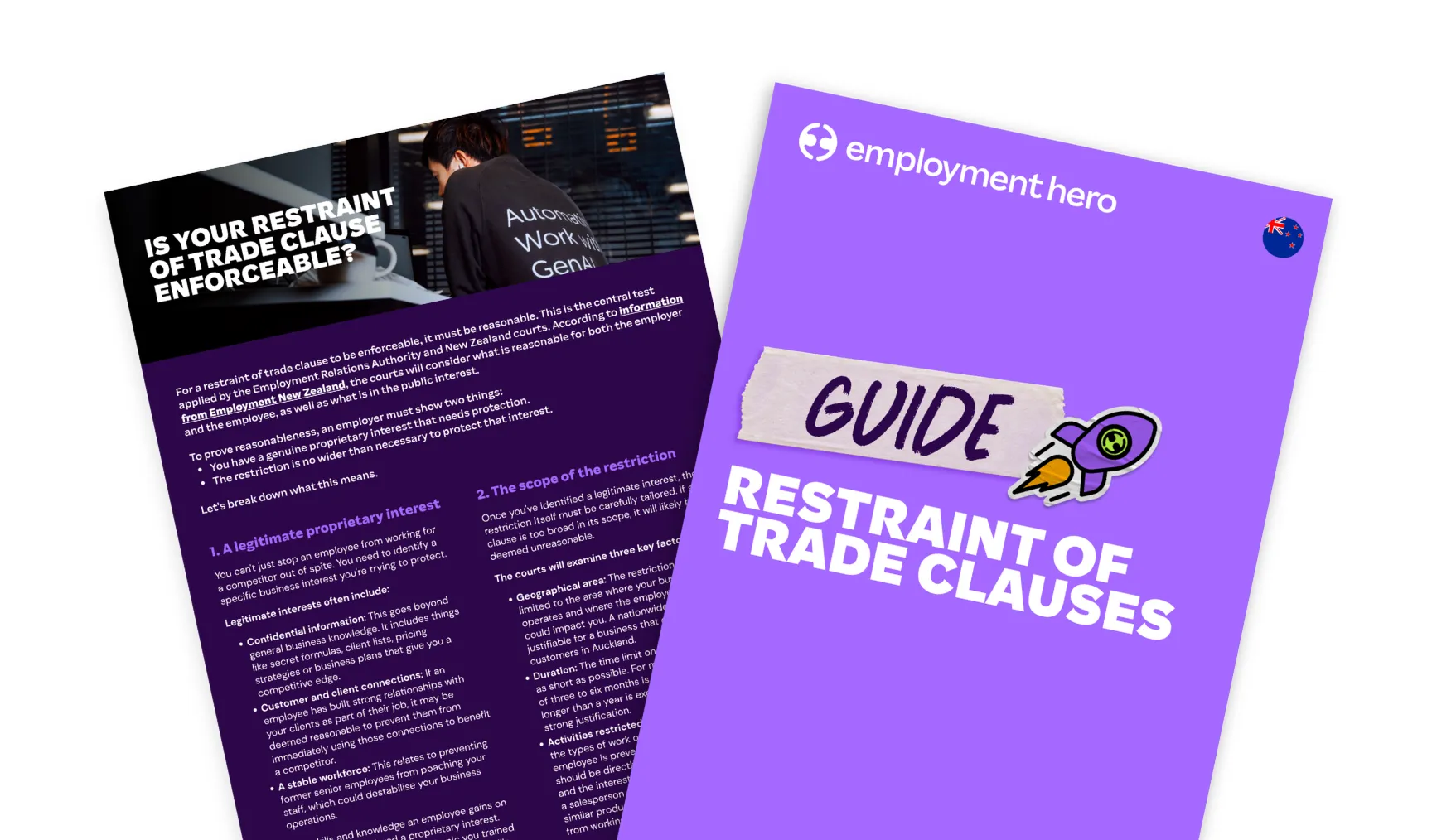 Read more: Guide to restraint of trade clauses in New Zealand
Guide to restraint of trade clauses in New Zealand
A straightforward guide to restraint of trade clauses, enforceability and protecting your trade secrets.

