 Australia
  United Kingdom
  Singapore
  Malaysia
  Canada (Français)
 New Zealand



The ultimate employee engagement guide
Last Updated
The ultimate employee engagement guide
Last Updated
There are many benefits to having an engaged workforce. Not only do engaged employees perform better, but you’ll also see stronger retention and a healthier workplace culture overall.
Employee engagement is the enthusiasm and connection your people hold for your business. It’s what drives motivation, effort and commitment, three things every leader wants to see from their team. And it all starts with the decisions made at the top.
Read on for a practical deep dive into what employee engagement is, what it’s made of, and how to build more of it in your organisation.
What is in this employee engagement guide?
Employee engagement has a direct impact on business outcomes and high employee churn comes with a real cost. Our whitepaper will show you how an engaged workforce boosts productivity and drives profitability. Here’s what you’ll learn:
- How strong leadership can lift employee engagement levels
- The connection between employee engagement and revenue growth
- How employee engagement can benefit your business, and a whole lot more
Download the guide by filling out the form on the right.
What is employee engagement?
Employee engagement is a measure of motivation, specifically whether your team is willing to go the extra mile to help your business perform and grow. It’s also a strong signal of commitment. Highly engaged employees bring more value to their work, help shape a stronger culture and lift morale and satisfaction for the people around them.
Types of employee engagement
There’s no single formula for building an engaged workforce. Most organisations find success by focusing on a combination of approaches and putting real effort into the areas that matter most to their team. The main types of employee engagement include:
- Clearly defining your organisation’s values
- Making a shared purpose
- Ensuring a positive and safe work environment
- Motivating employees with rewards
- Caring for health and wellbeing (physical and mental)
- Defining individual employee roles
- Nurturing employee relationships
- Maintaining clear communication channels
- Creating and fostering leaders
- Fostering personal development
- Psychological Safety: Allowing the employees to be themselves in the work environment
When leadership genuinely commits to these areas, a culture of engagement follows. Employees who connect with company values and feel a shared sense of purpose are far more likely to give their best, and that benefits everyone.
Why is employee engagement important?
Engaged employees are energised, motivated and better equipped to maintain positive mental health. They go the extra mile without being asked and raise the bar of what your business delivers.
The benefits go both ways. Engaged employees are happier and more fulfilled at work. They’re focused on what they’re doing, not watching the clock. An engaged workforce is one of the most valuable assets a business can have.
Key benefits of implementing employee engagement initiatives
Think about it the same way you think about customer experience: when people feel valued, they stay. Invest in the right initiatives and you’ll see:
- Increased productivity and stronger individual performance
- Better relationships between team members and clients
- Greater profitability
- Higher employee retention
- More collaborative, dynamic teamwork
The more intentional you are about designing, implementing and reviewing your engagement practices, the better the results.
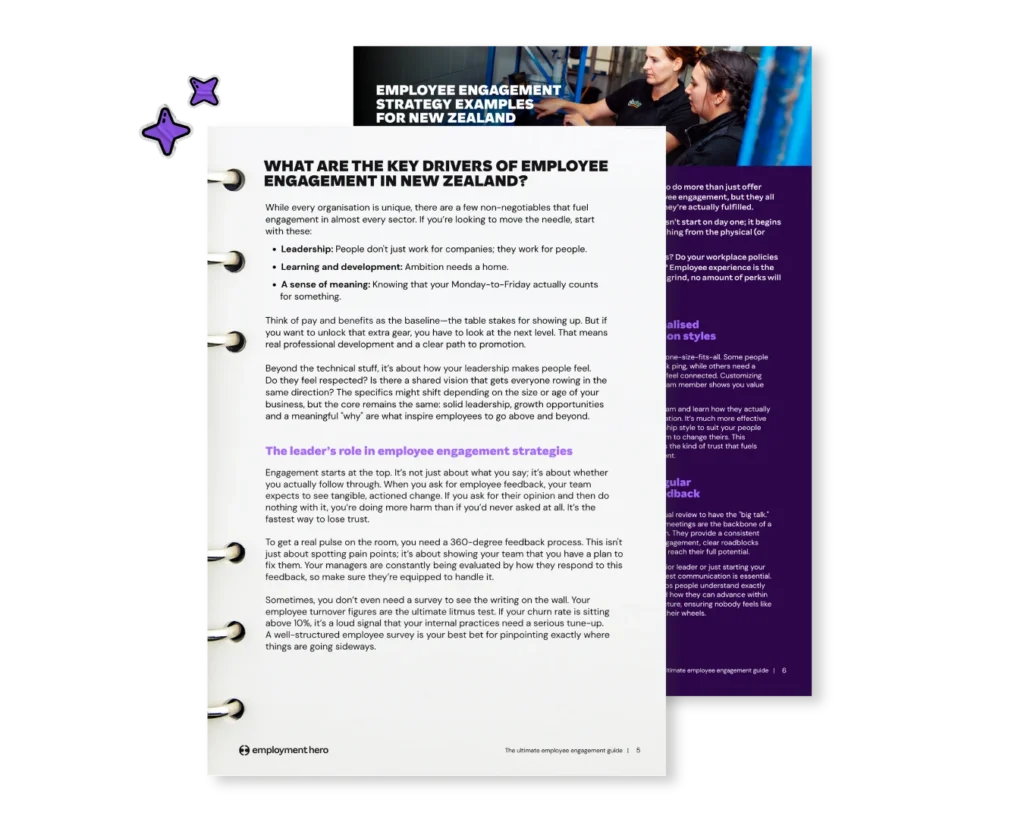
What are the key drivers of employee engagement?
Engagement drivers vary by organisation but a few things consistently make the biggest difference across industries:
- Leadership
- Learning and development opportunities
- A sense of meaning at work
- Pay and benefits
Beyond the basics, leadership style, the opportunity to progress and a clear, shared vision are what separate good workplaces from great ones. The specifics will shift depending on your team’s size, age and culture, but getting these fundamentals right gives you a strong foundation to build from.
The leader’s role in employee engagement strategies
Leadership behaviour shapes engagement more than almost anything else. When leaders ask for feedback and act on it, trust grows. When they ask and do nothing, it erodes fast. Ignoring employee feedback is more damaging than never asking for it in the first place.
A 360-degree feedback process helps you understand pain points across the organisation and shows employees that you’re committed to real change. Keep a close eye on your turnover figures too. A churn rate above 10% is a clear signal that something needs attention. An employee survey is often the best place to start diagnosing where things are going wrong.
Employee engagement strategy examples
Building genuine engagement goes beyond perks and pay. It starts before someone even applies for a role, from your employer brand and hiring process through to your day-to-day culture and the tools you give people to do their jobs well.
Ask yourself: do your policies reflect what today’s workforce actually needs? Do your employees have the right technology to work effectively? Is the experience you’re creating one that people genuinely want to be part of? Getting the employee experience right is the most direct path to stronger engagement.
Different ways you can conduct an employee engagement survey
Now that you know what an employee engagement survey is, it’s time to move on to how you can conduct one. Here are some different ways you can get employee feedback through an employee engagement survey:
- Use employee engagement software
- Send out paper surveys
- Host focus groups
- Do one-on-one interviews
Each of these methods has its own pros and cons, so it’s important to choose the one that will work best for your business. For example, if you have a large team, conducting focus groups or one-on-one interviews might not be practical. In this case, using employee engagement solutions would be more effective.
Employee engagement survey questions
The questions you ask matter. Avoid yes/no formats and stick to scales and open-ended questions instead, as you’ll get far more useful responses. Make sure all surveys are completely anonymous and encourage your team to be as open and honest as possible.
Career goals survey questions
- I can see myself working here in five years. (This is useful for understanding intent to stay, even for employees who aren’t actively job hunting elsewhere.)
- I always want to give my best when I’m at work.
- I’m proud to be a part of this company.
- I would recommend this company to others. (Your most engaged employees should be your best advocates, for recruitment and referrals alike.)
- I rarely think about looking for a new role. (A strong signal of genuine engagement.)
Career development survey questions
- I have access to what I need to do my job well. (A simple but important check. The answer should always be yes.)
- I have access to the learning and development opportunities I need. (L&D is one of the biggest drivers of engagement across most industries.)
- Most of our systems and processes support us in getting work done effectively.
- I know what I need to do to succeed in my role. (Clarity is the foundation everything else is built on.)
- I receive meaningful recognition when I do good work. (Recognition fuels motivation. Without it, engagement drops.)
Leadership survey questions
- My manager recognises my strengths and helps me use them.
- I trust that the leadership team knows what they’re doing. (Employees need to believe in the people above them.)
- My manager is a good role model.
- The leadership team at this company communicates well.
How to engage your team
1. Prioritise results over working hours
Move away from measuring input and focus on output instead. The number of hours someone spends at their desk is rarely the best measure of their contribution. An outcome-focused culture empowers employees to work in a way that suits them, which is good for both satisfaction and productivity. Flexible and remote working arrangements are a natural extension of this approach.
2. Engage employees with rewards and recognition
Recognition is one of the most effective tools in your engagement toolkit. For every piece of critical feedback an employee receives, six pieces of positive reinforcement should counterbalance it. If people don’t feel appreciated, engagement drops quickly and loyalty follows.
Recognition needs to be embedded in your culture, not saved for the end-of-year function. Equip managers and employees with the tools to acknowledge great work as it happens. Employment Hero’s Hero Points make this easy, offering a simple and flexible way to reward people for milestones, big wins and everyday contributions with something they’ll actually value.
3. Use personalised communication styles
How you communicate is just as important as what you communicate. Take the time to understand how each employee prefers to receive information and feedback, then adjust your approach to suit them rather than expecting them to adapt. This matters at every level of management, which is why it’s worth building communication awareness into your leadership development.
4. Provide regular employee feedback
Consistent one-on-ones are one of the simplest and most effective engagement tools available. Regular feedback helps employees understand where they stand, where they’re headed and how to get there. It keeps communication flowing in both directions, and that’s what high-performing teams are built on.
5. Use an employee engagement software
Employment Hero brings all of this together in one place. Our engagement tools make it easier to track what’s actually happening across your organisation and take action on it. Key features include:
- Employee self-service portal, where employees can manage leave, view payslips and update their own details, reducing admin and building autonomy
- Employment Hero Work app, where employees can manage timesheets, leave and contacts on the go
- Manager dashboard, a recognition tool that lets people publicly celebrate colleagues and keep the whole organisation connected
- Custom surveys, so you can create, send and analyse surveys tailored to your business and compare results against your outcomes over time
- Happiness scores, an anonymous monthly pulse check to understand how your team is really feeling
- Peer-to-peer feedback, which empowers employees to recognise each other and build a culture of genuine appreciation
Book a demo with one of our business specialists to see how it works in practice.
Engaged employees – the key competitive differentiator
Great engagement isn’t built by a single initiative. It takes consistent communication, a clear sense of purpose, genuine collaboration and ongoing investment in your people. Make use of the tools available to help your team communicate openly and work together seamlessly, and you’ll see the culture follow.
Download our guide now to learn more about creating a team of highly engaged employees.
Register for the guide
Related Resources
-
 Read more: The AI Adoption Blueprint
The AI Adoption Blueprint
What does it take to embed AI across an entire team? We’re sharing our training, our policies, and the lessons…
-
 Read more: Employment Essentials: AI Best Practices
Employment Essentials: AI Best Practices
Learn how to use AI in HR without creating privacy, compliance or employment risks in our latest webinar.
-
 Read more: The High Performance Series: The Power of Recovery
The High Performance Series: The Power of Recovery
Learn how elite teams manage recovery and prevent burnout. Join Employment Hero and The Blues for practical HR mental health…

