
















The 2026 employee benefits trends to look out for
Contents
The employment landscape and expectations of employees in New Zealand is shifting. As we look toward 2026, the traditional list of perks, like a fruit bowl in the kitchen or a subsidised gym membership, doesn’t carry the weight it once did. Kiwi employees are scrutinising what their employers bring to the table beyond the salary. They want security, flexibility and genuine support for their wellbeing.
Staying ahead of these trends is a strategic necessity for New Zealand employers. The battle for the best talent remains fierce across many sectors, and retaining the skilled people you already have is far more cost-effective than recruiting new ones.
In 2026, we expect to see a move towards hyper-personalisation, financial wellness and a deeper integration of flexible working arrangements that go beyond just working from home. Let’s explore the key trends shaping benefits strategies for the year ahead and how you can adapt your offering to meet these evolving expectations.
Trend 1: The rise of financial wellness support
We’re all feeling the pinch. The cost of living crisis has left a lasting impact on New Zealand households and financial stress is a significant distraction for employees. It impacts productivity, engagement and overall mental health. In response, forward-thinking employers are moving beyond standard remuneration reviews to offer comprehensive financial wellness support.
This doesn’t necessarily mean handing out pay rises across the board, although fair pay remains the baseline. Instead, it involves providing tools and resources that help staff manage their money better.
We’re seeing more companies partnering with financial advisers to offer free consultation sessions or workshops on budgeting, KiwiSaver optimisation and mortgage structuring. Others are offering discounts on essential services like insurance or utilities through corporate partnerships. By alleviating financial anxiety, you allow your team to focus on their work with a clearer mind.
Trend 2: Flexibility 2.0 (autonomy over location)
The “work from home” debate has settled into a new reality. It is no longer about whether we work remotely but how we structure that flexibility to benefit everyone. In 2026, the trend is moving toward autonomy. Employees value the trust to choose where they work best, whether that is a collaborative day in the office or a focus day at home.
However, true flexibility goes further than location. It includes flexibility of time. Giving your employees the opportunity to flex their working hours to balance their commitments demonstrates a trust in their ability to get their work done, while making their life that little bit easier. Compressed working hours, such as working a nine-day fortnight, are also becoming a popular alternative for employers where this kind of option is possible.
If you are considering changes to working arrangements, it is crucial to stay aligned with Employment New Zealand guidelines regarding flexible working requests. The law provides a framework for these discussions but the most successful businesses are those that proactively offer flexibility rather than waiting for a formal request. This proactive approach signals trust and respect, two pillars of a strong workplace culture.
Trend 3: Health insurance is a popular perk
Private health insurance used to be a perk reserved for executive tiers but that’s changing rapidly. With pressure on the public health system, employees are placing a higher value on immediate access to medical care. Offering fully funded or subsidised health insurance for staff (and sometimes their families) is becoming a standard expectation for mid-sized businesses looking to compete for talent.
This trend extends to mental health support. Access to EAP (Employee Assistance Programmes) is now the minimum standard. Leading employers are supplementing this with proactive mental health days, subscriptions to wellness apps and specific allowances for wellbeing activities.
It is worth noting that providing these benefits requires clear communication. Often, employees are unaware of the full extent of their coverage. A benefits strategy is only effective if your team knows how to use it. Regular reminders and easy-to-access information hubs are essential to ensure uptake and value perception.
Trend 4: Personalised “lifestyle” accounts
One size rarely fits all. A young graduate might value a transport subsidy or student loan assistance, while a parent might prioritise childcare support or extra leave during school holidays. This diversity of needs is driving the adoption of “lifestyle spending accounts”.
Instead of prescribing specific benefits, employers may allocate a set budget per employee that can be spent on a range of pre-approved categories. One person might use their allowance for gym membership, another for professional development courses and a third for a hobby class.
This approach puts the power in the hands of the employee. It demonstrates that you see them as individuals with unique lives outside of work. It also simplifies administration for you. Rather than managing ten different vendor relationships for ten different perks, you manage one allocation system. This flexibility is particularly attractive to a multi-generational workforce where priorities vary significantly.
Trend 5: More inclusive support for parents and individuals
New Zealand’s statutory parental leave provisions are a safety net, but they often fall short of maintaining a family’s standard of living. Employers who top up government paid parental leave to full salary for a period are winning the loyalty of their staff.
We are also seeing a compassionate expansion of what “family support” looks like. This includes specific leave policies for fertility treatments, surrogacy and adoption. Recognising that the path to parenthood isn’t always linear creates a deeply supportive environment.
Furthermore, support for menopause is emerging as a critical trend. Women over 45 are a rapidly growing demographic in the workforce, yet symptoms of menopause can be debilitating and often lead to skilled women leaving their roles prematurely. Introducing specific menopause policies,such as flexible uniform requirements, temperature control considerations or specific medical leave,shows a commitment to inclusivity and retaining experienced talent.
Trend 6: Sustainable and ethical benefits
Employees, particularly younger generations, are increasingly values-driven. They want to work for organisations that align with their personal ethics. This extends to the benefits package.
We are seeing a rise in “green benefits”. This could be incentives for using public transport, subsidies for purchasing e-bikes or electric vehicles, or extra leave days for volunteering with environmental charities.
Offering a scheme where the company matches employee donations to registered charities is another powerful way to connect. It fosters a sense of shared purpose and community contribution. When staff feel their work contributes to a greater good, their engagement and job satisfaction invariably rise.
Creating your 2026 benefits strategy
Building a competitive benefits package doesn’t require an unlimited budget, but it does require some research. Before you invest in new perks, ask your team what they actually value. Run anonymous surveys or hold focus groups to understand their pain points. You might be surprised to find that a paid day off on their birthday is valued more highly than a complex rewards platform.
Once you have your insights, examine the four main focuses of common company benefits: financial security, health, flexibility and professional growth. If you can offer something meaningful in each of these pillars, you’ll be well-placed to attract and retain the people who will drive your business forward.
Remember to keep compliance in mind. Any changes to employment agreements or remuneration packages must adhere to the regulations set out by the Ministry of Business, Innovation and Employment (MBIE). Ensuring your contracts are updated and compliant protects both you and your employees.
The trends for 2026 are clear. It is about treating employees as whole people, not just workers. It is about providing the stability they need to live well, so they can work well. By adopting a human-centric approach to your benefits strategy, you build a resilient, loyal and high-performing workforce ready for whatever the future holds.
Get a first-hand look at how Employment Hero can empower your team
Employment Hero’s Employment Operating System is designed to support New Zealand businesses in everything HR, people and payroll. From effective digital surveys to one-to-one meeting frameworks, our software enables the communication you need to create the best benefits for your team. We also offer an EAP service with our platform that you can offer to your team when they need it.
Find out how our platform can transform your organisation and build a thriving workplace culture by booking a demo with one of our team today.
The information in this article is current as at 30 December 2025, and has been prepared by Employment Hero Pty Ltd (ABN 11 160 047 709) and its related bodies corporate (Employment Hero). The views expressed in this article are general information only, are provided in good faith to assist employers and their employees, and should not be relied on as professional advice. Some information is based on data supplied by third parties. While such data is believed to be accurate, it has not been independently verified and no warranties are given that it is complete, accurate, up to date or fit for the purpose for which it is required. Employment Hero does not accept responsibility for any inaccuracy in such data and is not liable for any loss or damages arising directly or indirectly as a result of reliance on, use of or inability to use any information provided in this article. You should undertake your own research and seek professional advice before making any decisions or relying on the information in this article.
Related Resources
-
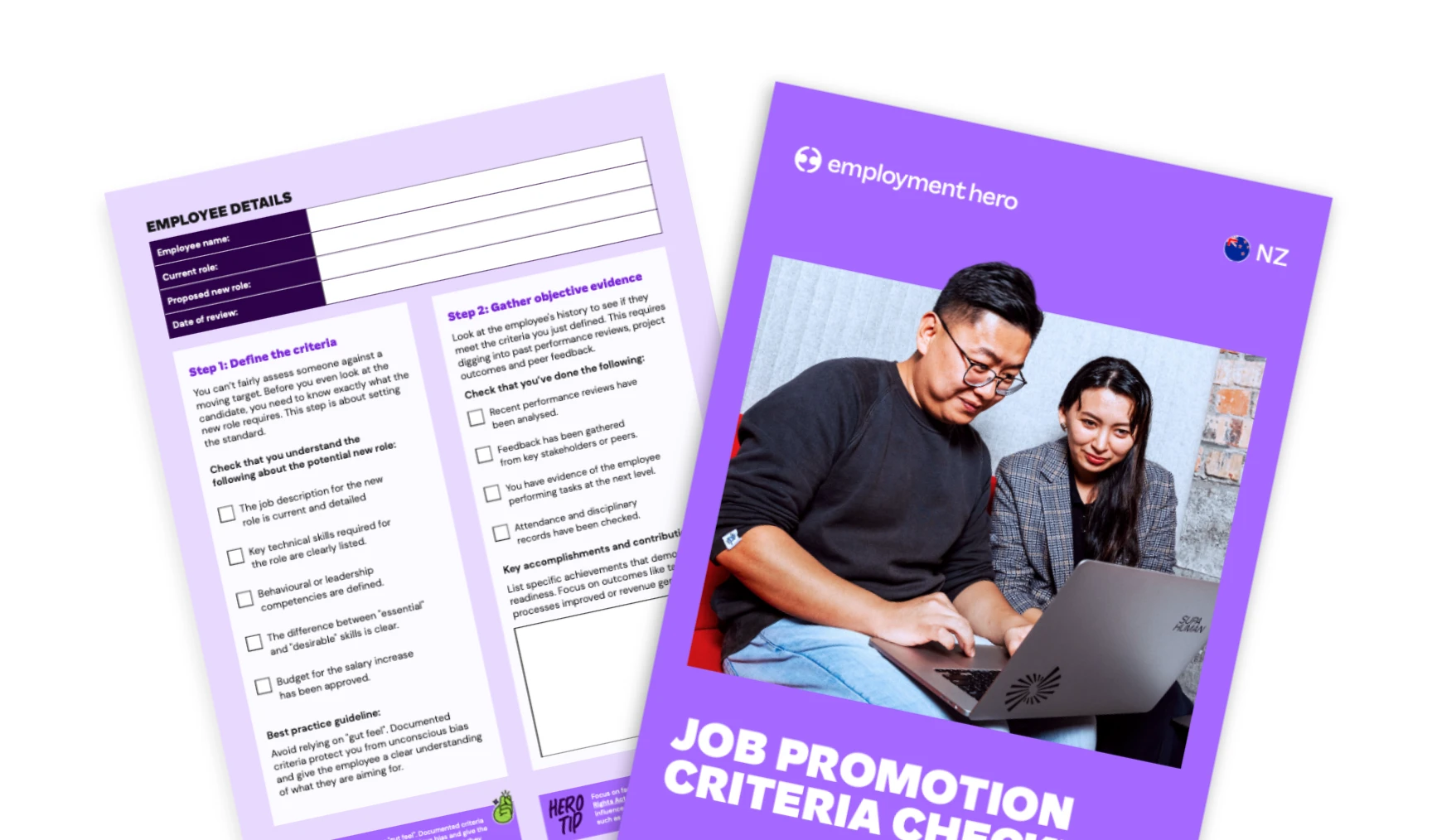 Read more: Job promotion criteria checklist
Job promotion criteria checklist
Promoting staff? Use our checklist to make fair, transparent and smart promotion decisions. Download the checklist now.
-
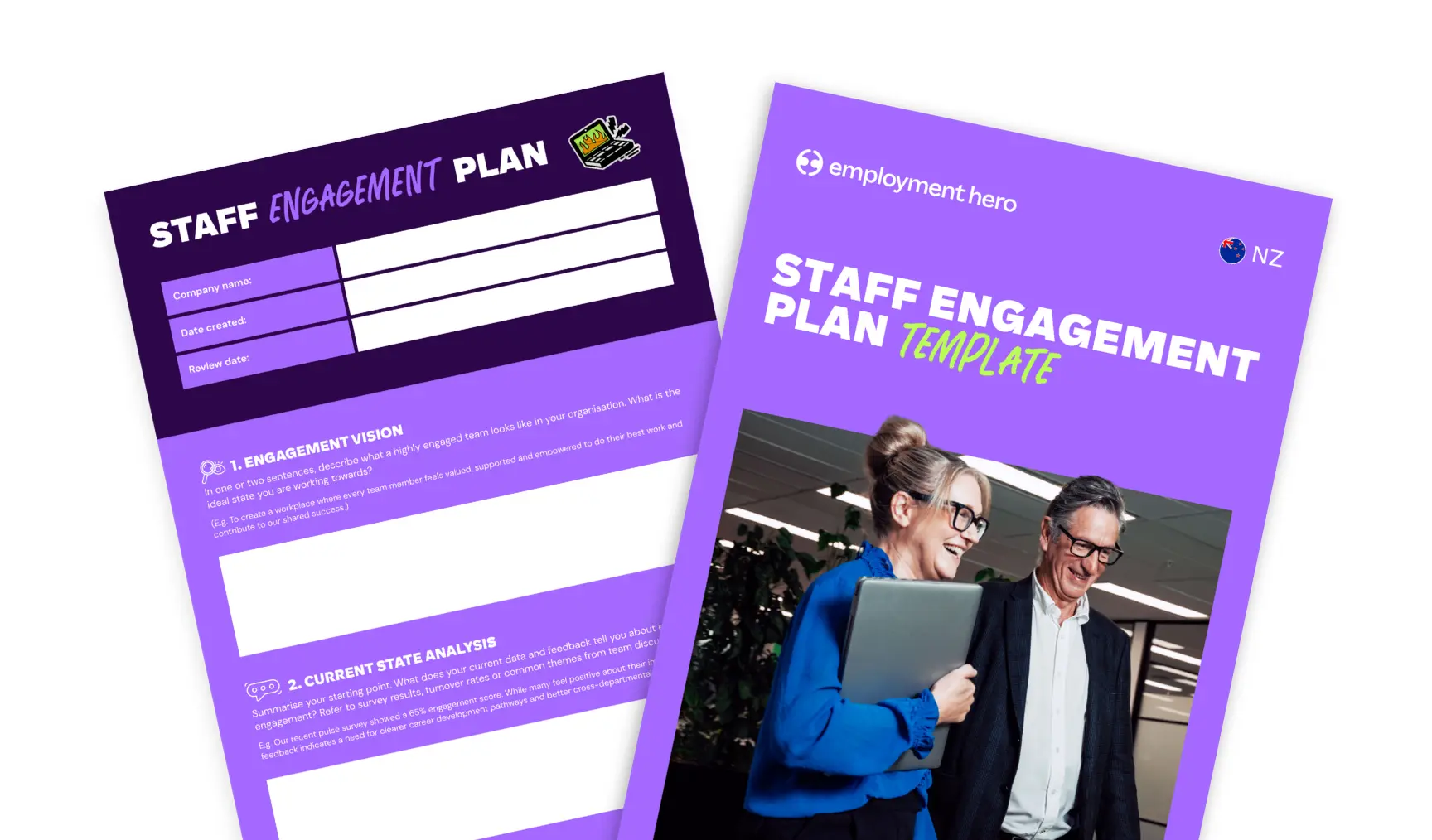 Read more: Staff engagement plan template and guide
Staff engagement plan template and guide
Discover effective strategies for creating a staff engagement plan that drives results. Download our template and guide.
-
 Read more: Employment Relations Act: Key changes explained
Employment Relations Act: Key changes explained
Stay up to date with the latest changes to New Zealand’s Employment Relations Act. Understand what’s new and how it…

