












The New Zealand AI Paradox: How Workers Really Feel

Contents
Ask Kiwi workers how they feel about AI and you get a fairly straight answer: pretty good, actually.
New Zealanders are genuinely optimistic about AI. More than half say it’s helping them build more valuable skills and replacement anxiety is low. Compared to every other market in our new research, New Zealand workers are also the most at ease with AI, carrying the least guilt around its use. That may partly reflect that New Zealand sits lower on the adoption curve but the underlying attitude is positive.
But look closer and a more complicated picture emerges. That same workforce is teaching itself AI through social media, presenting AI-generated work without disclosing it and quietly wondering whether any of this is actually okay. Much of that uncertainty exists because organisations haven’t caught up yet with what their people are already doing.
That is the New Zealand AI paradox: a workforce moving forward on instinct, in workplaces that don’t yet have the frameworks to match. The opportunity for employers lies in closing that gap. Unlike some of the harder problems in the AI conversation, this one is very much within reach.
How do we know this? We surveyed 3,290 business leaders and 5,454 workers across Australia, Canada, New Zealand and the UK, conducted with Focaldata between 23 April and 7 May 2026, with a New Zealand sample of 256 business leaders and 820 workers. These findings are drawn from a regionalised data set of the Employment Hero AI Paradox at Work (2026).
Key findings at a glance
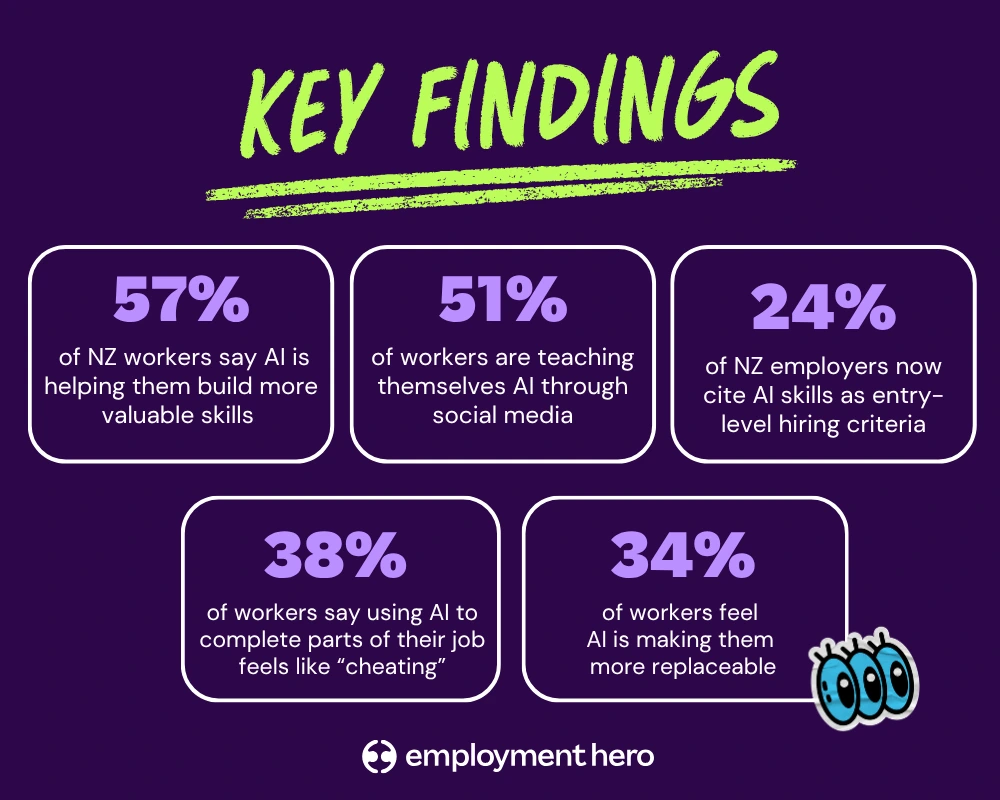
- 57% of NZ workers say AI is helping them develop more valuable skills
- 34% feel AI is making them more replaceable, the lowest of any market surveyed
- 38% say using AI to do parts of their job feels like “cheating”
- 51% of workers are teaching themselves AI through social media
- 24% of NZ employers now cite AI skills as entry-level hiring criteria
- Nearly 1 in 5 (18%) business leaders say new roles will be created due to AI and a further 50% say some existing roles will be re-focused – ~68% expect some form of positive/transformative workforce change vs. outright cuts.
- Only 19% of businesses think their workforce will stay the same over the next 12 months, meaning 81% expect transformation of some kind
- Thriving businesses are more likely to say AI skills are essential when hiring and more likely to say AI is driving innovation, reinforcing the idea that AI maturity correlates with growth rather than contraction.
New Zealand workers are optimistic about AI
57% of New Zealand workers say AI is helping them develop more valuable skills. This is great news: a majority of the workforce says that AI makes them better at what they do.
Replacement anxiety tells a similar story. Only 34% of NZ workers feel AI is making them more replaceable, the lowest figure of any market we surveyed. While the global conversation about AI and job displacement often appears quite dramatic, Kiwi workers are largely reading the situation with their typical “she’ll be right” outlook.
The combination of optimism and low anxiety means that the Kiwi workforce is in a strong position to make the most of AI. The question is whether the organisations they work for are set up to match that energy.
Confidence and uncertainty are travelling together
Here’s where things get interesting. For all the optimism, a significant number of New Zealand employees are navigating AI without a clear sense of where the boundaries are.
38% say using AI to complete parts of their job feels like “cheating.” A similar percentage feel a sense of guilt when they use AI to produce high-quality work and 32% admit to presenting AI-generated work as their own without disclosing it. Notably, the workers who are most competent with AI are also the most conflicted about it.
This isn’t a workforce that’s resistant to AI. It’s a significant proportion of the workforce using it enthusiastically and wondering, quietly, whether that’s okay. The guilt is not coming from the technology. It is coming from an absence of organisational norms around its use.
When workers are uncertain about whether AI use is sanctioned, they tend to keep it to themselves. That creates a data governance risk and a culture where one of the most productivity-enhancing tools available is treated as something to manage carefully.
The organisations that resolve this fastest are the ones that name AI use explicitly. They do this as a cultural signal: this is how we work now and doing it well is something to be proud of.
Kiwi workers want employers to lead on AI development
51% of NZ workers are currently teaching themselves AI skills through social media. That speaks to classic Kiwi initiative: people investing their own time to build capability and find solutions.
What makes this finding particularly notable is how it compares internationally. Unlike every other market we surveyed, where workers tend to see AI development as their own responsibility, New Zealand workers are more likely to place that responsibility with their employer. Kiwi workers are self-starting out of necessity but they’d like their organisations to pick up the lead.
That’s a meaningful opening for employers. Formalising AI development, with clear expectations, structured learning and visibility into what good practice looks like in your specific context, is one of the most effective things an employer can do right now. It creates a retention signal and closes the gap between what workers are doing on their own and what the organisation needs from them.
The employer opportunity is significant
34% of New Zealand employers say AI is helping drive more innovation in their business, while 15% of SMEs describe AI as core to their operations. These numbers point to an adoption curve that is still in its early stages but that’s an encouraging place to be.
Businesses that move now won’t be playing catch-up. They’ll establish the practices, the culture and the internal capability that will compound over time. The organisations most deeply embedding AI today are, in our research, the ones growing headcount fastest. AI adoption and workforce growth are moving together, instead of in opposition.
For New Zealand SMEs in particular, this matters. Small, well-integrated teams that use AI effectively can operate at a scale and pace that was not previously possible. The 15% already there are building an advantage that will be harder to close the longer others wait.
AI skills are becoming a hiring baseline
The hiring data reflects a workforce and employer base that’s moving, even if the pace varies. 24% of NZ employers now cite AI skills as entry-level hiring criteria. 17% say those skills are essential at the point of hire, with a further 33% calling them advantageous. The businesses investing in AI capability internally today are the ones that will be able to set the standard, rather than scramble to meet it.
There’s also a retention dimension here. Employees who feel their employer is actively investing in their AI development have a reason to stay. Given that Kiwi workers are already looking to employers to lead on this, the signal is unusually clear.
What employers can do with this
The New Zealand AI paradox is solvable. A workforce this willing and this low-anxiety is a strong foundation, so here are three things worth prioritising.
Normalise AI use openly
Workers who feel uncertain about whether AI is welcome tend to keep it quiet. Setting clear expectations, naming the tools you want people to use and recognising great AI-assisted work publicly changes that dynamic. The businesses where AI becomes a real competitive advantage are the ones where people share their work and achievements using the tool.
Build what workers are already looking for
New Zealanders are already building AI skills. They’re doing it on their own through social media because they want to. And unlike workers in most other markets, they’re actively looking to their employers to provide a better path. Structured AI learning, tied to your specific business context, creates capability you can see and a retention signal your people will feel.
Treat AI as a strategic priority, not an IT question
The businesses getting the most from AI aren’t the ones that have the best tools. They’re the ones where leadership is investing in AI capability. That means clear direction on how AI fits into how you work, a focus on development and a genuine appetite to learn from what your people are already doing.
New Zealand workers are ready. They’re optimistic, low-anxiety and actively building skills. They’re also looking to their employers to help them do it well. For employers, the opportunity is there for the taking.
Employment Hero is built for businesses that have already decided to take the lead. Our Employment Operating System brings HR, payroll, performance and recruitment into an AI-powered system. It handles compliance, automates pay runs and surfaces the workforce insights that HR teams need to make faster, better decisions.
For HR professionals spending the bulk of their week on admin, that change in where their time goes is significant. The same productivity argument this research makes for workers applies to the people running your people function.
Related Resources
-
 Read more: The New Zealand AI Paradox: How Workers Really Feel
The New Zealand AI Paradox: How Workers Really Feel
Kiwi workers are optimistic about AI, yet 38% think using it feels like “cheating”. We explore that complicated picture.
-
 Read more: An NZ employer’s guide to PEO risk management
An NZ employer’s guide to PEO risk management
HR compliance and payroll risks can cost NZ businesses dearly. Discover how a PEO reduces risk, cuts costs and supports…
-
 Read more: Employer Of Record risks
Employer Of Record risks
Learn the key employer of record risks businesses should consider before choosing a provider.