 Australia
  New Zealand
  United Kingdom
  Singapore
  Malaysia
  Canada (Français)




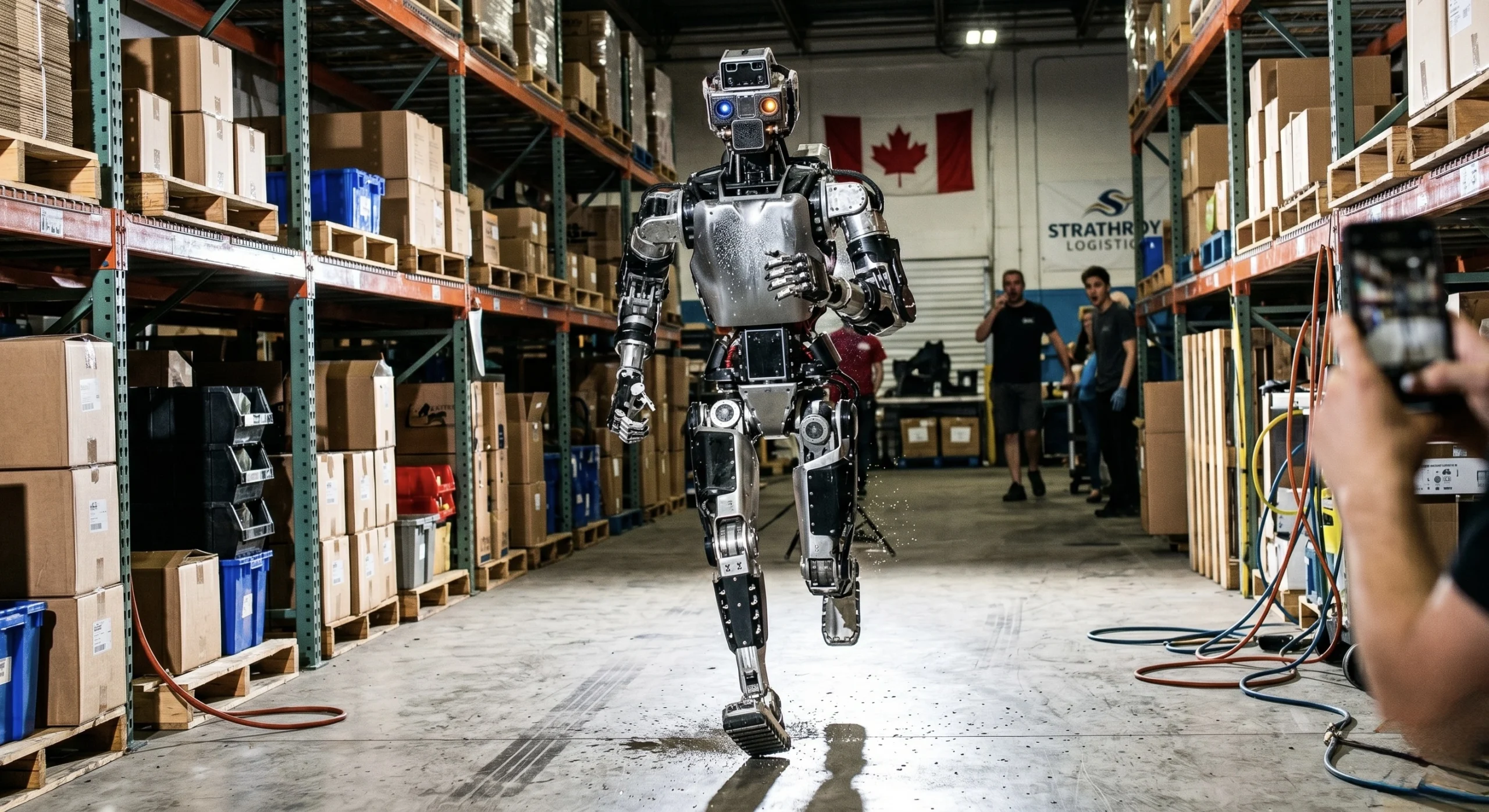
The era of AI being a polite chatbot living in your browser is over. If you’ve been sitting back thinking you have years to prepare for the “robot revolution”, the latest data from the sports world just served a very loud wake-up call. We’re seeing Sony AI’s table tennis robot, Ace, take down professional human players and humanoid runners smash Olympic records in Beijing, as reported by AI News. For Canadian SMB employers, this isn’t just a cool science experiment; it’s an early signal of where the technology could go.
While we’ve all been busy debating how to use AI for better emails, the technology has literally walked out of the lab and onto the track. A robot named Lightning just finished a 21-kilometre half-marathon in 50 minutes and 26 seconds — nearly seven minutes faster than the human world record. This shift represents a huge opportunity for Canadian businesses to ditch the “status quo” and start looking at physical AI as the ultimate tool for productivity, safety and growth.
Why Canadian SMBs should care about a ping-pong robot
It’s tempting to dismiss a table-tennis-playing robot as a high-tech toy, but that’s a mistake that’ll cost you. The tech behind Ace is exactly what’s needed in a busy warehouse or a precision manufacturing plant in Ontario. It uses nine synchronized cameras to track movement and makes decisions faster than the human eye can even process. We’re talking about perception and motor control that doesn’t get tired, doesn’t get distracted and doesn’t need a coffee break.
The speed of improvement is what should really grab your attention. By early 2026, these systems weren’t just participating; they were winning against elite professionals. For an SMB owner, this suggests a future where robots aren’t stuck behind safety glass. In the future, we may see them working more closely alongside humans, handling the high-speed, high-precision tasks that usually lead to human error or burnout. It’s about giving your team the mechanical muscle they need to scale without the traditional headaches of expansion. The real opportunity isn’t replacing people: it’s combining human judgment with machine precision. Physical AI works best when humans remain in the loop, guiding decisions while automation handles repetitive or high-risk tasks.
“The rise of physical AI represents the next great frontier for productivity in the Canadian market,” says KJ Lee, CEO at Employment Hero Canada. “We’re moving into a world where machines can perceive and respond to their environment with more agility than a human expert, which opens up incredible possibilities for SMBs to scale.”
The Beijing Humanoid Half Marathon was a brutal stress test that proved these machines can handle the real world. Over 100 robots competed, and the winning machine, Lightning, even recovered from a collision with a barricade to finish first. That’s the kind of structural reliability we need in Canadian construction, logistics and agriculture. Last year, the fastest robot took over two hours to finish; this year, it took fifty minutes. That’s the kind of exponential growth we’re dealing with.
This isn’t just about speed; it’s about solving the labour shortages that have been a thorn in the side of Canadian small businesses for years. If a humanoid can navigate a 21-kilometre race course autonomously, it suggests these systems could eventually assist in environments like stockrooms or job sites. The liquid-cooling and navigation tech being refined on the racetrack today will be the standard for your industrial tools tomorrow.
“Employers shouldn’t see these developments as a threat to their workforce, but as an opportunity to innovate their operations,” says Lee. “By embracing physical AI, SMBs can offload the most repetitive or dangerous physical tasks, while keeping humans in the loop to oversee, guide and make higher-level decisions.”
Get your business ready for the robotic colleague
If you’re waiting for a formal invitation to join the AI age, this is it. The Sony robot, Ace, was trained in a simulation, meaning it learned strategies that a human coach wouldn’t even think of. It doesn’t have “tells” or emotional signals, which makes it an incredibly consistent and predictable partner for industrial work. This “self-training” capability means that when these systems hit the Canadian market, they’ll be ready to work from day one. And while they may require less traditional training, they will still need thoughtful integration into existing workflows.
Canadian business owners need to stop asking “if” this is happening and start asking “how” they’ll use it. How might your workspace evolve to support these technologies? Have you looked at your safety protocols lately? The winners in the Canadian market won’t be the ones who played it safe and waited for the tech to become “perfect.” They’ll be the ones who saw the potential in a 50-minute half-marathon and decided to lead the charge.
The data from these global trials is a loud and clear message: the gap between human and machine performance is closing fast. Whether it’s a 21-kilometre run or a high-stakes match, the technology is improving rapidly, with meaningful implications for how humans and machines will work together. For Canadian employers, the goal is simple: don’t get left in the dust. Physical AI is a powerful tool that’s about to redefine how we work, build and win.