

















Guide to restraint of trade clauses in New Zealand
Published
Guide to restraint of trade clauses in New Zealand
Published
Restraint of trade clauses are common in employment agreements but they are also commonly misunderstood. For many New Zealand businesses they represent a critical line of defence, protecting valuable company information and customer relationships when an employee leaves. Yet their effectiveness is often debated in court, leaving employers uncertain about where they stand.
Navigating the complexities of these clauses is essential. A well-drafted restraint can safeguard your business interests. A poorly constructed one can be worthless, offering a false sense of security and failing when you need it most.
This guide is designed to strip away the legal jargon and provide clear practical insights. We’ll look at why you’d use this clause, how to draft reasonable restrictions and provide some wording examples. As always, this isn’t legal advice, so we’d highly recommend you seek independent legal counsel if you want to introduce a restraint of trade clause in your employment relationships.
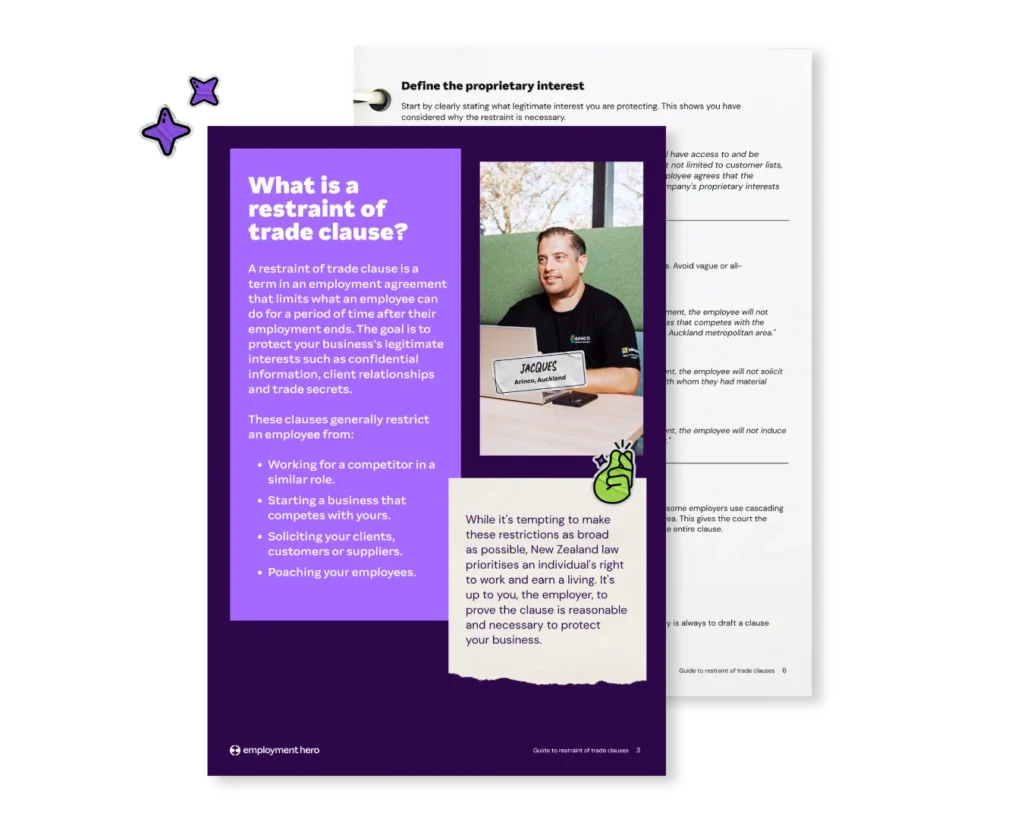
What is a restraint of trade?
A restraint of trade clause is a provision in an employment agreement that limits an employee’s professional activities after their employment ends. Its purpose is to prevent a former employee from using the knowledge, connections and confidential information they gained on the job to unfairly compete with your business. It’s a tool to protect your legitimate business interests, not to punish a departing team member.
These clauses typically restrict an employee for a specific period and within a defined geographical area. Think of it as creating a temporary buffer zone, giving your business time to solidify its position and client relationships without immediate interference from someone who holds insider knowledge.
Main types of restraint of trade clauses
Restraint of trade is not a one-size-fits-all concept. There are different types of clauses, each designed to protect specific aspects of your business. Understanding these variations helps you choose a level of protection.
- Non-competition clauses: This is the most restrictive type. It prevents a former employee from working for a competitor or starting a competing business for a set time and in a specific location.
- Non-solicitation clauses: This clause stops a former employee from actively pursuing your clients’ customers or suppliers to win their business.
- Non-poaching clauses: This prevents a former employee from encouraging your current staff to leave their jobs and join them at a new company.
- Non-dealing clauses: This is broader than non-solicitation. It prohibits a former employee from doing business with your clients or customers at all, whether they initiated the contact or not.
Non-compete vs non-solicitation clauses
It’s important to distinguish between a non-compete clause and a non-solicitation clause. A non-compete stops someone from working in a similar field altogether. A non-solicitation clause is more targeted. It doesn’t stop them from working but it does stop them from approaching your clients, staff or suppliers.
Because they are less restrictive on an individual’s right to earn a living, non-solicitation clauses are often viewed more favourably by the courts. For many businesses they offer a more practical and enforceable way to protect key relationships, without imposing a blanket ban on a former employee’s career.
Are restraint of trade clauses enforceable?
This is the crucial question for every employer. In New Zealand, the starting point for any court is that restraint of trade clauses are unenforceable. The law prioritises an individual’s right to work and use their skills to make a living.
The burden is on you the employer to prove that the clause is reasonable and necessary to protect a genuine business interest. Simply wanting to avoid competition is not enough. You must demonstrate that without the restraint your business would be unfairly disadvantaged.
The litmus test: principles for determining enforceability
When the Employment Relations Authority or a court assesses a restraint of trade clause, they apply a “reasonableness” test. Information from Employment New Zealand confirms that this test considers what is fair to both the employer and the employee, as well as the public interest.
The key factors considered are:
- The proprietary interest: Do you have a legitimate interest to protect, such as confidential information, trade secrets or special client relationships?
- The scope of activities: Are the restricted activities specific and directly related to the interest you are protecting?
- The duration: Is the time limit on the restraint as short as possible? For many roles, three to six months is considered the upper limit of what’s reasonable.
- The geographical area: Is the restriction limited to the specific area where you do business and where the employee could actually impact you?
If any of these aspects are deemed too broad, the clause will likely be struck down in court.
Should your business use restraint of trade clauses?
Before adding a restraint of trade clause to your agreements, ask yourself if you truly need one. Do you have genuine proprietary interests that require protection? These are interests that belong to the business, not the general skills and experience an employee develops.
Examples include:
- A secret recipe or manufacturing process.
- A highly valuable client list with detailed contact information and history.
- Strategic business plans or pricing models.
For a senior employee with deep knowledge of your business strategy and strong client relationships, a restraint might be justifiable. For a junior employee with limited access to sensitive information, it would almost certainly be unreasonable.
Employment agreements and drafting clauses
When you decide a restraint is necessary, you should first seek independent legal advice. This will help ensure that you take the right steps and minimise risk. Once that’s done, careful drafting is vital. Vague or overly broad clauses are destined to fail. The key is to be specific and tailor the clause to the employee’s role.
A good clause will clearly state the business interest being protected and define the limits of the restraint in precise terms. Consider using cascading clauses which offer a series of descending options for time or area. This can give a court the flexibility to uphold a narrower version of the restraint, rather than dismissing it entirely.
Editing your current restraint of trade clauses
Businesses evolve and so do employee roles. A restraint of trade clause that was reasonable five years ago might not be today. It’s good practice to review your employment agreements periodically.
If an employee is promoted and gains access to more sensitive information, their restraint clause may need to be updated. Any changes must be discussed and agreed upon with the employee in writing. Simply relying on an old generic clause is a risk. An aggressive or outdated clause could be found unreasonable, leaving you with no protection at all.
Employment relations and good faith
Under New Zealand law, employers and employees have an obligation to deal with each other in good faith. This principle extends to negotiating employment agreements. You cannot pressure an employee into signing a restraint of trade clause.
The process should be transparent. Explain why the clause is necessary and what it means for them. Some employers offer consideration, such as a higher salary or a specific payment, in exchange for the employee agreeing to the restraint. This demonstrates a fair exchange and strengthens the argument that the clause is part of a balanced agreement.
What to do when an ex-employee breaches a clause
Discovering a former employee has breached their restraint can be stressful. The first step is often to have your lawyer send a formal letter, reminding them of their obligations and demanding they cease the activity.
If that doesn’t work, you can apply to the Employment Relations Authority or the court for an injunction. This is a legal order to stop the breach. You may also be able to sue for financial damages if you can prove the breach has caused your business to lose money. This process can be costly and time-consuming, which underscores the importance of having a well-drafted reasonable clause from the beginning.
For more information on restraint of trade clauses, download the guide by filling in the form on the right.
The information in this article is current as at 13 February 2026, and has been prepared by Employment Hero Pty Ltd (ABN 11 160 047 709) and its related bodies corporate (Employment Hero). The views expressed in this article are general information only, are provided in good faith to assist employers and their employees, and should not be relied on as professional advice. Some information is based on data supplied by third parties. While such data is believed to be accurate, it has not been independently verified and no warranties are given that it is complete, accurate, up to date or fit for the purpose for which it is required. Employment Hero does not accept responsibility for any inaccuracy in such data and is not liable for any loss or damages arising directly or indirectly as a result of reliance on, use of or inability to use any information provided in this article. You should undertake your own research and seek professional advice before making any decisions or relying on the information in this article.
Register for the guide
Related Resources
-
 Read more: Guide to restraint of trade clauses in New Zealand
Guide to restraint of trade clauses in New Zealand
A straightforward guide to restraint of trade clauses, enforceability and protecting your trade secrets.
-
 Read more: Employment law updates 2026
Employment law updates 2026
Keep your business up-to-date with the latest changes in NZ employment law. Here’s what you need to know about the…
-
 Read more: How to organise employee records for instant access
How to organise employee records for instant access
Struggling to find employee files fast? Discover simple ways to organise records for instant access while staying audit-ready.

