 Australia
 United Kingdom
 Singapore
 Malaysia
 Canada (Français)

 New Zealand


Interview checklist for hiring managers
Published
Interview checklist for hiring managers
Published
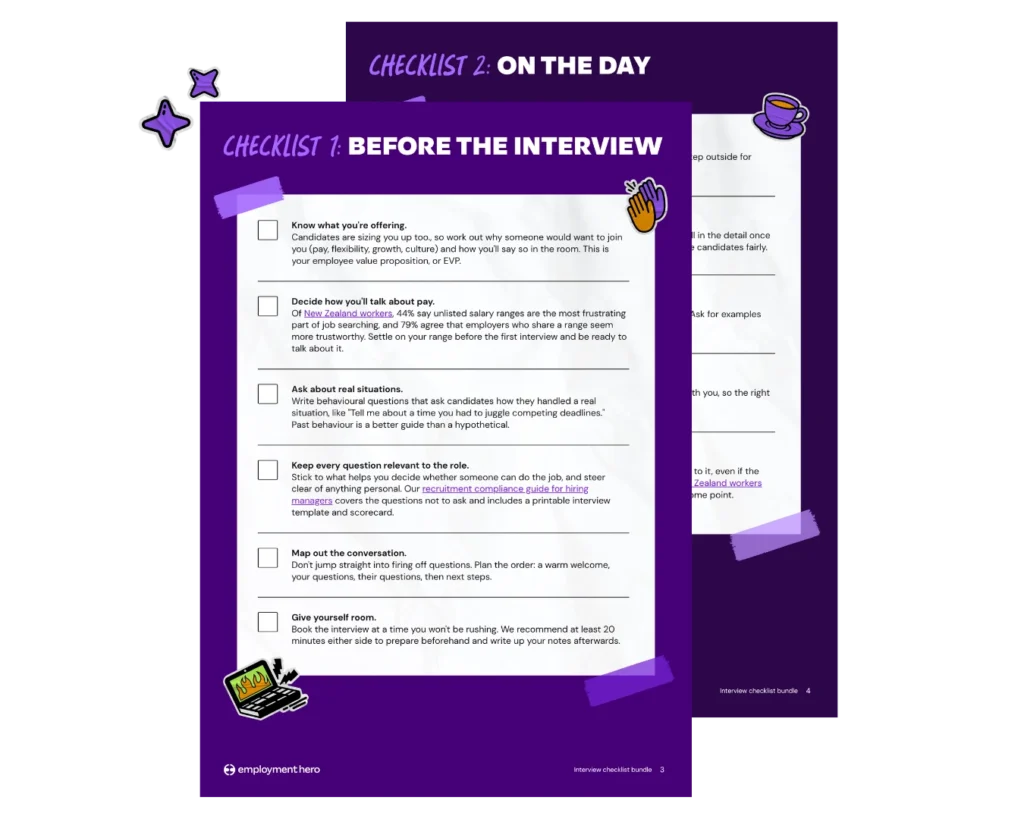
Ensure you are fully prepared for your next round of interviews with our handy, downloadable checklists. We’ve created three checklists that help you before, during and after the interview to make sure you don’t forget anything important.
These interview checklists will cover everything from:
- How to include your EVP in the interview process
- Tips for planning out interview questions
- Note taking advice
- Follow up on best practice
Download your free checklists by filling in the form on the right.
11 first-time hiring manager tips for recruitment
Think back to the last time you sat through a job interview. Chances are you were the one answering the questions. Then the promotion comes through, and suddenly you’re on the other side of the table.
Maybe your manager has just approved a new hire who’ll report to you and you’re already picturing how you’ll work together. Then it hits: you’ve never run an interview, let alone made a hire.
If that sounds familiar, this one’s for you. Here are 11 tips to take you from the first conversation to the final offer.
1. Be prepared
Think about the interviewers who made you feel at ease. They probably weren’t born confident. They’d done the prep: a list of questions, a plan for the conversation and a few follow-ups ready for any gaps.
Do the same: write a balanced set of questions and know how you’ll keep the conversation moving. If it’s your first time, ask your manager or another senior leader to join you for the first few interviews. They can step in if you drift off track and you can debrief together afterwards on what worked and what to change.
2. Define the role
Before you advertise, get clear on what you’re hiring for and what success looks like. Think about how you’d like the role to grow over six, 12 and 24 months. Decide who it reports to, where it sits in the organisation, what the day-to-day tasks are and which skills the job needs. Then put it in writing.
3. Write a job ad that stands out
Candidates have usually looked at plenty of other roles. Here’s how to give yours a reason to stop scrolling.
Use a clear job title. It’s the first thing people see, so say what the job is and include the level and type of role. Check similar titles at other businesses to see what candidates are searching for.
Tell your story. Many candidates won’t know your business. Open with a short intro on who you are and why you exist, then add your mission, values and a glimpse of your team.
Sell the role. Share what makes it worth applying for: company highlights, mentoring and development, benefits and perks and what your team culture is really like.
Be specific. Say why the role exists and what the duties are, how they’re done and why they matter. Write as though the reader knows nothing about the job, because most people skim at first. Say who the role reports to and whether anyone will report to them.
Put the pay in. Of New Zealand workers, 44% say unlisted salary ranges are the most frustrating part of job searching, and 79% agree employers who share a range seem more trustworthy. If you can include a range, do.
Keep it short and simple. Plain language and a clear layout help candidates understand the role even at a glance.
Show your EVP. Your benefits and EVP give candidates a feel for working with you. Aim for a balance across three areas, and make sure you follow through on every one:
- Extras: free coffee, health insurance, gym memberships, flexible working. The list is long, so pick what suits your budget.
- Values, mission and purpose: help people see why their work matters.
- People and culture: great people want to work with great people and a good culture makes Monday easier.
Need a head start? Grab our ideal job ad template.
4. Know what you’re looking for
List the skills and attributes you want before you start. Look for people who are humble, hungry and smart, with the experience to back it up. If the role now involves AI tools, include that in your list.
Ask questions about their past experience, their strengths and where they want to grow. You’ll feel more confident in your shortlist and you’ll lower the risk (and the cost) of a hire that doesn’t work out.
Not finding what you need in the people applying? Our post on passive candidates shows how to reach people who aren’t actively looking.
5. Decide how the interviews will run
Candidates want to know what to expect, so be transparent from the start. A junior role will look very different from a senior one, but for any role, decide:
- How many interview rounds there will be
- Who candidates will meet in your business
- Which non-technical questions you’ll ask
- Which technical questions are specific to the role
- Whether you’ll set a task, and what it is
If you use AI to screen or interview candidates, say so upfront. People should always know whether they’re talking to a person or a tool.
6. Block out interview time early
Setting time aside before interviews are booked sounds backwards, but it works. When your calendar fills up, an hour or two held for interviews means your HR team can offer slots straight away, without double bookings. Good candidates get a quick answer and don’t wait around.
Add around 20 minutes either side of each interview, so you have time to prepare and write up your notes.
7. Use an ATS to keep hiring organised
Writing the ad, posting it to job boards like SEEK or Trade Me Jobs, sorting applications, calling and interviewing can take over your week. A spreadsheet or a folder of bookmarked emails only goes so far.
An applicant tracking system (ATS) puts your candidate pipeline in one place, so you can move people from stage to stage and see where everyone’s up to. It also helps when several people are involved, because everyone works from the same information. That matters for candidates, too. The last thing you want is to look disorganised when you’re trying to win great people.
8. Ask relevant questions
Know the skills you’re hiring for and write them into a checklist, with the must-haves in one column and the nice-to-haves in another. Then draft questions and tasks aimed at those skills, so you can narrow your pool with confidence.
Aim to learn about a candidate’s skills, personality and working style. Good areas to cover:
- How they connect with your purpose
- What they already know about your business and its leaders
- Their work experience
- How they communicate at work
- Practical or technical questions about the role
- How they like to be managed
- Their view on remote or hybrid work
Keep every question tied to the role, and steer clear of anything personal. Our recruitment compliance guide for hiring managers covers the questions not to ask.
9. Take notes throughout
Whether you’re meeting in person or online, take notes. When you’re talking to lots of candidates, they’re what you’ll rely on to narrow things down. A few words next to a point on the CV is enough.
Without a shared system, feedback tends to end up scattered across emails, forwarded CVs and different calendars. In an ATS, everyone’s notes sit on the same candidate profile alongside the CV and application answers, so it’s easier to compare candidates fairly.
10. Partner with your HR team or a recruiter
Sometimes doing the hiring yourself isn’t realistic and that’s fine. Lean on your HR team or an external recruiter. Give them a clear brief, set the tone you want and stay transparent with each other throughout.
11. Follow up promptly
Waiting to hear back is stressful, especially for someone who really wants the role. Get back to every candidate quickly with an outcome, whether that’s the next step or a final decision. It matters: 62% of New Zealand workers say the hiring process has put them off looking for a job at some point.
Also give candidates a rough timeline up front. If your top pick is interviewing elsewhere and an offer lands before yours, there’s a good chance they’ll take it.
You’ve got this
When your first interview comes around, be prepared, be consistent and listen closely. Check references before you offer and if the role needs a background check, get the candidate’s written consent first.
Ready to go? Download your interview checklists and start hiring with confidence.
The information in this article is current as at 1 September 2026 and has been prepared by Employment Hero Pty Ltd (ABN 11 160 047 709) and its affiliates (Employment Hero). The views expressed in this article are general information only, are provided in good faith to assist employers and their employees, and should not be relied on as professional advice. Some information is based on data supplied by third parties. While such data is believed to be accurate, it has not been independently verified and no warranties are given that it is complete, accurate, up to date or fit for the purpose for which it is required. Employment Hero does not accept responsibility for any inaccuracy in such data and is not liable for any loss or damages arising directly or indirectly as a result of reliance on, use of or inability to use any information provided in this article. You should undertake your own research and seek professional advice before making any decisions or relying on the information in this article.
Register to download the checklist.
Related Resources
-
 Read more: The $200k personal grievance threshold: What NZ employers need to know
The $200k personal grievance threshold: What NZ employers need to know
New NZ rules limit unjustified dismissal claims for employees earning $200K or more. Get our free factsheet and see what…
-
 Read more: Follow the Shift: Connected Rostering & Attendance in Action
Follow the Shift: Connected Rostering & Attendance in Action
Stop relying on paper timesheets and spreadsheet guessing games. See how to connect your rosters, photo clock-ins, live tracking, and…
-
 Read more: NZ Employment Law: What Changed in 2026 & What’s Next?
NZ Employment Law: What Changed in 2026 & What’s Next?
Employment law changed in 2026. Join our local Employment Counsel to see what is in effect and what to prepare…

