 Australia
 United Kingdom
 Singapore
 Malaysia
 Canada (Français)

 New Zealand


What your fragmented HR systems are really costing you: A practical guide for NZ businesses
Published
What your fragmented HR systems are really costing you: A practical guide for NZ businesses
Published
Most Kiwi businesses don’t set out with a fragmented tech stack in mind. It tends to happen gradually as business needs evolve and teams grow.
It can look like a payroll platform when the spreadsheet stops coping. An applicant tracking system when hiring is picking up. A separate tool for onboarding, another for scheduling, one more for benefits. Each one solved a real problem. Initially anyway.
On the surface, everything still works. But underneath, the costs begin to build. Wasted time, avoidable errors, slower processes, a patchy employee experience. These aren’t costs that always show up on a balance sheet, but they’re felt across the business every day. And as organisations grow, they don’t just persist. They compound.
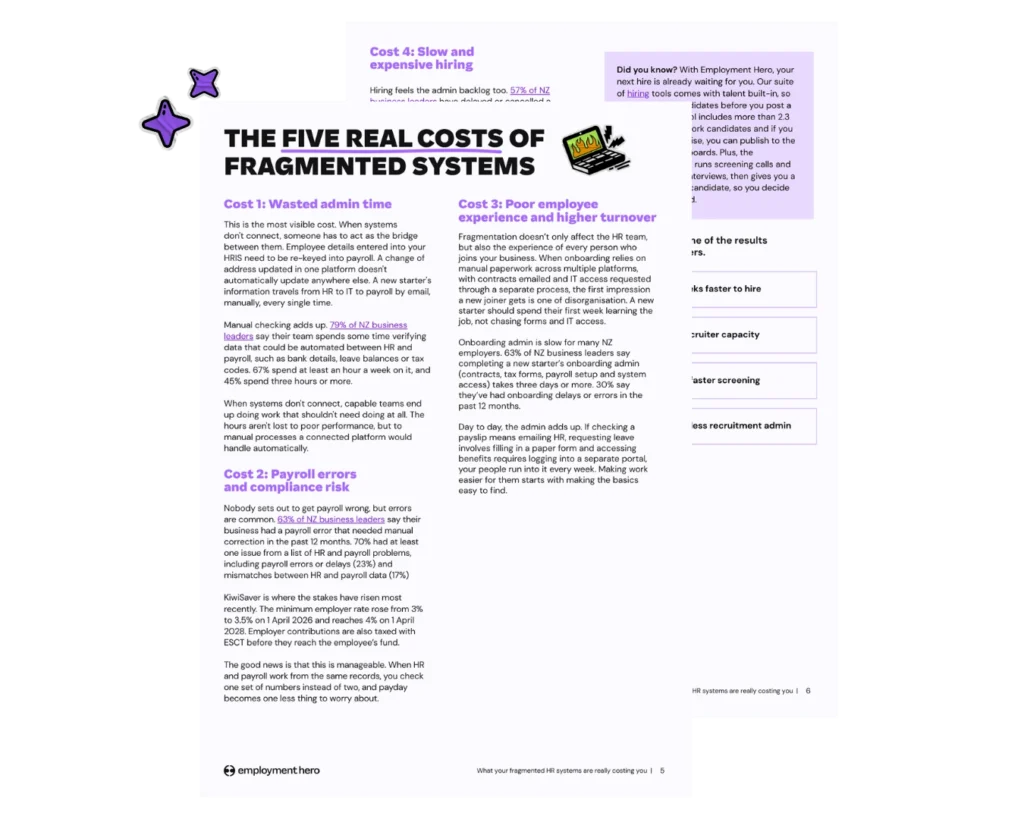
This guide breaks down what fragmented HR systems are really costing UK businesses and what changes when you bring everything together in one place. Download the guide to find:
- The real cost of fragmented systems
- The compliance challenges with fragmented systems
- The system consolidation checklist
- What an integrated system changes
- How to choose the right consolidated system
Download the guide by filling in the form on the right.
What are fragmented HR systems?
Fragmented HR systems refer to the use of multiple, disconnected tools and processes to manage different aspects of human resources within a business. Instead of operating from a single, unified platform, organisations rely on separate systems for tasks such as payroll, recruitment, onboarding, performance management, absence tracking and employee records.
In practice, this often means HR teams are switching between spreadsheets, email chains, standalone software and manual records to complete everyday tasks. The problem arises when these systems don’t communicate with each other, leading to duplicated data entry, inconsistent information and a lack of real-time visibility across the employee lifecycle.
For New Zealand businesses, fragmentation usually develops gradually as teams adopt tools to solve immediate problems without considering long-term integration. While each system may work well in isolation, the lack of connectivity between them creates inefficiencies that can grow significantly as the organisation scales.
Why are fragmented systems a problem for Kiwi businesses?
Fragmentation tends to creep up on business owners and HR managers. It starts small and spreads across teams, and because each tool works independently, the cost isn’t always visible. Over time, the workarounds become part of everyday operations.
Most New Zealand businesses are small, so this affects most of the market. 97.2% of NZ enterprises employ fewer than 20 people.
Here are some of the real-world problems fragmented systems create:
- Wasted admin time. Manual data entry, reconciliation and duplicate work across platforms are the most visible cost of fragmented systems, but it’s rarely quantified. The same employee details get entered into the HRIS, re-keyed into payroll and copied again somewhere else for IT access. Multiply that across every new starter, every pay run, every personnel change and the hours add up fast.
- Payroll errors and compliance risk. When payroll data sits apart from HR data, errors are a matter of when, not if. Employers must send pay details to Inland Revenue on every payday, so an incorrect tax code, a missed ACC earners’ levy or a wrong KiwiSaver deduction ends up in an official filing. Those errors take time to fix, and they damage trust with employees in a way that’s hard to rebuild.
- Slow and expensive hiring. Disconnected job boards, spreadsheet tracking and email chains are no match for high application volumes. Without an integrated ATS, candidates move through a process that relies on manual steps at every stage: CV downloads, individual phone screens, hiring manager updates sent by email. Time-to-hire stretches. Strong candidates accept other offers. And every hire made through external sourcing tools that sit outside your core platform adds to the cost per hire unnecessarily.
- Poor employee experience and higher turnover. Fragmentation doesn’t just affect your HR team. It affects every employee who joins the business. Clunky onboarding, paperwork scattered across systems, no ability to self-serve payslips, leave requests, or benefits: these are the everyday experiences that shape whether a new hire commits or starts looking elsewhere within months. Replacing a mid-level employee in New Zealand is expensive in both time and money and a poor onboarding experience is one of the most preventable causes of early attrition.
- Hidden IT and subscription costs. This is the cost that rarely appears on anyone’s radar until someone sits down and adds it up. Multiple platform licences, renewal dates no one is tracking, integration costs for connectors that half-work, developer time maintaining Zapier workflows holding the whole thing together. Then there’s the redundancy: features you’re paying for in two or three different tools because no single platform does everything. When did you last add up every subscription your HR function is running? The total is usually a surprise.
The benefits of a consolidated system
Running HR, payroll and recruitment on one platform doesn’t just remove the friction from your current processes. It changes what your HR function is capable of, what your employees experience and how confidently you can manage compliance. Here’s what that looks like in practice:
- Data is entered once and trusted everywhere. A new joiner’s details flow automatically to payroll, onboarding and every system that needs them. No re-keying, no cross-referencing, no version control issues. One record per employee, updated in one place, accurate across the board. When a detail changes, it changes everywhere. Your HR team stops being the people who manually keep everything in sync and starts being the people who actually move things forward.
- Compliance is built into the process, not checked after the fact. Payday filing, work rights checks and leave calculations all work best when they run from the same source of truth. Before someone starts, employers must confirm they’re entitled to work in New Zealand, and keep a record of how they checked. Keeping that record alongside the employee’s file is far easier than hunting for it across three platforms.
- Hiring moves faster and loses fewer good people. When your ATS, onboarding workflows and HR records all sit in the same platform, a candidate moves from application to offer to their first day without anyone re-entering the same information at every stage. There are no handoffs between tools, no export and re-import, no email chains updating a hiring manager who doesn’t have access to the ATS. Strong candidates don’t fall through the cracks because the process couldn’t keep up with the volume. The best people get an experience that reflects well on your business from day one.
- Your team gets meaningful time back. Not a few minutes here and there. The hours currently spent reconciling data between systems, chasing information that should be in one place and correcting errors that a connected system would have caught automatically. That time is real, it compounds every week and it’s currently going into work that only exists because your systems don’t connect. On a consolidated platform, it goes back into the work that actually moves your business forward.
- AI tools deliver on their promise. AI is only as good as the foundation it sits on. It needs clean data, simple processes and a single source of truth to work properly. When your employment data all lives in one place, AI-powered tools, from automated candidate screening to payroll exception flagging, can actually do their job accurately and at scale. Layer AI on top of disconnected systems and you don’t fix the fragmentation. You make the mess move faster. Consolidate first and AI stops being a promise and starts being a practical advantage your competitors don’t have yet.
Ready to find out what fragmented systems are costing your business?
Fragmented HR systems rarely feel urgent until you add up the numbers. The hours lost to admin that shouldn’t exist. The payroll errors that could have been caught automatically. The compliance gaps that grow quietly as employment legislation gets more complex.
But there is a better way. Find out what consolidating your HR, payroll and recruitment onto one platform could save your business in time, money and compliance risk.
Register for the guide
Related Resources
-
 Read more: What your fragmented HR systems are really costing you: A practical guide for NZ businesses
What your fragmented HR systems are really costing you: A practical guide for NZ businesses
Fragmented HR systems cost NZ businesses more than they realise. Discover the hidden admin, payroll and compliance costs – and…
-
 Read more: Free annual leave calculator for NZ employers
Free annual leave calculator for NZ employers
Know how much annual leave your NZ employee has entitled and accrued, and how the 2028 Employment Leave Act changes…
-
 Read more: Christmas closedown guide: get leave, pay and hiring right before the break
Christmas closedown guide: get leave, pay and hiring right before the break
A free guide for NZ employers on closing down over Christmas. Covers notice, annual holidays, public holiday pay, recruitment and…
