

















How to organise employee records for instant access
Contents
Running a small business means wearing a lot of hats. On any given morning you might be quoting a job, answering customer emails and managing a delivery, all before 9am. The last thing you want is to spend 20 minutes hunting for an employment agreement when a staff question comes up. Good record-keeping is not just a compliance task; it’s one of the quiet foundations of a well-run business.
This guide will walk you through what employee records you need to keep, how to organise them so you can actually find things and how to build a system that grows with your team.
Why organised records matter more than you think
Many micro business owners manage employee information in a loose mix of email threads, shared folders and memory. It works, until it doesn’t. A personal grievance claim, an IRD audit or simply an employee asking about their leave balance can reveal very quickly how fragile an informal system is.
Under the Employment Relations Act 2000 and the Holidays Act 2003, employers in New Zealand have specific legal obligations around what records they keep and for how long. One key responsibility is keeping wage and time, holiday and leave records for at least six years. Having those records organised and accessible is not just good practice; it’s part of meeting your obligations as an employer.
The good news is that getting organised does not require a complicated system or expensive software. It mostly requires a clear structure and the habit of keeping it up to date.
What records do you actually need to keep?
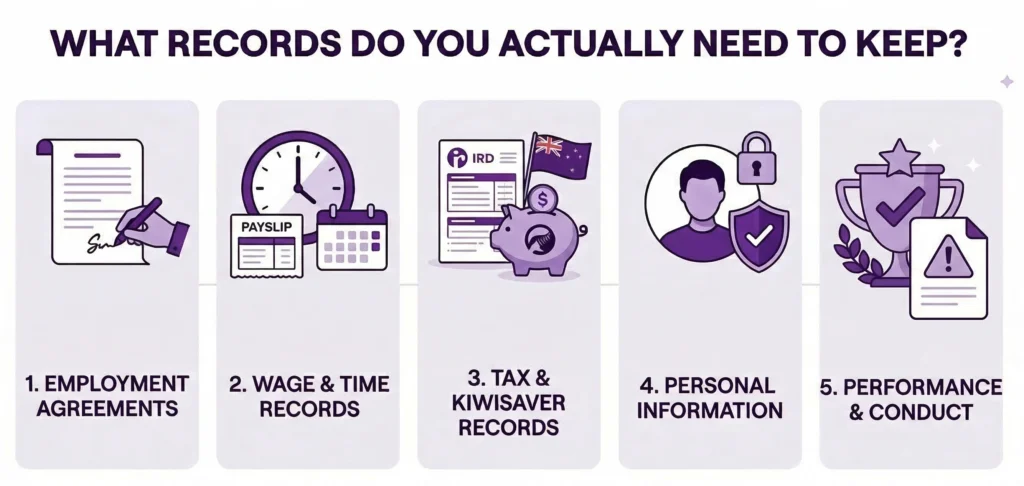
Before you can organise your records, you need to know what belongs in them. Here is a breakdown of the core categories every employer should have covered.
Employment agreements
Every employee must have a written employment agreement, as required by the Employment Relations Act 2000. This should be signed by both parties, before or on the first day of work. Keep the signed original (or a clear digital scan) and note the start date.
Wage and time records
Employers legally have to keep accurate records of hours worked and wages paid. Under the Holidays Act, you also need to keep detailed records of leave entitlements, leave taken and the basis for holiday pay calculations. These records must be kept for at least six years.
Tax and KiwiSaver records
PAYE deductions, KiwiSaver contributions and employer records related to IR filing all need to be retained. IRD can request records going back several years, so keeping these tidy pays off in the long run.
Personal information
Contact details, emergency contacts, visa or right-to-work documentation and any notes relevant to the employment relationship can be important too. The Privacy Act 2020 governs how you collect, store and use this information, so only keep what is necessary and store it securely.
Performance and conduct records
Written notes from performance conversations, any formal warnings and outcomes of disciplinary processes. If you ever face a personal grievance claim, these records are invaluable.
Hero tip: Employment Hero’s platform stores employment agreements, leave records and payroll data in one place, automatically linked to each employee profile. That means when you need to pull up a record, it only takes a few seconds.
Building a structure you can actually use
The best record-keeping system is the one you will actually maintain. Here is a simple structure that works for most micro businesses, whether you are using a filing cabinet, a cloud folder or dedicated HR software.
One folder per employee
Whether physical or digital, each employee should have their own dedicated space. Name folders consistently (last name, first name works well) so they’re easy to scan.
Active employees
Keep records for current staff easily accessible. Organise by surname and sub-divide by document type.
Former employees
Archive the files when someone leaves but don’t delete them. Wage records must be kept for six years under the Holidays Act.
Consistent naming for documents
When you save a document, use a name that will still make sense in two years. Something like Smith_Jane_EmploymentAgreement_2024.pdf is far more useful than final_agreement_v3.pdf. Include the employee name, document type and year as a minimum.
A clear version history
Employment agreements vary as pay rates change, laws change and roles evolve. Keep all versions, not just the current one, and mark the dates clearly. If you are ever asked to show what terms applied at a particular point in time, you will be glad you did.
Keeping personal information secure
Employee records contain sensitive personal information, and the Privacy Act 2020 places clear obligations on you as an employer to protect it. One easy way to keep your files safe is to use a software platform that comes with security certifications, like Employment Hero. Our HR software is certified under ISO 27001, ISO 27017, and ISO 27018, meeting international standards for data security. .
Making records work for day-to-day management
Well-organised records are not just about compliance. They make your life easier in the day-to-day moments: when an employee asks about their leave balance, when you are preparing for a performance conversation or when someone needs their pay history for a mortgage application.
Consider keeping a simple one-page summary at the front of each employee’s folder covering their start date, current role, pay rate, leave balance and any probation or review dates. You can update this quickly and it gives you everything you need at a glance, without having to open five different documents.
Hero Tip: With Employment Hero, that summary dashboard is built in. Every employee profile shows you current pay, leave balances, upcoming reviews and document status in one view. Plus, your employees can view their details as well, which means they can access their own information when they need it.
A quick-start checklist for getting organised
If your records are currently scattered, don’t try to fix everything at once. Start here:
- Gather all current employment agreements and confirm they’re signed
- Create a secure digital folder for each current employee
- Collect wage and time records for the past six years
- Check that personal information is stored securely, with appropriate access controls
- Create an archive section for former employees and note their end dates
- Set a calendar reminder to review records for disposal after six years
- Establish a consistent file-naming convention and communicate it to anyone else who saves documents
You don’t have to build this from scratch
Getting your employee records in order is one of the most valuable things you can do as a small employer. It reduces stress, supports compliance and means you can respond confidently when something comes up.
If you are at the point where managing employee data manually feels like too much, Employment Hero was built with exactly this in mind. It brings employment agreements, payroll, leave management and employee records into one secure platform. You get the structure and compliance confidence of a larger business, without needing a dedicated HR person to run it.
That’s not all. With our Employment Operating System, you can create, send and store digital contracts and documents in just a few clicks. Customisable templates and automated workflows make it simple to onboard new team members or update existing agreements.
The information in this article is current as at 5 March 2026, and has been prepared by Employment Hero Pty Ltd (ABN 11 160 047 709) and its related bodies corporate (Employment Hero). The views expressed in this article are general information only, are provided in good faith to assist employers and their employees, and should not be relied on as professional advice. Some information is based on data supplied by third parties. While such data is believed to be accurate, it has not been independently verified and no warranties are given that it is complete, accurate, up to date or fit for the purpose for which it is required. Employment Hero does not accept responsibility for any inaccuracy in such data and is not liable for any loss or damages arising directly or indirectly as a result of reliance on, use of or inability to use any information provided in this article. You should undertake your own research and seek professional advice before making any decisions or relying on the information in this article.
Related Resources
-
 Read more: How to organise employee records for instant access
How to organise employee records for instant access
Struggling to find employee files fast? Discover simple ways to organise records for instant access while staying audit-ready.
-
 Read more: Is your patchwork system putting employee data at risk?
Is your patchwork system putting employee data at risk?
Discover the hidden risks of using patchwork HR systems and learn how to protect employee data with secure, integrated solutions…
-
 Read more: How to save time on payroll through bulk bank payments
How to save time on payroll through bulk bank payments
Tired of time-consuming and tedious payroll tasks? Discover how bulk bank payments can save you valuable time and bring ease…
