 Australia
  New Zealand
  United Kingdom
  Singapore
  Malaysia
  Canada (Français)





The retail career progression template that stops your best people from checking out
Published
The retail career progression template that stops your best people from checking out
Last Updated
Your best people don’t sit still. They want momentum. Growth. A future that feels bigger than the shift they’re working today. If they can’t see a future within your four walls, they’ll go build it with a competitor—and that hurts.
You’ve invested months training them on your inventory, your brand voice, and building their customer rapport. When a star floor staffer leaves, you aren’t just losing an employee; you’re losing sales, decreasing floor morale, and creating gaps in your roster that are expensive and exhausting to fill.

The question your top performers are quietly asking during the 10-minute floor huddle before the doors open is simple: “What’s next for me here?”
If you can’t answer that, you’re already at risk of losing them to the shop down the street.
A retail career progression framework changes the narrative. It gives your team a clear, honest roadmap of how they can grow—moving from the register to visual merchandising, store management, or even head-office buying. It removes the “dead-end job” stigma, builds deep trust, and shows your people you’re invested in their professional journey, not just their ability to fold shirts or process transactions.
This guide breaks it down and provides a customizable retail career progression template so you can start building your future leadership team today.
Stop the “revolving door”: What is a retail career progression framework?
Think of a career progression framework as your store’s navigation system. It lays out every role – from casual associate to cluster manager – and the specific goals, product knowledge, and leadership markers required at each level. It shows employees the path forward in real, achievable steps, not vague “maybe one day” promises.
For a retail business, this is your most powerful retention tool. It shifts the conversation from “I need more hours” to “I want to master inventory replenishment.” When your team sees a ladder they can actually climb inside your brand, they stop looking for a ladder elsewhere.
The business case for retail growth (It’s about the bottom line)
Keeping your floor team intact is a win for morale, but the business benefits run much deeper. A solid progression plan builds a highly skilled workforce that understands your customer’s buying habits inside and out.
- Become an “employer of choice”: In a tight labor market, the best candidates aren’t just looking for a staff discount; they’re looking for a career. A visible commitment to promoting from within is your biggest competitive advantage.
- Close the skills gap: Retail is changing. From omnichannel fulfillment to digital POS systems, you need a team that can adapt. Mapping growth paths allows you to identify and train for these skills before they become a crisis.
- Reduce recruitment burnout: Instead of spending thousands on external searches for a new Store Manager, you develop the talent you already have. This proactive approach proves to your team that you believe in their potential, which is the #1 driver of loyalty during the holiday rush.
How to build a retail framework that actually works

Building a framework isn’t about a poster in the breakroom; it’s about a living system. Here is your no-nonsense, step-by-step guide to making it happen in a retail environment.
Step 1: Align with your brand’s expansion goals
Where is your brand headed? If you’re planning to open three new locations next year, you don’t just need staff—you need a pipeline of leaders. Build your framework to support the specific skills (like multi-site coordination or new store openings) that your business will need to reach its next milestone.
Step 2: Create logical job levels
Growth needs to be visible. Move beyond the generic “Junior” and “Senior.” Define levels based on real-world responsibility—such as key holder, department lead, visual specialist or assistant manager. Each step should feel like a distinct achievement with clear new responsibilities.
Step 3: Define impact, not just tasks
Scrap the boring list of duties. A modern retail role description focuses on outcomes. Instead of “merchandising shelves,” use “Optimizing floor layout to increase conversion by 5%.” When you define roles by their contribution to the store’s success, you give employees a sense of ownership.
Step 4: Map multi-directional pathways
Retail careers aren’t always a straight line to the top. The most effective frameworks recognize that a great salesperson might be a brilliant future Buyer or E-commerce Coordinator. Map out lateral moves that allow staff to stay with the brand while pivoting to a different area of interest.
Step 5: Implement training that bridges the gap
A plan without support is just a wish. Connect your pathways to real development. If a staff member wants to move into Store Management, provide them with training on P&L statements, labor-cost management, and conflict resolution. Use your HR software to track these milestones so they never feel “forgotten.”
Step 6: Launch, live and review
Your framework must be part of your store’s DNA. Use it during every 1-on-1 and performance review. Retail moves at lightning speed—set a schedule to review your framework annually to ensure it still matches modern consumer habits and your current tech stack.
Dual career paths: The “super-seller” vs. the manager
One of the biggest mistakes retailers make is assuming the only path “up” is into management. You have star performers who love the thrill of the sale but hate the admin of a roster. Forcing them into a store manager role is a fast track to losing them.
The solution: Create a “specialist” track. allow your best people to advance in seniority and pay as master stylists, technical experts or visual leads. This allows you to retain deep product expertise and elite selling skills without forcing a great “doer” to become a frustrated “manager.”

Download the template and start building your future leaders
Stop leaving employee growth to chance. Hope is not a strategy for retention. It’s time to build a clear, fair and motivating system that turns jobs into careers and shows your people you’re invested in them for the long haul.
Our downloadable career progression template for retail is the tool you need to get started. Use it to build a framework that retains your most valuable people and develops the next generation of leaders from within your own walls.
Ready to future-proof your business and keep your top talent fired up about what comes next?
Or check out our other library of resources for retail industry:
Seasonal hiring in Canada: Retail and hospitality best practices
Register to download the template
Related Resources
-
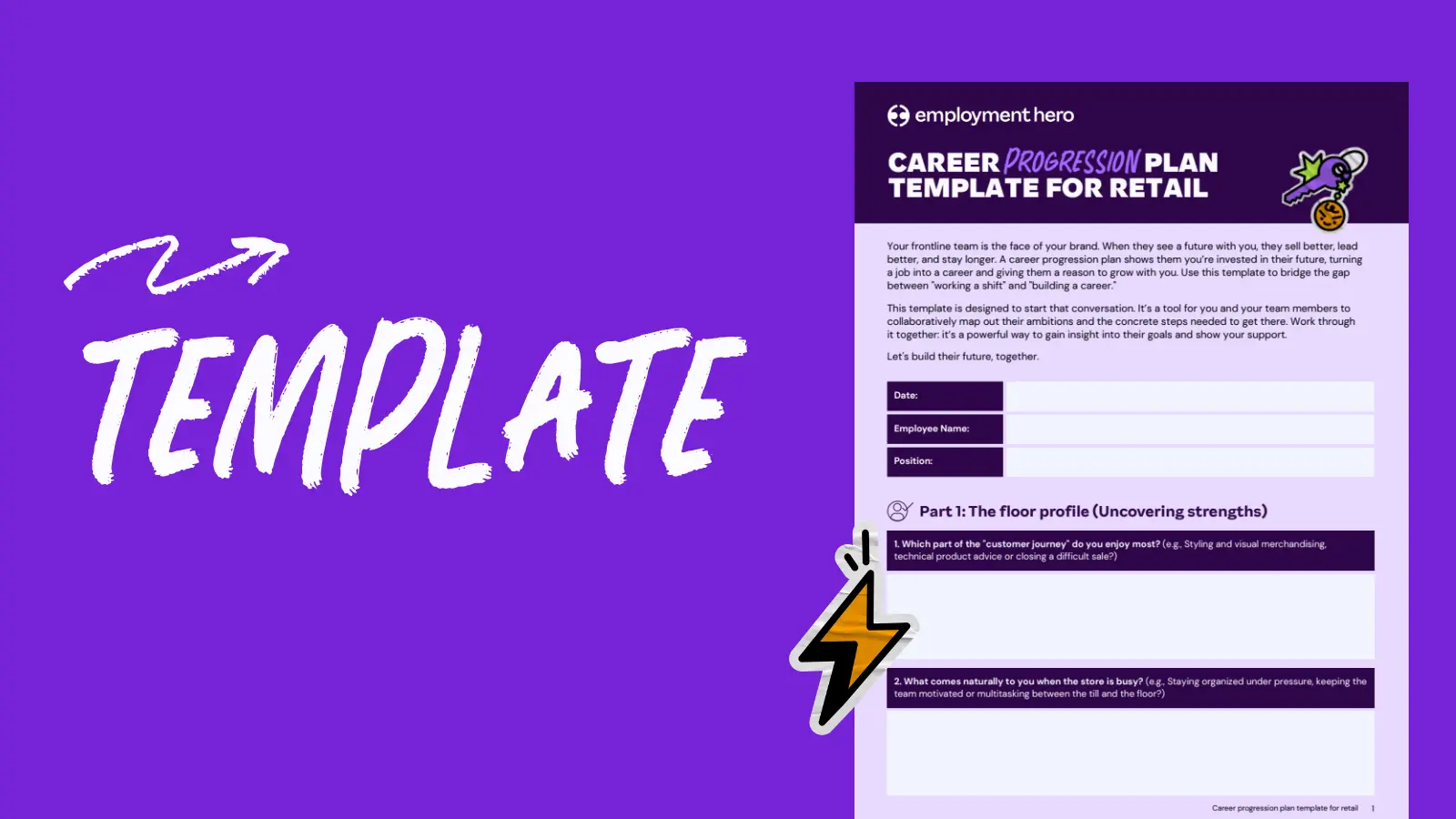 Read more: The retail career progression template that stops your best people from checking out
The retail career progression template that stops your best people from checking out
Download our free career progression plan template for retail. Help employees grow, stay engaged and achieve their career goals.
-
 Read more: Hiring in Québec doesn’t have to slow you down
Hiring in Québec doesn’t have to slow you down
A step-by-step guide for Canadian employers hiring in Québec. Master the Civil Code, Revenue Québec taxes and language laws.
-
 Read more: Statutory Holiday Pay Rules in Québec: A Guide for Employers
Statutory Holiday Pay Rules in Québec: A Guide for Employers
Confused by the 1/20th calculation? Learn the rules for statutory holiday pay in Québec, including working on holidays, specific laws…