 Australia
  New Zealand
  United Kingdom
  Singapore
  Malaysia
  Canada (Français)





Vacation Policy Template for Canadian Employers
Published
Vacation Policy Template for Canadian Employers
Published
A well-defined vacation policy is a crucial component of any successful workplace in Canada. It provides clarity for both employers and employees on vacation entitlements, ensuring fair and consistent application across the organization. By outlining expectations for vacation time and pay, a clear policy helps foster a positive work environment, promotes work-life balance and maintains compliance with Canada’s employment laws.
Here is a quick summary of what you need to know:
- Canadian vacation entitlements are governed by federal and provincial laws, with minimums based on length of service.
- Vacation pay is calculated as a percentage of gross wages, typically starting at 4% for a two-week entitlement.
- A comprehensive policy should cover accrual, request procedures, statutory holidays and payout administration.
- Employers must navigate specific rules around scheduling time off, managing unused balances and handling terminations.
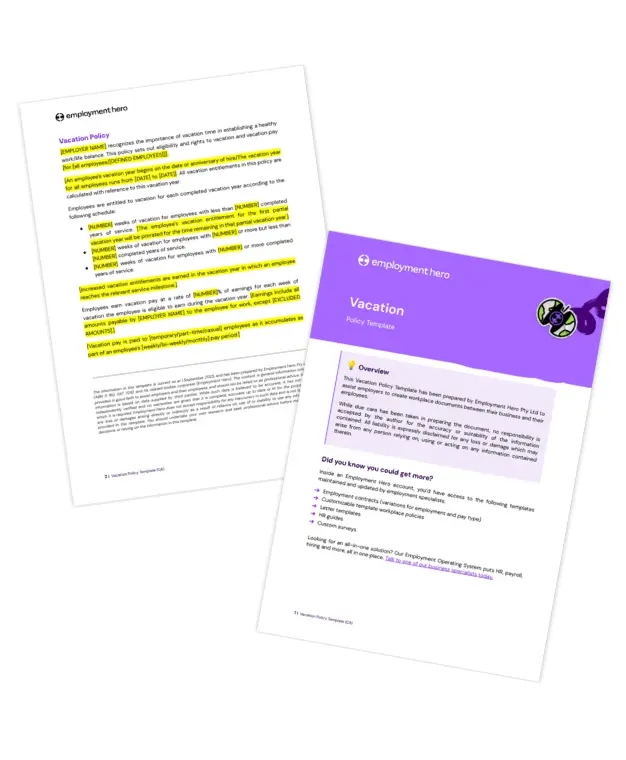
Our downloadable vacation policy template is designed specifically for Canadian employers. It provides a comprehensive, ready-to-use document that you can easily customize to fit your company’s unique needs. The template includes detailed sections on eligibility, accrual and vacation pay,
What is the vacation policy in Canada?
In Canada, vacation and vacation pay entitlements are governed by a combination of federal and provincial/territorial employment laws. While the specifics vary, all jurisdictions mandate a minimum amount of vacation time and pay.
Vacation days entitlements
The number of vacation days an employee is entitled to typically increases with their length of service. These are the minimum standards, and many employers choose to offer more generous vacation time as a competitive benefit.
- Federally regulated employers:
- 2 weeks of vacation annually after completing 1 year of employment.
- 3 weeks after 5 consecutive years of employment.
- 4 weeks after 10 consecutive years of employment.
Vacation Pay
Vacation pay is calculated as a percentage of an employee’s gross wages earned during the vacation entitlement year. The rate of vacation pay corresponds to the number of weeks of vacation an employee is entitled to.
- Federally regulated employers:
- 4% of gross wages for employees entitled to 2 weeks of vacation.
- 6% of gross wages for employees entitled to 3 weeks of vacation.
- 8% of gross wages for employees entitled to 4 weeks of vacation.
Please note that “gross wages” typically includes all forms of remuneration, such as salary, hourly wages, earned commissions and bonuses, but generally excludes tips, gratuities, overtime pay, general holiday pay, unearned bonuses, expenses and allowances.
Provincial and Territorial vacation policy variations
While federal standards apply to federally regulated industries, most employers fall under provincial or territorial jurisdiction. The rules for vacation and vacation pay can differ significantly. For a quick comparison, see the table below.s. It ensures that you cover all the necessary information, protecting your business while treating your employees with respect.
| Province/territory | Minimum vacation entitlement | Minimum vacation pay |
|---|---|---|
| Federal | 2 weeks (1-4 years); 3 weeks (5-9 years); 4 weeks (10+ years) | 4% (1-4 years); 6% (5-9 years); 8% (10+ years) |
| Alberta | 2 weeks (1-4 years); 3 weeks (5+ years) | 4% (1-4 years); 6% (5+ years) |
| British Columbia | 2 weeks (1-4 years); 3 weeks (5+ years) | 4% (1-4 years); 6% (5+ years) |
| Ontario | 2 weeks (1-4 years); 3 weeks (5+ years) | 4% (1-4 years); 6% (5+ years) |
| Quebec | 2 weeks (1-2 years); 3 weeks (3+ years) | 4% (1-2 years); 6% (3+ years) |
| Saskatchewan | 3 weeks (1-9 years); 4 weeks (10+ years) | 5.77% (1-9 years); 7.69% (10+ years) |
| Nova Scotia | 2 weeks (1-7 years); 3 weeks (8+ years) | 4% (1-7 years); 6% (8+ years) |
| New Brunswick | 2 weeks (1-7 years); 3 weeks (8+ years) | 4% (1-7 years); 6% (8+ years) |
| Manitoba | 2 weeks (1-4 years); 3 weeks (5+ years) | 4% (1-4 years); 6% (5+ years) |
| Newfoundland & Labrador | 2 weeks (1-14 years); 3 weeks (15+ years) | 4% (1-14 years); 6% (15+ years) |
| Prince Edward Island | 2 weeks (1-7 years); 3 weeks (8+ years) | 4% (1-7 years); 6% (8+ years) |
| Yukon | 2 weeks (1+ years); 3 weeks (6+ years) | 4% (1-5 years); 6% (6+ years) |
| Northwest Territories | 2 weeks (1-5 years); 3 weeks (6+ years) | 4% (1-5 years); 6% (6+ years) |
| Nunavut | 2 weeks (1-5 years); 3 weeks (6+ years) | 4% (1-5 years); 6% (6+ years) |
It is also important to understand the impact of business ownership changes on vacation liabilities. During a business sale or transfer, the accumulated vacation pay and time responsibilities generally transfer from the old owner to the new owner, meaning the new employer inherits the existing employees’ length of service and accrued vacation entitlements.
Key aspects of a vacation policy
A well-crafted vacation policy should go beyond the legal minimums to address the practicalities of managing time off. A robust policy includes:
Vacation accrual and carry-over
This section defines how employees earn their vacation time. It can be a “use-it-or-lose-it” system (where vacation must be used within the year) or a policy that allows for a certain number of days to be carried over to the next year. It’s important to clearly state the rules to prevent disputes and liability for unused vacation time. You can set maximum rollover caps for unused vacation time that exceeds statutory minimums, preventing excessive accumulation of vacation liability year over year. You should also clarify how vacation entitlements are managed during job-protected or unpaid leaves. While employees continue to accumulate seniority and vacation time during leaves like parental or medical leave, they may not accrue vacation pay since it is calculated as a percentage of gross wages earned. Additionally, you can set probationary periods for new hires; while they begin earning vacation pay immediately, you can dictate when they are permitted to start using their accrued time.
Request and approval process
Outline the procedure for requesting vacation, including the required notice period and the method for submission (e.g., via email, an online portal). This ensures a smooth process and turns the request procedure into a practical tool for managers to plan coverage and maintain team productivity. The policy should also specify how far in advance employees can request time off.
Vacation and statutory holidays
Clarify how statutory holidays that fall during an employee’s vacation are handled. Most jurisdictions require that the employee be given a day in lieu or an extra day of vacation.
Vacation pay administration
Detail how and when vacation pay is paid out. This can be in a lump sum before the vacation, with each regular paycheque or on the employee’s regular payday during the vacation. This section should also specify the calculation of vacation pay.
Download our free Vacation Policy for Canadian employers
Our expertly drafted template is your solution for creating a compliant and comprehensive vacation policy with ease. It covers all the essential elements required by Canadian employment standards.
What’s inside our template?
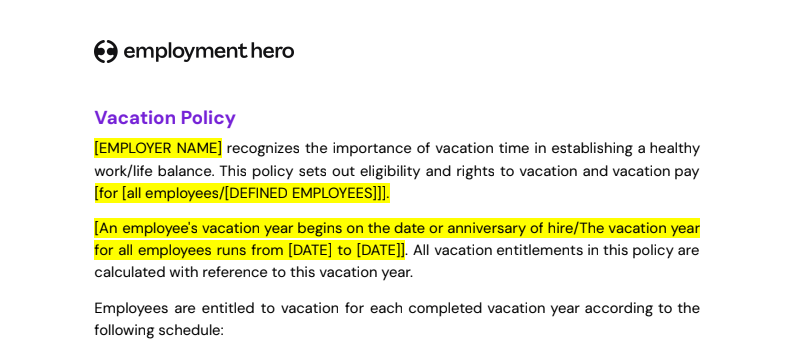
Our policy template includes:
- A clear and concise introduction that sets the tone for your company’s commitment to work-life balance.
- The exact legal language regarding vacation entitlements and vacation pay, based on employment tenure.
- A pre-written section on the vacation accrual year, which you can customize to your business.
- Placeholders for you to insert your specific policies on requesting time off, carry-over and vacation pay administration.
Tips for developing your vacation policy
When creating or updating your vacation policy, consider these best practices to ensure it is effective and fair.
Go beyond the minimums
Offering vacation entitlements that exceed the legal minimums can be a powerful tool for attracting and retaining talent. In a competitive labor market, a generous vacation policy can make you an employer of choice.
Be transparent and clear
The language in your policy should be easy for all employees to understand. Avoid jargon and ambiguity. A clear policy prevents misunderstandings and demonstrates that you value your employees’ time and well-being.
Communicate the policy effectively
Once the policy is finalized, ensure it is easily accessible to all employees. Include it in your employee handbook and review it during the onboarding process for new hires. Regular reminders can also help ensure everyone is aware of the rules.
Ready to create your vacation policy?
Developing a clear and compliant vacation policy is a critical step for any Canadian employer. It protects your business while demonstrating a commitment to your employees’ well-being. Our customizable template simplifies this process, providing you with a professional and legally sound foundation. Download our free vacation policy template today and take the first step toward a more organized and employee-friendly workplace.
Frequently asked questions
The number of vacation days varies depending on the employee’s tenure and the province or territory they work in. However, the most common minimum standard is two weeks (10 business days) of vacation after one year of employment.
Generally, once a vacation request is approved, an employer cannot unilaterally cancel it without a valid business reason. If a cancellation is necessary, the employer must provide reasonable notice and, in some cases, may be required to compensate the employee for any incurred non-refundable costs, such as flights or accommodations.
A mandatory vacation policy requires employees to take a certain amount of time off each year, often in a single block. This can be used for compliance, to reduce the risk of burnout, or for security reasons in industries where employees handle sensitive information.
Vacation leave is essential for promoting employee health, preventing burnout and improving productivity. It allows employees to rest, recharge and return to work with renewed energy and focus.
Encouraging employees to use their vacation time benefits employers in several ways. It reduces the risk of employee burnout and stress, leading to higher morale and engagement. It can also improve productivity and creativity, as well as mitigate the financial liability of unused vacation pay that accumulates over time.
When an employee is terminated, accrued vacation pay from partially completed entitlement years must be paid out to them. Employers are legally obligated to include this accumulated vacation pay in the employee’s final pay, typically within a strict post-termination window defined by provincial or federal employment standards.
Yes, an employer can legally force an employee to take vacation at a specific time by scheduling their dates. However, employers must provide a minimum notice period—such as two weeks under federal and some provincial laws—if they require an employee to take their accrued vacation time during a specific period.
No, strict “use it or lose it” vacation policies are generally not legal in Canada when applied to statutory minimums. There is a critical legal distinction between vacation time and vacation pay: while vacation time may expire under certain contracts, vacation pay is an earned wage that cannot simply be forfeited. Employees are generally legally required to take their earned vacation time within ten to 12 months after the entitlement year ends, and precise contractual wording matters to ensure any forfeiture policies only apply to extra-statutory vacation benefits.
The difference between PTO (Paid Time Off) and vacation is that PTO is a general term for any paid absence, while vacation is a specific statutory entitlement. Employers often confuse grouped PTO banks with dedicated statutory vacation leave, but Canadian employment laws strictly regulate vacation time and pay, meaning general PTO policies must still meet all minimum vacation requirements.
Certain professional and industry-specific jobs are exempt from standard vacation pay and time rules. Professions such as commissioned salespeople, teachers and real estate agents may be exempt from standard vacation entitlements depending on the specific provincial or territorial employment standards that apply to them.
Blackout periods for vacation requests are specific times of the year when employees are not permitted to take time off. Implementing these periods is a practical policy tool for businesses to ensure adequate staffing during peak seasons or critical project deadlines.
The information in this template is current as at 1 September 2025, and has been prepared by Employment Hero Pty Ltd (ABN 11 160 047 709) and its related bodies corporate (Employment Hero). The content is general information only, is provided in good faith to assist employers and their employees, and should not be relied on as professional advice. Some information is based on data supplied by third parties. While such data is believed to be accurate, it has not been independently verified and no warranties are given that it is complete, accurate, up to date or fit for the purpose for which it is required. Employment Hero does not accept responsibility for any inaccuracy in such data and is not liable for any loss or damages arising directly or indirectly as a result of reliance on, use of or inability to use any information provided in this template. You should undertake your own research and seek professional advice before making any decisions or relying on the information in this template.
Register for the template
Related Resources
-
 Read more: Stat holidays in Saskatchewan 2026 and 2027: Dates and pay rules explained
Stat holidays in Saskatchewan 2026 and 2027: Dates and pay rules explained
Learn Saskatchewan’s statutory holiday rules, eligibility requirements, and holiday pay calculation methods for employers. Read the guide.
-
 Read more: Stat holidays in Manitoba 2027: List and employer pay rules
Stat holidays in Manitoba 2027: List and employer pay rules
Confused by the 5% holiday pay calculation or the first and last shift rule? Master Manitoba general holiday laws and…
-
 Read more: Statutory holidays BC 2027: Complete list and pay eligibility rules
Statutory holidays BC 2027: Complete list and pay eligibility rules
Struggling to calculate stat holiday pay in British Columbia? Master the 15/30 rule, check the 2027 calendar, and stay compliant.…