 Australia
  United Kingdom
  Singapore
  Malaysia
  Canada (Français)
 New Zealand



Employment law updates 2026
Published
Employment law updates 2026
Published
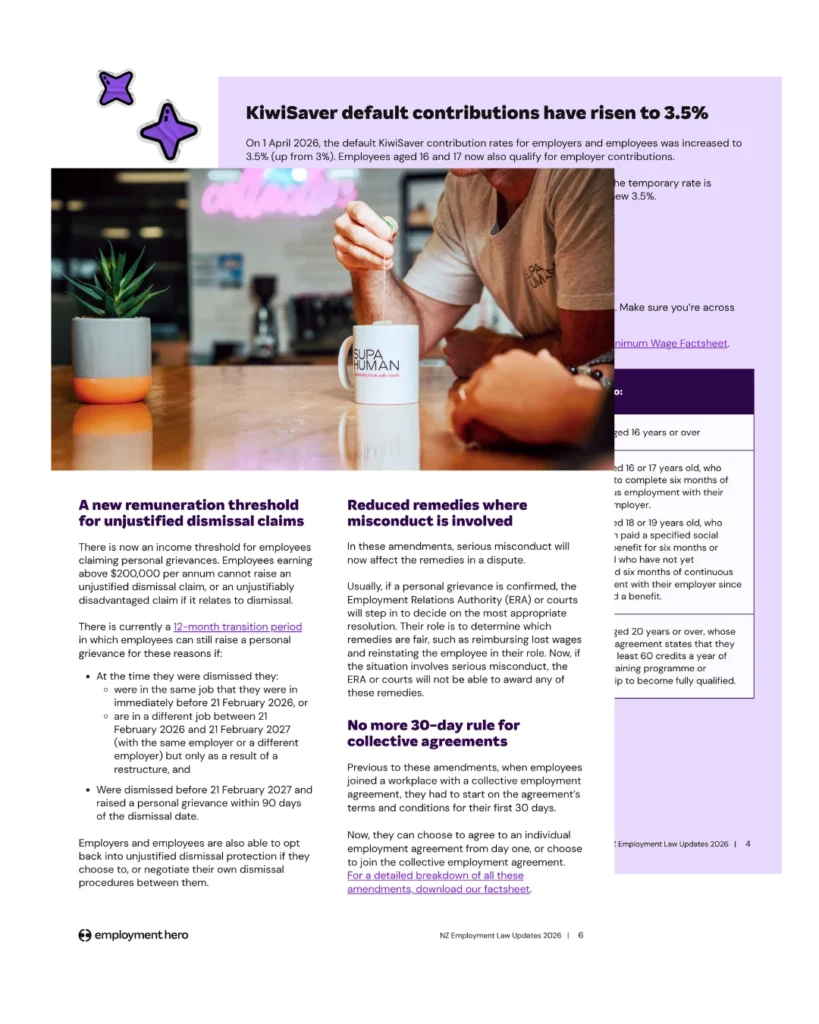
2026 is already proving eventful when it comes to New Zealand employment law. Significant changes to the Employment Relations Act have now come into force, while an upcoming increase to the KiwiSaver default contribution could have ripple effects on many employer budgets.
And, with the general election set for November 2026, we can expect to see even more changes to employment law in the coming months.
As employers, it’s critical that you stay up to date with the latest information. In this factsheet, we’ll be covering all the new updates, as well as the ones in the works. This includes:
- Changes to the Privacy Act
- Amendments to the Employment Relations Act (including a new contractor gateway test)
- A minimum wage increase
- Changes to the default KiwiSaver contribution
- Pay deductions on partial strikes
- Wage theft
- Changes to the Accredited Employer Work Visa
- Pay disclosure legislation
- Proposed reforms to health and safety law
- The replacement of the Holidays Act with a new Employment Leave Act
Understand your employer obligations with our 2026 Employment Law updates, so you can boost your compliance confidence and get back to focusing on growing your business.
Frequently asked questions
Employment law in New Zealand is the framework of rules that governs the relationship between employers and employees. The Employment Relations Act 2000 provides the baseline context for this, explicitly acknowledging an inherent inequality of power in employment relationships. A foundational legal requirement for all New Zealand employment relationships is the principle of good faith. Employers cannot legally provide fewer minimum rights than the law requires, even if an employee explicitly agrees to it in writing.
According to Employment New Zealand, the minimum leave entitlements under the Holidays Act 2003 include four weeks of paid annual leave, ten days of sick leave, and 12 public holidays.
By law, every employee in New Zealand must be provided with a written employment agreement that includes specific statutory protections and terms. This agreement must outline protections under the Wages Protection Act 1983, confirming that wages must be paid in money and employers cannot make deductions without the employee’s written consent unless strictly required by law. Additionally, if an employer wishes to restrict staff from holding multiple jobs, the agreement must meet the legal threshold of having genuine reasons to enforce secondary employment rules and restrictions.
The core responsibilities of an employee in New Zealand include attending work, obeying lawful instructions, and maintaining appropriate behaviour.
An employee can report that their rights are not being met by following a structured dispute resolution process. Here are the steps to follow:
- Raise the issue directly to seek an early resolution.
- Use state-sponsored dispute resolution tools like the Employment New Zealand Early Resolution Service.
- Attend mediation, which is statutorily prioritised as the primary mechanism for resolving employment relationship problems in New Zealand.
Employment laws protect migrant workers by ensuring they have the exact same minimum employment rights as New Zealand workers. Additionally, protections against discrimination under the Human Rights Act 1993 ensure fair treatment and hiring for all workers.
Workplace health and safety duties under the Health and Safety at Work Act 2015 require employers to ensure the health and safety of workers.
There are exemptions for high-income earners in New Zealand employment law. According to Employment New Zealand, employees earning $200,000 or more a year do not have certain protections during dismissal unless they opt back in.
The 2026 employment law updates introduce several changes that impact business operations. Here is a comparison of the current law versus the 2026 updates:
| Topic | Current Law | 2026 Update |
|---|---|---|
| Contractor Gateway Test | Previous contractor tests applied | New contractor gateway test introduced |
| KiwiSaver Contribution | Previous default rate | Changes to the default KiwiSaver contribution |
| Pay Deductions | Standard wage protection rules | New rules for pay deductions on partial strikes |
| Health and Safety | Health and Safety at Work Act 2015 baseline duties | Proposed reforms to health and safety law |
The information in this article is current as at 18 June 2026, and has been prepared by Employment Hero Pty Ltd (ABN 11 160 047 709) and its related bodies corporate (Employment Hero). The views expressed in this article are general information only, are provided in good faith to assist employers and their employees, and should not be relied on as professional advice. Some information is based on data supplied by third parties. While such data is believed to be accurate, it has not been independently verified and no warranties are given that it is complete, accurate, up to date or fit for the purpose for which it is required. Employment Hero does not accept responsibility for any inaccuracy in such data and is not liable for any loss or damages arising directly or indirectly as a result of reliance on, use of or inability to use any information provided in this article. You should undertake your own research and seek professional advice before making any decisions or relying on the information in this article.
Register for the factsheet
Related Resources
-
 Read more: The AI Adoption Blueprint
The AI Adoption Blueprint
What does it take to embed AI across an entire team? We’re sharing our training, our policies, and the lessons…
-
 Read more: Employment Essentials: AI Best Practices
Employment Essentials: AI Best Practices
Learn how to use AI in HR without creating privacy, compliance or employment risks in our latest webinar.
-
 Read more: The High Performance Series: The Power of Recovery
The High Performance Series: The Power of Recovery
Learn how elite teams manage recovery and prevent burnout. Join Employment Hero and The Blues for practical HR mental health…

