

















Conflict resolution strategies & workplace mediation
Published
Conflict resolution strategies & workplace mediation
Published
An ideal workplace is one where the whole team gets along, where harmony prevails and where communication and camaraderie rule the day. Unfortunately, that isn’t always the case. Every team includes a mix of different personalities and working styles, and sometimes that can lead to a clash. So what can you do when there’s conflict in your business?
It turns out, there is plenty you can do to try and regain some peace in the team. Start with our guide, which sets out key strategies for managing conflict. Should those fail, we’ll take you through the workplace mediation process as well.
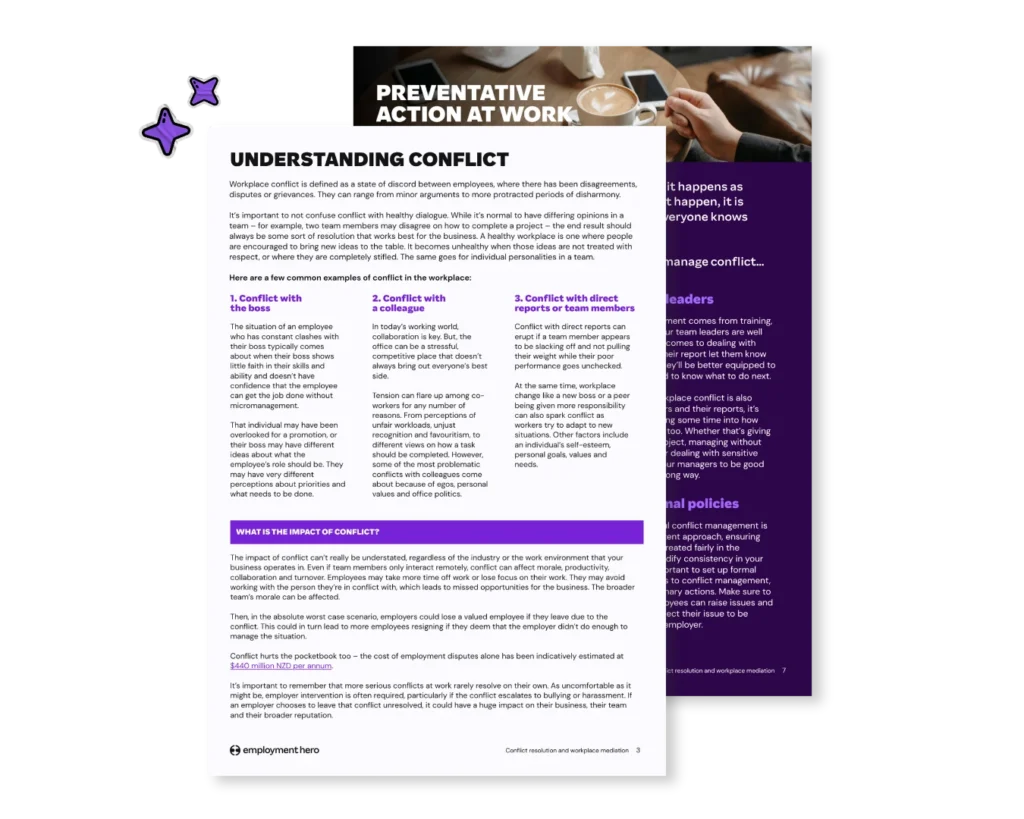
Our guide covers:
- Understanding conflict
- The impact of conflict
- Conflict management strategies
- The workplace mediation process
- Warnings and disciplinary actions
- Preventative action at work
Download the guide by filling in the form on the right.
Understanding workplace conflict
Before you can resolve conflict you need to understand what it is and where it comes from. It’s not just about arguments or heated discussions. Conflict can be subtle, simmering under the surface and manifesting as passive aggression, reduced cooperation or a general sense of tension.
Disagreements can stem from many sources and recognising the type of conflict is the first step toward finding the right solution. Without a clear understanding you risk addressing only the symptoms, not the underlying problem, which means the issue is likely to resurface.
What is workplace conflict?
At its core, workplace conflict is any disagreement or dispute between two or more people within a professional setting. It can range from a simple difference of opinion over how to approach a task, to more serious issues like perceived bullying or harassment.
For example, a conflict might arise when two team members in a tech company have disagreed on how a shared task should be executed. Or it could be a disagreement between a manager and an employee in a retail store about performance expectations and rostered hours. These situations, if not handled well, can disrupt workflow, damage relationships and poison the team atmosphere.
Conflict isn’t always negative. Healthy debate and differing perspectives can lead to better ideas and innovation. The problem arises when disagreement becomes personal, destructive, or is left to fester without a clear path to resolution.
Common types of workplace conflict
Most conflicts you’ll encounter will fall into a few common categories. Identifying the type of conflict can help you tailor your approach to resolving it more effectively.
Personality clashes
This is perhaps the most common source of conflict. It happens when employees have fundamentally different communication styles, values or working approaches that create persistent tension. One team member might be direct and fast-paced, while another is more reflective and cautious. Without mutual understanding this difference can be misinterpreted as one person being aggressive and the other being slow or uncooperative, leading to friction and resentment.
Role ambiguity
Conflict often occurs when job responsibilities are unclear or overlapping. If two employees believe they are responsible for the same task or if a critical task has no clear owner, disputes are bound to happen. For instance, if a marketing coordinator and a sales executive both believe it’s their job to approve final campaign messaging, it can lead to power struggles and confusion. This is particularly common in fast-growing businesses where roles evolve quickly.
Resource disputes
In any organisation resources like budget, equipment, or even people’s time are finite. Disputes can arise when teams or individuals must compete for these limited resources. A classic example is two department heads vying for the same slice of the annual budget, each believing their projects are the top priority. This creates a win-lose dynamic that can foster inter-departmental rivalry and undermine company-wide goals.
Remote team miscommunication
With the rise of flexible and remote work, miscommunication has become a significant source of conflict. Without the benefit of face-to-face cues like body language and tone of voice it’s easy for messages in emails or chat platforms to be misinterpreted. A brief direct message intended to be efficient can come across as abrupt or dismissive. These small misunderstandings can quickly escalate into larger feelings of disrespect or exclusion if not addressed.
The impact of unresolved conflict in the workplace
Ignoring conflict doesn’t make it go away. It’s like a small water leak that, if left unattended, can cause significant structural damage over time. The consequences of unresolved issues can ripple through your entire business, impacting everything from daily operations to your bottom line.
Productivity takes an immediate hit. Employees involved in a conflict spend valuable time and mental energy worrying about the situation, discussing it with colleagues or actively avoiding the other person. This distraction pulls their focus away from their work, leading to missed deadlines and lower-quality output. The negative atmosphere can also spread to the wider team, causing a general drop in motivation and engagement.
Team morale can plummet. A tense work environment where disagreements simmer beneath the surface is emotionally draining for everyone. It erodes trust and makes collaboration difficult. Good employees who value a positive and supportive culture may start to disengage. This often leads to an increased employee turnover risk.
Losing talented people is costly, not just in terms of recruitment expenses but also in the loss of institutional knowledge and experience. Recent data shows that a toxic workplace culture is a major driver of resignations and unresolved conflict is a key ingredient in that toxicity.
Perhaps most seriously for a business, unresolved conflict can create significant legal exposure. What starts as a personality clash can escalate into allegations of bullying, harassment or discrimination. This could lead to a personal grievance claim, creating considerable legal costs, reputational damage and management distraction. Following fair and proper processes from the outset is your best defence.
Effective conflict resolution strategies for HR managers
As an HR manager or business leader you are in a unique position to guide your teams through disagreements constructively. Adopting a proactive and structured approach can make all the difference. Here are seven effective strategies to resolve workplace conflict.
1. Address issues early and directly
The longer a conflict is left to fester, the more entrenched the positions become and the harder it is to resolve. Encourage employees and managers to address minor issues as they arise and before they escalate. This might mean coaching a manager on how to have a difficult conversation or facilitating a brief informal chat between two colleagues. Prompt and direct communication can often resolve misunderstandings before they turn into major problems.
2. Create a safe space for open dialogue
For any meaningful resolution to occur, people need to feel safe to express their concerns without fear of punishment or judgment. As an HR leader you can facilitate this by establishing a confidential and neutral environment. This means setting up meetings in a private space, ensuring discussions remain confidential and actively moderating the conversation to ensure it stays respectful. When employees trust the process they are more likely to engage honestly.
3. Actively listen and acknowledge different perspectives
One of the most important roles you can play in conflict resolution is that of an active listener. This goes beyond simply hearing the words being said. It involves paying attention to non-verbal cues, asking clarifying questions and summarising what you’ve heard to ensure you understand. Make sure each person has a chance to share their side of the story without interruption. Acknowledging their feelings and perspective by saying things like “I can see why you would feel that way” validates their experience and helps to de-escalate emotions, even if you don’t agree with them.
4. Focus on interests, not positions
People often enter a conflict with a fixed position – for example, “I want my desk moved to the other side of the office.” Getting stuck on these positions can lead to a stalemate. A more effective approach is to uncover the underlying interests or needs behind those positions by asking “Why do you want that?” The employee might say “Because I can’t concentrate with the noise from the kitchen.” Their interest isn’t the desk itself but a quieter workspace. Once you understand the underlying interests you can explore a wider range of solutions, like providing noise-cancelling headphones or establishing quiet zones that might satisfy both parties.
5. Collaborate on mutually beneficial solutions
The goal of conflict resolution should be to find a win-win outcome, not for one person to win at the other’s expense. Guide the involved parties to brainstorm potential solutions together. Encourage creativity and an open mind. By working collaboratively everyone feels a sense of ownership over the final agreement, making them more likely to stick to it. Your role is to facilitate this process, helping them evaluate the pros and cons of each option and find common ground.
6. Establish clear expectations and follow-up
Once a solution has been agreed upon it’s crucial to make sure everyone understands the next steps and their individual responsibilities. Document the agreed actions clearly. What will each person do differently? By when? How will you measure success? This clarity prevents future misunderstandings. It’s also important to schedule a follow-up meeting, perhaps in a week or two, to check in on progress and ensure the agreement is holding up. This shows you are committed to a lasting resolution.
7. Bring in a neutral mediator when needed
Sometimes a conflict is too complex or emotionally charged to be resolved internally. If you’ve tried to facilitate a resolution and are not making progress or if you feel your own neutrality is compromised it may be time to bring in a professional. A neutral third-party mediator can bring a fresh perspective and specialised skills to help guide the parties toward a resolution. This is not a sign of failure but a sensible step toward resolving a difficult situation.
The workplace mediation process in New Zealand
Mediation is a formal, structured, yet flexible process where a neutral person helps parties in a dispute to find a solution on their own terms. It’s a very common and effective step for resolving employment relationship problems in New Zealand, often preventing the need for more costly and adversarial legal action.
Step 1: Determine if mediation is appropriate
Mediation is most effective when both parties are willing to participate in good faith to find a resolution. It’s a voluntary process so you can’t force an employee to attend, although a refusal might be viewed unfavourably later on. Mediation may not be suitable for issues involving serious misconduct, like theft or violence, that require a formal investigation and potential disciplinary action. It’s best for disputes where there is room for negotiation and a desire to repair the working relationship.
Step 2: Choose an internal or external mediator
You can use a trained internal manager or HR professional as a mediator, provided they are seen as neutral by all parties. However for more complex or sensitive issues an external mediator is often the better choice. In New Zealand, the Ministry of Business Innovation and Employment (MBIE) offers a free mediation service for employment disputes. You can also hire an independent mediator from a professional body like the Resolution Institute. An external mediator brings impartiality and expertise which can increase the parties’ confidence in the process.
Step 3: Set clear ground rules and objectives
The mediation will typically begin with the mediator explaining their role and the process. They will set clear ground rules for the discussion, such as speaking respectfully, not interrupting and keeping the discussions confidential. The mediator will also work with the parties to clarify the objectives of the mediation. What do they hope to achieve? This ensures everyone is working toward the same goal.
Step 4: Facilitate constructive dialogue
The mediator then guides the conversation, allowing each person to explain their perspective and what they want to achieve. The mediator might meet with the parties together and also separately in private caucuses. In these private sessions, parties can speak more freely to the mediator who can then test potential solutions and options without committing either party. The mediator uses their skills to reframe issues, manage emotions and keep the dialogue focused and constructive.
Step 5: Agree on actions and next steps
Through this facilitated discussion the mediator helps the parties identify common ground and work toward a mutually acceptable agreement. The focus is on finding practical, forward-looking solutions. This agreement will outline the specific actions each person will take to resolve the issues and move forward. For example, it could include changes to work arrangements or an apology.
Step 6: Document outcomes and follow up
If an agreement is reached, the mediator will help the parties document it in a signed settlement agreement. This document makes the terms of the resolution clear and, if worded correctly, can be legally binding. It provides certainty and closure for everyone involved. It’s also good practice for the business to follow up internally to ensure the terms of the agreement are being implemented and that the working relationship is improving.
Managing escalated conflicts: Warnings and disciplinary actions
Sometimes conflict goes beyond a simple disagreement and crosses the line into misconduct or a serious breach of company policy. This could include behaviour like bullying, harassment, refusing to follow a reasonable management instruction or a breach of your health and safety policy. In these situations informal resolution may not be enough and a more formal process is necessary.
When misconduct is alleged, your obligation as an employer is to handle it fairly and in line with New Zealand employment law. This typically involves a disciplinary process. This process must be procedurally fair, which means investigating the allegations thoroughly, giving the employee a chance to respond and considering their explanation before making any decision.
Depending on the seriousness of the misconduct, the outcome could range from a formal warning to, in the most serious cases, dismissal. Following a fair and proper process is crucial. Any failure to do so can leave you vulnerable to a personal grievance claim for unjustified disadvantage or unjustified dismissal, even if the misconduct itself was real.
Remember that this isn’t legal advice – if you have any doubts, concerns or questions about handling misconduct, we’d highly recommend that you seek independent legal counsel.
Preventing workplace conflicts before they arise
While knowing how to manage conflict is essential, the best approach is always to prevent it from happening in the first place. Building a positive workplace culture where disagreements are handled constructively can significantly reduce the frequency and severity of disputes.
Proactive strategies are your best defence. They include things like:
- Clear job descriptions and expectations, so everyone knows what their role is and what they are accountable for, reducing the chance of role ambiguity.
- A strong communication culture, where open honest and respectful feedback is the norm. This encourages people to raise concerns early before they escalate.
- Regular team check-ins and one-on-one meetings, which give managers the opportunity to check the pulse of the team and address potential issues proactively.
- Training managers in conflict resolution skills so they have the confidence and competence to handle issues within their teams effectively, without needing to escalate everything to HR.
- Encouraging psychological safety – an environment where employees feel safe to take interpersonal risks, speak up with ideas and concerns and be vulnerable without fear of negative consequences.
Build a positive workplace culture with effective conflict resolution
Managing workplace conflict effectively is not just about solving problems as they arise. It’s about building a resilient culture of respect, communication and collaboration. By addressing issues early, training your managers and having clear consistent processes you can turn potential disputes into opportunities for individual and team growth.
For more information on conflict resolution, download our guide by filling in the form on the right.
The information in this article is current as at 30 December 2025, and has been prepared by Employment Hero Pty Ltd (ABN 11 160 047 709) and its related bodies corporate (Employment Hero). The views expressed in this article are general information only, are provided in good faith to assist employers and their employees, and should not be relied on as professional advice. Some information is based on data supplied by third parties. While such data is believed to be accurate, it has not been independently verified and no warranties are given that it is complete, accurate, up to date or fit for the purpose for which it is required. Employment Hero does not accept responsibility for any inaccuracy in such data and is not liable for any loss or damages arising directly or indirectly as a result of reliance on, use of or inability to use any information provided in this article. You should undertake your own research and seek professional advice before making any decisions or relying on the information in this article.
Register for the guide
Related Resources
-
 Read more: A guide to seasonal employee rights and agreements
A guide to seasonal employee rights and agreements
Our guide walks New Zealand employers through every aspect of seasonal employment, from drafting agreements to managing fixed-term contracts.
-
 Read more: Tradies’ guide to New Zealand Payroll
Tradies’ guide to New Zealand Payroll
A practical guide to payroll for tradies. Learn how to manage wages and compliance to keep your business running smoothly.
-
 Read more: Promoting employees the right way: Employer’s guide
Promoting employees the right way: Employer’s guide
Learn the best practices for promoting staff and understand how to help your team during a change of role.

